
I thought it would
fade after just one session,
so why is the mark still there?
You may have felt discouraged when, despite having received treatment and applying supposedly effective skincare products, you looked in the mirror and saw the same mark still staring back at you, wondering, “Why hasn’t mine changed?”
I often meet patients in the consultation room who feel resigned when melasma and dark spots look even more noticeable after washing their face and wonder, “Is this simply the kind of skin I was born with?”
So today, I will explain step by step everything you need to know about the “intervals between laser treatments for hyperpigmentation at a dermatology clinic”—from why it is difficult to finish in a single session to how you can receive treatment effectively.
By the time you finish reading, your previously vague treatment plan should feel much clearer.
Those marks that keep showing through
are called hyperpigmentation
Hyperpigmentation refers to
marks that appear dark or brown
when melanin in the skin
becomes excessively concentrated
in one area.
When stimuli such as ultraviolet rays,
hormonal changes,
frequent friction, or inflammation
build up, our skin produces
more melanin
to protect itself.
Just as paper exposed to sunlight
for a long time turns yellow,
the skin also leaves behind
the traces of irritation
as discoloration.
This includes melasma, freckles,
dark spots, and even the brown marks
left behind after acne.
Although they may look similar
on the surface, their characteristics
can differ considerably depending
on whether the pigment is shallow
in the epidermis or has extended
deep into the dermis.

The principle of gently addressing
pigment in the skin with light
One of the most common ways
to address this type of pigmentation
is through light-based treatments
such as lasers and IPL.
The light is selectively absorbed
by melanin in the skin,
breaking the pigment particles
into smaller pieces.
The fragmented pigment is then
naturally eliminated over time.
IPL uses a broad range of wavelengths
to address melasma, freckles,
dark spots, and even facial redness,
while laser toning uses a specific
wavelength to gently focus on
deeper pigmentation.
It is like sweeping a wide area first
and then cleaning the corners separately—
the treatment is selected according
to the condition of the skin.
That is why, when discussing
“intervals between laser treatments
for hyperpigmentation at a dermatology clinic,”
an important starting point is deciding
which type of light to use
and at what interval.

There is a reason treatment
does not end after one session
The question I am asked most often is,
“Is one session enough?”
To be honest,
most pigmentation is difficult
to remove completely
with a single treatment.
Because pigment is distributed
across several layers of the skin,
it is generally less stressful for the skin
to reduce it gently over multiple sessions
rather than breaking it up aggressively
all at once.
Treatment is therefore usually divided
into sessions spaced two to four weeks apart,
with the number of sessions varying
according to the depth and type
of pigmentation.
Shallow freckles or dark spots
in the epidermis may fade
after relatively few sessions,
whereas melasma that extends
deep into the dermis requires
more consistent care.
This is precisely why it is important
to allow sufficient time when planning
the “intervals between laser treatments
for hyperpigmentation at a dermatology clinic.”

Between treatments,
at-home care accounts for half the process
Care between treatments
is just as important as the treatment itself.
Immediately after laser treatment,
pigmentation may temporarily
look even darker.
This is a natural process in which
the fragmented pigment rises toward
the surface, and it usually fades
within one to two weeks.
The most important thing to pay attention
to during this period is sun protection.
If sunlight reaches the areas
where pigment has been reduced,
melanin may become active again,
so it is best to apply sunscreen
thoroughly before going outside.
For about a week after treatment,
avoid saunas, jjimjilbangs, and strenuous exercise,
and keep your skin sufficiently moisturized.
These small habits add up
and influence the overall outcome
of the “intervals between laser treatments
for hyperpigmentation at a dermatology clinic.”

FAQ: The director answers your questions directly
Q1. Is the treatment very painful?
A. IPL may feel like a light snap
from a rubber band,
while laser toning may cause
a prickling sensation and warmth.
Most people find it tolerable,
and if necessary, we can apply
numbing cream to reduce discomfort.
Q2. Is it okay to receive treatment in summer?
A. You can receive treatment,
but because ultraviolet rays are stronger
in summer, pigmentation can recur more easily.
By adjusting the treatment intensity
and being more diligent about sun protection,
you can receive care regardless
of the season.
Q3. Will it never come back after treatment?
A. Freckles and dark spots tend
to remain relatively stable after fading,
but melasma may become darker again
depending on hormones and ultraviolet exposure.
That is why we also recommend
consistent care after treatment.
Q4. When can I start wearing makeup?
A. Your skin is sensitive on the day
of treatment, so please avoid makeup.
You may wear it starting the next day.
Please use gentle products
along with sunscreen.

Together for longer, at a comfortable pace
I fully understand the desire
to look completely different
after a single treatment.
However, just as pigmentation
accumulates gradually over time,
reducing it is ultimately more comfortable
when we respect the skin’s pace
and move forward slowly.
이지함피부과 is a place where
we work together to create
a comfortable-looking face through
honest consultations and proven treatments,
rather than pursuing excessive change.
If the “intervals between laser treatments
for hyperpigmentation at a dermatology clinic”
have felt overwhelming, start by carefully
examining your skin condition and finding
the pace that suits you.
We will be your trusted companion
by your side for your skin
for a long time to come.
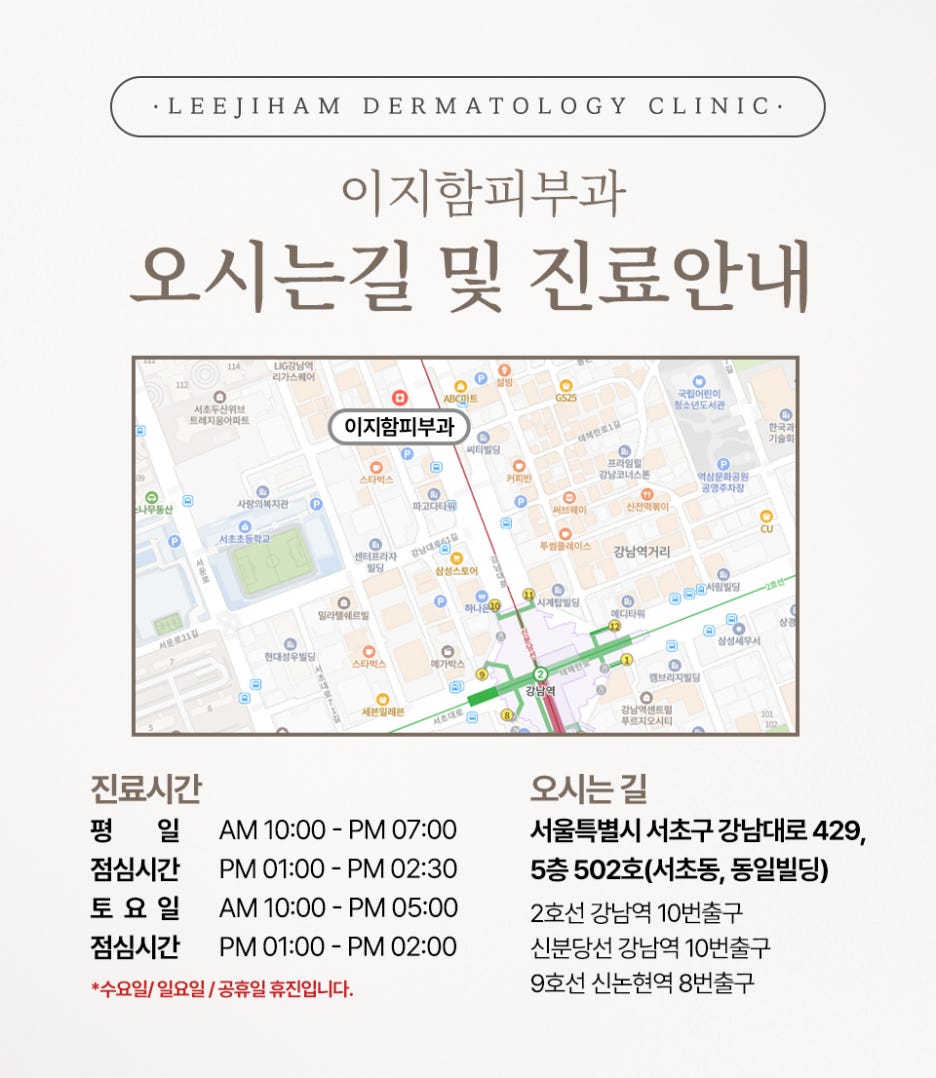
📍 Directions
5th Floor, Room 502, 429 Gangnam-daero,
Seocho-gu, Seoul
(Dongil Building, Seocho-dong) · Near Gangnam Station and Sinnonhyeon Station
📞 Telephone inquiries
02-567-5900
🕒 Hours
· Monday, Tuesday, Thursday, Friday: 10:00–19:00
· Saturday: 10:00–17:00
· Weekday lunch break: 13:00–14:30
· Closed on Wednesdays, Sundays, and public holidays












Previous image
Next image









Previous image
Next image