Hello,
This is Dr. Kim Tae-young, the chief director of Barun Young Dental Clinic at Yaksu Station.^^
In my previous post, I explained the timing of implant placement after tooth extraction and mentioned that bone grafting may be performed at the same time.
During implant consultations at a Yaksu Station dental clinic, quite a few people are hearing the term bone grafting for the first time.
"Doctor, does that mean I need bone grafting for the implant too?"
"Can’t I just get the implant without it?"
"If I have bone grafting, will it really become like my own bone?"
Many people are curious about or worried about implant bone grafting like this.
Implant bone grafting is a procedure that is actually performed quite often, but for patients, it can feel somewhat unfamiliar.
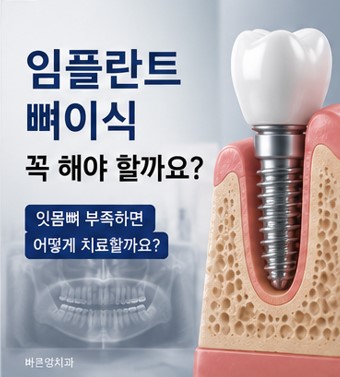
Today, I’ll explain what implant bone grafting is,
why bone grafting may be needed during implant treatment,
and what the treatment process looks like when there is not enough jawbone, step by step.
What is implant bone grafting?
Implant bone grafting is a procedure in which graft material is added to an area with insufficient jawbone to create an environment suitable for implant placement.
Because implants are placed into the jawbone, the amount, thickness, and height of the bone are important factors.
However, in some cases, such as when a tooth has been missing for a long time or when the bone has been affected by inflammation or gum disease, there may not be enough jawbone.
In such cases, bone grafting may be performed together to supplement the deficient area and establish a treatment plan for the implant.
Over time, the grafted area becomes integrated with the patient’s own bone and forms a foundation for implant placement.
When is bone grafting needed for implants?
During implant consultations at a Yaksu Station dental clinic, many people also ask why bone grafting is necessary.
Because implants are fixed into the jawbone, the condition of the jawbone is very important.
Bone grafting may be considered together in the following cases.
When the jawbone has been resorbed after a tooth has been missing for a long time
When there has been damage to the jawbone due to inflammation at the extraction site
When the bone has receded due to gum disease
When the bone thickness is naturally thin, such as in the upper molars
When bone thickness is important for esthetics, such as in the front teeth
In these cases, implant treatment is planned while supplementing the insufficient jawbone conditions through bone grafting.
However, bone grafting is not necessary for all implant treatments.
I also often hear the question, "Is bone grafting absolutely necessary for implants?"
If the jawbone condition is sufficient, implant placement may be possible without bone grafting, and conversely, if there is not enough bone, bone grafting may be performed together.
What types of graft materials are there?
The materials used for bone grafting are broadly divided into four types.
Autograft
This is a method that uses the patient’s own bone. In many cases, a small amount is collected from around the jawbone and used.
Because it is the patient’s own tissue, compatibility is high, but the collection process is an additional step.
Allograft
This is a material made from bone derived from a human donor that has been sterilized and processed.
Autograft and allograft are both conducive to bone formation,
but because they are absorbed quickly, using them alone may not achieve the desired volume.
Xenograft
This is a material made by processing bone, mainly from cattle or pigs, and is relatively widely used in clinical practice.
It helps maintain the structure in which bone can form.
Synthetic graft
This is an artificially manufactured material. It is sometimes used in combination with other graft materials.
The choice of material depends on factors such as the amount and location of the missing bone and the overall oral condition.
Although each type of graft material has its own advantages and disadvantages,
I mainly use allograft and xenograft depending on the case.
Why is a membrane used?
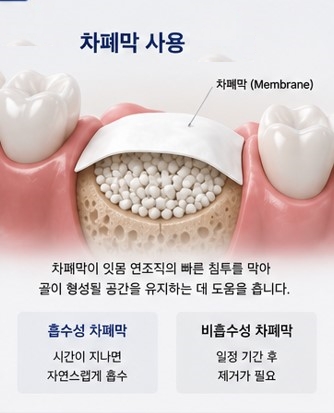
A membrane is something that is often used together with bone grafting.
Covering the graft material with a membrane can help reduce the speed at which soft gum tissue grows into the grafted area and can help maintain the space needed for bone formation.
When is bone grafting performed?
The timing of bone grafting can vary depending on the overall implant treatment flow.
When performed at the same time as extraction
This is a method in which graft material is placed immediately after extraction to reduce changes in the jawbone at the extraction site and prepare for later implant treatment.
When performed at the same time as implant placement
This is a method in which the implant is placed while also supplementing the surrounding insufficient jawbone.
When bone grafting is performed first
If the lack of jawbone is significant, bone grafting may be performed first, followed by a healing period before implant placement.
How is recovery after bone grafting?
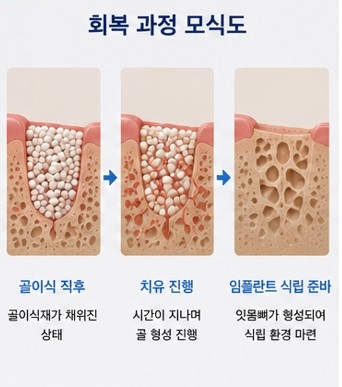
After bone grafting, there is a recovery period during which the grafted area becomes integrated with the patient’s bone.
In general, the graft material becomes incorporated with the patient’s own bone over time, and this process may take several months.
During the recovery period, the following guidance is often given.
Avoid stimulating the grafted area Eat soft foods
Take the prescribed medication Have the healing status checked through regular follow-up visits
Recovery speed varies from person to person, so it is important to receive individualized guidance.
As I provide implant treatment at a Yaksu Station dental clinic, I often feel that even the same implant treatment can vary in the treatment process depending on the condition of the jawbone.
I think of bone grafting as a process that supplements an insufficient jawbone environment and creates the foundation for an implant placement plan.
For easier understanding, I sometimes refer to the additional procedures needed for implants as bone grafting, but not only bone grafting using graft material, but also secondary surgery using a membrane without graft material, gingival grafting, and gum surgery are procedures that help create jawbone volume (including gum volume).
Ultimately, whether bone grafting is needed in implant treatment depends on the patient’s jawbone condition.
If the jawbone is sufficient, placement may be possible without bone grafting, and if it is insufficient, bone grafting may be considered together.
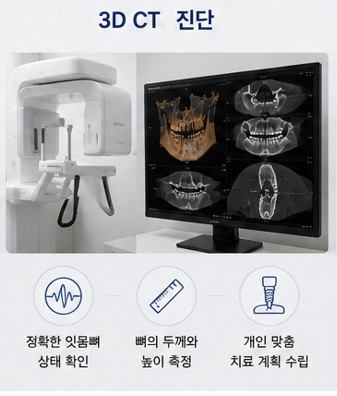
You can find out which method is suitable for your own jawbone condition through a precise diagnosis, including 3D CT.
This has been Barun Young Dental Clinic at Yaksu Station.^^
I believe proper treatment leads to proper results.
We are committed to providing care so that everyone who visits us can leave feeling more comfortable.
Barun Young Dental Clinic
This post was written for the purpose of providing medical information and complies with Article 56, Paragraph 1 of the Medical Service Act.