Hello.
I am Tae-young Kim, the director of Bareunyeong Dental Clinic near Yaksu Station^^
In my previous post, I organized information about care after implant surgery.
Today, as a continuation of that topic, I would like to discuss peri-implantitis, an issue that people who use their implants for a long time may encounter at least once.
Even after receiving implant treatment and using the implants comfortably for a long time, some people may suddenly notice swelling or bleeding in the gums around the implant and experience discomfort.
The questions patients often ask include:
“Once an implant is placed, isn’t it supposed to be fine for life?”
“I have been taking fairly good care of it, so why are these symptoms occurring?”
The lifespan of an implant can vary depending on chewing habits, care methods, and overall health, but implants are not permanent materials.
Today, I will explain what peri-implantitis is, why it occurs, what symptoms may appear, and how it can be managed and prevented.
What Is Peri-Implantitis?
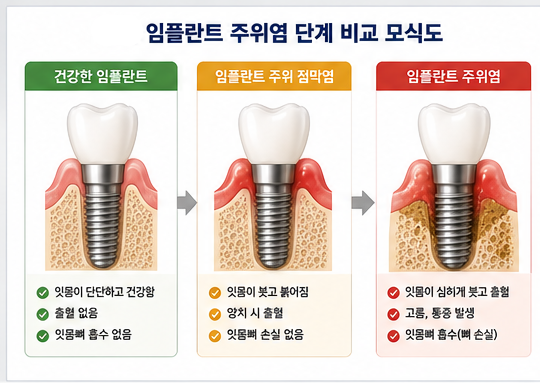
Peri-implantitis refers to a condition in which inflammation develops in the gums and jawbone around an implant.
Just as periodontitis (gum disease) can develop around natural teeth, bacteria can accumulate around an implant and cause inflammation.
Problems in the tissues around an implant are broadly divided into two stages.
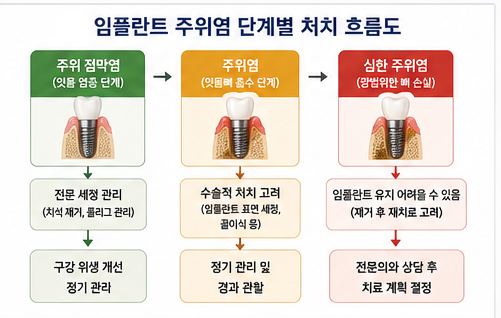
Peri-Implant Mucositis
This is the stage in which inflammation is limited to the gums (soft tissue).
The gums may bleed when brushing or become swollen, but there is not yet any bone damage.
It is a relatively early stage, and recovery may be possible with appropriate care.
Peri-Implantitis
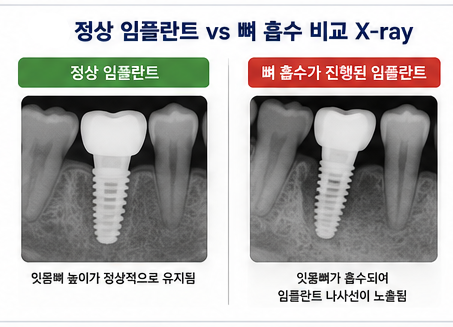
This is the stage in which inflammation has progressed to the jawbone.
It is accompanied by resorption of the jawbone, making treatment more important.
More active treatment may be necessary at this stage.
Why Does Peri-Implantitis Occur?
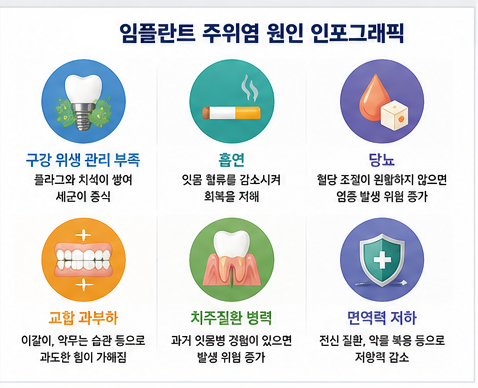
The main cause is bacterial plaque that accumulates around the implant.
However, the following factors may also have an effect.
Insufficient Oral Hygiene
When plaque and tartar accumulate around an implant, inflammation may develop.
Smoking
Smoking can affect blood flow to the gums and may reduce the ability to heal and defend against inflammation.
Diabetes
When blood sugar is not well controlled, the likelihood of inflammation occurring or progressing may increase.
Excessive Occlusal Force
Clenching or grinding the teeth can transfer excessive force to the implant.
History of Periodontal Disease
People who have had gum disease in the past may also be more likely to experience problems in the tissues around an implant.
Reduced Immunity
The inflammatory response may vary depending on overall health.
Peri-Implantitis May Be More Serious Than Periodontitis Around Natural Teeth
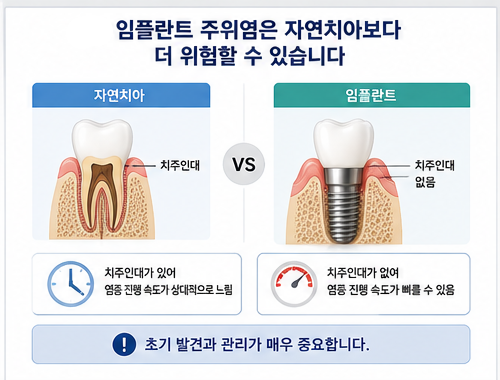
This is something that many patients are more curious about than you might expect.
Natural teeth and implants are similar in that inflammation can develop around the gums.
However, there are differences in the structure of the surrounding tissues.
Natural teeth are connected to the jawbone through a tissue called the periodontal ligament.
In contrast, implants are directly integrated with the jawbone without a periodontal ligament.
Because of this structural difference, when inflammation develops around an implant, bone resorption may sometimes progress more quickly than periodontitis around a natural tooth.
Of course, not every case of peri-implantitis progresses rapidly.
However, the symptoms may not be obvious in the early stages, so regular evaluations are important.
That is why implants require consistent care and regular checkups even after placement is complete, and it is best not to dismiss small changes such as gum bleeding or swelling.
What Symptoms May Occur?
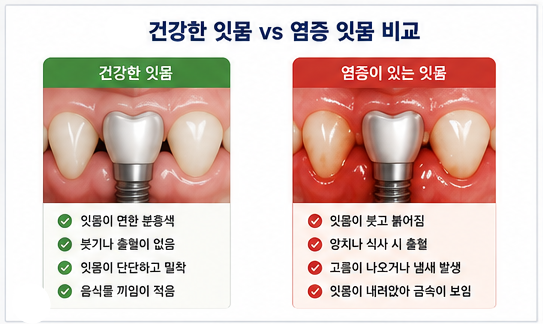
Peri-implantitis may cause no particular symptoms in its early stages.
As a result, it is not uncommon for it to be discovered incidentally during a regular checkup.
The following symptoms may occur:
Swelling or redness of the gums around the implant
Bleeding when brushing
Pus or an unpleasant odor
Receding gums, making more of the metal portion visible
Discomfort when chewing
A sensation that the implant is loose
In particular, if bleeding around an implant occurs repeatedly, it is advisable not to consider it merely irritation and to have an examination.
How Is Peri-Implantitis Diagnosed?
Dental clinics use the following methods to evaluate the condition.
Clinical Examination
The condition of the gums around the implant is checked using a periodontal probe.
Bleeding and probing depth are measured.
Radiographic Examination (X-ray)
The height of the jawbone around the implant is checked.
Comparing the results with previous images makes it possible to assess bone resorption more accurately.
For this reason, radiographs taken regularly after implant treatment can help compare the condition over time.
How Is Peri-Implantitis Treated?
The treatment method may vary depending on the condition.
Early Stage
Professional cleaning around the implant and tartar removal are performed.
Instructions on proper brushing and the use of supplemental oral hygiene products are also provided.
Moderate or More Advanced Stage
When accompanied by jawbone resorption, surgical treatment may be considered.
Depending on the situation, cleaning of the implant surface or bone grafting may also be performed.
Severe Cases
When jawbone damage is extensive, it may become difficult to preserve the implant.
That is why early detection is important.
If Peri-Implantitis Develops, Does the Implant Have to Be Removed?
Many people worry about whether an implant must be removed if peri-implantitis develops.
To conclude, not every case of peri-implantitis leads to implant removal.
If the condition is discovered at the mucositis stage or treated during a relatively early stage of peri-implantitis, treatment can often proceed while preserving the implant.
Conversely, preservation may be difficult when jawbone damage has progressed extensively.
Therefore, we often explain that what matters is not simply whether peri-implantitis has developed, but when it was discovered.
This is because the earlier it is detected, the greater the possibility may be of preserving the implant.
Can Peri-Implantitis Be Prevented?
It cannot be prevented completely, but it is possible to reduce the risk.
Care at Home
In addition to brushing, using interdental brushes and an oral irrigator may help care for the area around the implant.
Regular Checkups
It is important to have regular checkups even when there are no symptoms.
In general, regular checkups approximately every six months are recommended, although the interval may vary depending on an individual’s oral condition.
When early changes are detected through regular checkups, they can often be addressed with relatively simple care.
In Closing
Implants can be used for a long time when they are properly maintained.
However, just as with natural teeth, inflammation can develop in the tissues around an implant, and this is called peri-implantitis.
In my practice providing implant care at a dental clinic near Yaksu Station, I have often heard patients with peri-implantitis say:
“I thought everything was fine because it didn’t hurt.”
Even when there are no symptoms, checking for small changes through regular examinations is an important part of using implants for a long time.
Key Points from Today’s Post
✔ Implants can develop gum disease, just like natural teeth.
✔ The condition is classified as peri-implant mucositis or peri-implantitis.
✔ Since bone resorption may sometimes progress more quickly than around natural teeth, early detection is important.
✔ Oral hygiene, smoking, diabetes, and a history of periodontal disease may have an effect.
✔ Common symptoms include gum bleeding, swelling, pus, and gum recession.
✔ Not every case of peri-implantitis leads to implant removal, but early detection is important.
✔ Regular checkups can be helpful even when there are no symptoms.
This post was written for the purpose of providing medical information in compliance with Article 56, Paragraph 1 of the Medical Service Act.