In Part 1, I only gave a simple interpretation of what the content was about. In this Part 2, as a board-certified plastic surgeon performing #filler procedures, I’d like to share my thoughts on its academic value and my own opinion.
The opinion of the doctor featured in the video about fillers is:
Although fillers are said to be absorbed and disappear,
some tissue grows in, so they never disappear for life,
and in the case of the chin, they cause bone resorption and bone depression, so don’t get fillers there!
In one YouTube video,
I saw various dermatology clinic directors posting rebuttal articles and rebuttal videos, and criticizing it strongly in a somewhat heated tone. Today, I am not trying to criticize the plastic surgeon, who is my colleague, featured in the controversial video, nor am I trying to criticize the dermatology clinic directors who posted rebuttal videos.
I simply want to cautiously share my opinion based on the medical knowledge I know and my conscience as a specialist. Today, I will especially analyze the Chinese paper on bone resorption after fillers that was used as a reference in that video, and write my opinion about it.
Below is the paper from China published in the October 2018 issue of the Aesthetic Surgery Journal, Volume 38.
The title is “Unexpected Chin Bone Resorption Caused by Soft Tissue Fillers.” As the title suggests, it officially means that doctors were not aware of bone resorption caused by fillers.
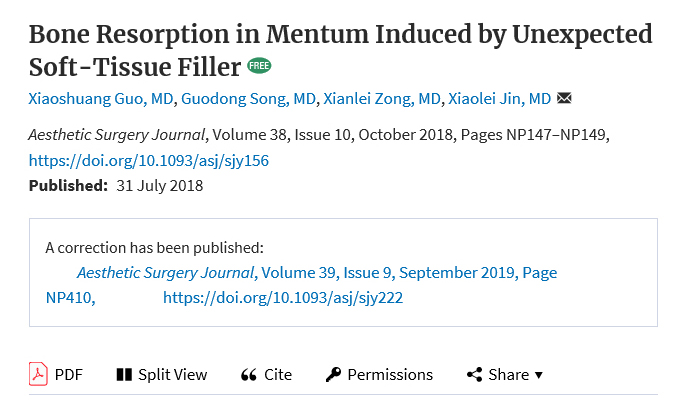
Since there is no specific patient information, it looks more like a simple case report rather than a research paper. In medical papers, a case report means the doctor who reported it saw such a patient, so please take note, and when you see a similar patient, let’s study it together.
They found chin depression while performing chin surgery in 9 patients, and all 9 had a history of chin filler injections. However, the sample size is extremely small, and there is no information on whether each patient had any systemic disease that could cause bone resorption or whether they had previously undergone chin implant procedures. So there is a lack of logical support to make a definitive conclusion. Based on this paper alone, you cannot conclude that chin fillers definitely cause bone resorption.
 -> Because people in East Asia prefer a fairy-like, pointed chin shape, they often undergo noninvasive soft tissue filler or chin implant surgery for chin contouring.
It simply says that because many East Asians have small chins, they often want a somewhat pointed chin.
 -> HA (hyaluronic acid) fillers are commonly used because they are generally safe and effective, but side effects can occur. From October 2016 to April 2018, they found 9 cases in which #HAfillers were injected into the chin and bone resorption occurred.
It is very insufficient to conclude from only 9 patient cases that chin fillers cause bone resorption or bone depression. There is no mention of whether there were any other systemic diseases that could cause bone resorption, and more importantly, as a board-certified plastic surgeon, the most disappointing part is that there is no mention of whether any chin implant was present before the filler was injected into the chin. This is because, as clearly stated in the body of the Chinese paper above:

Bone resorption caused by implants is a well-known fact. If an implant had been inserted into the chin and later removed for various reasons, and filler was then injected into that area, it cannot be said that the bone resorption was caused by the filler.
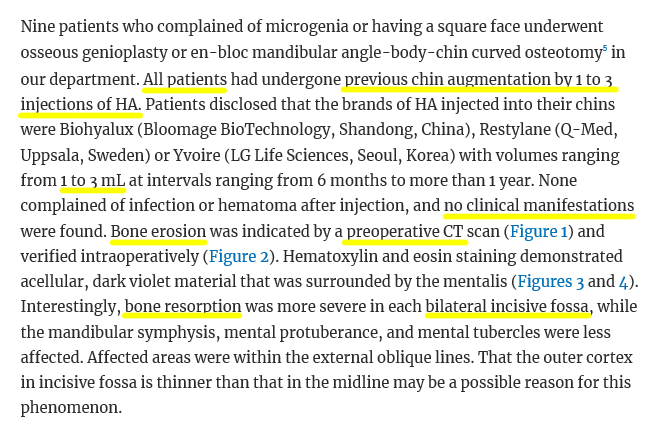 -> All 9 patients had received HA filler injections into the chin 1 to 3 times, 1 to 3 cc each time, but they showed no particular symptoms. The areas where bone resorption occurred were directly confirmed visually on preoperative CT scans or during chin surgery, and what is interesting is that the depressed areas were on both sides of the midline in the chin.
In fact, I think this sentence in the paper points to a very important issue. When filler is injected to make the chin more pointed, it is usually placed in the center of the chin, not divided and injected to both sides. If it is not injected in the center, it cannot be made pointed and it easily ends up looking blunt.
Then the filler is mainly injected into the center, but the areas on both sides of the center are depressed?
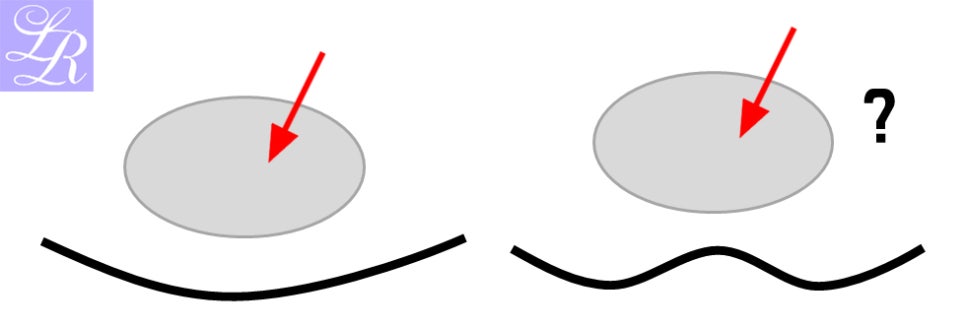
It feels somewhat illogical, but it is possible to speculate that because the chin muscles attach to the depressed areas on both sides, the muscle action may apply greater pressure there, causing both sides to become depressed.
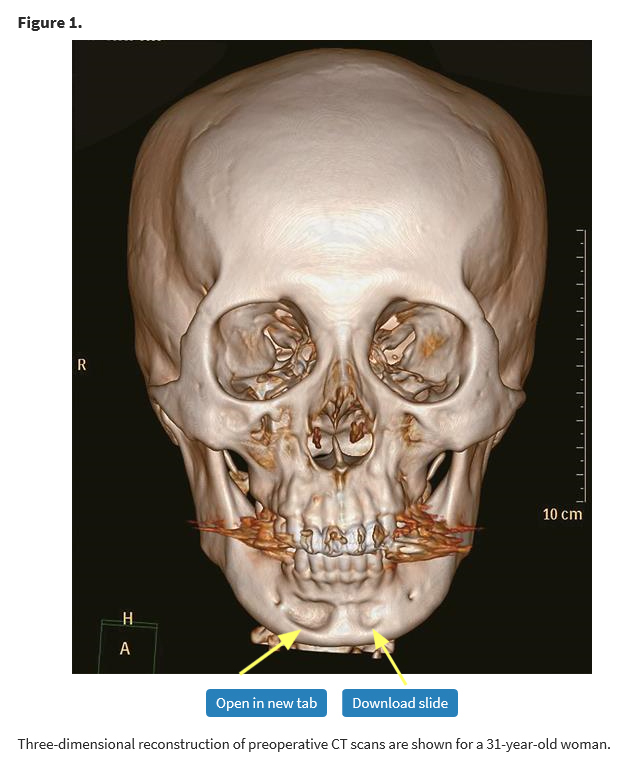 -> In the 3D CT image, the yellow arrows point to the depressed areas.
The mysteries of the human body are called a small universe, so they are truly mysterious. (I’m Mister Kim, though haha.)
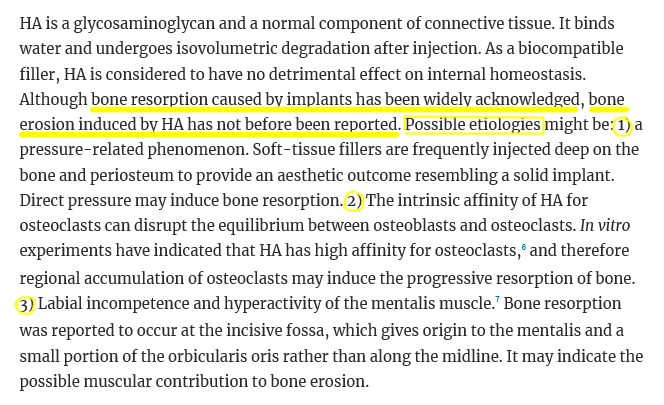 -) HA fillers do not have any particularly harmful effect on the body. Bone resorption caused by implants is already a well-known fact, but bone resorption caused by HA fillers has not yet been reported.
Possible reasons include:
-
A pressure-related phenomenon — that is, periodically injected soft tissue filler placed deeply 바로 above the bone and periosteum may act like a solid implant.
-
The affinity of HA filler for osteoclasts may disrupt the balance between osteoblasts and osteoclasts. In laboratory in vitro testing, HA filler has affinity for osteoclasts, and the local concentration of such cells may induce gradual bone resorption.
-
Excessive movement of the chin muscle and insufficient lip function — bone resorption usually occurs in the depressed areas below both canines, and because the chin muscle does not attach to the midline but to the depressed areas on both sides, this may affect such bone resorption.
If, as the paper says, HA filler increases the activity of osteoclasts and causes bone resorption, then as mentioned above, I strongly feel that it would also be impossible for both sides of the center to become depressed. Osteoclasts do not carve things out; they would not be able to leave the center untouched and only hollow out both sides.
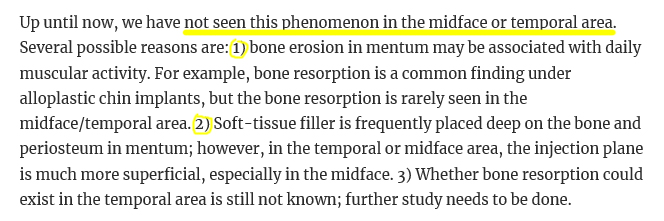 -> So far, we have not observed this kind of bone resorption in the midface or temporal region. Therefore, regarding the possibility of chin bone resorption related to this:
-
Chin bone resorption may be somewhat related to continuous muscle movement. For example, bone resorption commonly seen with chin implants is rarely seen in the midface/temporal region.
-
Soft tissue filler is usually injected deeply, right above the bone and periosteum in the chin, but in the temporal and midface regions it is injected more superficially.
-
Therefore, as for bone resorption in the temporal region, nothing is known yet and further research is needed.
Perhaps the Chinese authors of this paper may not have injected filler into the chin very often. When injecting filler into the chin, it should be placed as superficially as possible in order to create a beautifully pointed chin shape. If it is injected right above the periosteum, as the paper says, the chin can become blunt and may look like a prognathic jaw.
Therefore, in my view,
with only one case-report-style paper that is quite lacking in logical support, it would still be difficult to accept as fact that chin fillers cause bone resorption, and I think this is something that requires more discussion and research.
Medicine is also a part of science, and science is a discipline based on probability. In medicine, especially in plastic surgery, there is no such thing as 100%. There are cases like this and cases like that. Just as what one has seen does not represent everyone, even if it is 9 cases—or hundreds or thousands of cases—it is still not possible to say with 100% certainty that it is always this way or always that way. So doctors must approach any phenomenon more carefully than anyone else.
Also, in a time like this, although it may not be the case most of the time, it makes me sigh when I see how many people speak with truly impure motives when you look back later, and it makes me wonder if I should live like that too.
Rather than saying whether filler-related bone depression is right or wrong,
my position is that it is still not certain, so let’s study it carefully from multiple angles.