I’m looking into orthodontic treatment
because I’m considering it,
and everyone tells me to
get treatment from an “orthodontic specialist.”
Is there a particular reason for that?

When considering orthodontic treatment, many people wonder:
-Which dental clinic should I visit?
-How much difference will there be in cost between Dental Clinic A and Dental Clinic B?
-Should I just go somewhere close to work?
These are the kinds of questions people often have.
Before considering those factors, however, I would recommend first looking for a dental clinic with an orthodontic specialist.
In particular, many people considering Invisalign, which is a popular orthodontic treatment option, tend to think that the appliances will be the same everywhere. They may not pay much attention to the doctor and instead choose a clinic based on the idea that, if the appliance is the same, it is better to go with the less expensive option.
However, regardless of the type of appliance used, the orthodontic treatment process and results can also vary depending on the doctor’s expertise, technical skill, and experience. Therefore, carefully evaluating the doctor’s qualifications is especially important for achieving satisfactory results.
At this point, checking whether the doctor is an orthodontic specialist can be helpful as an indication of their experience and skill level.
Let’s take a closer look at how orthodontic specialists differ and why it may be beneficial to receive treatment from one.
How does someone become an orthodontic specialist…?
It is useful to first understand how one becomes a specialist.
Typically, a dentist completes two years of pre-dental studies and four years of dental school, then passes the national dental licensing examination to obtain a dental license.
This means that they are officially qualified to work as a general dentist.
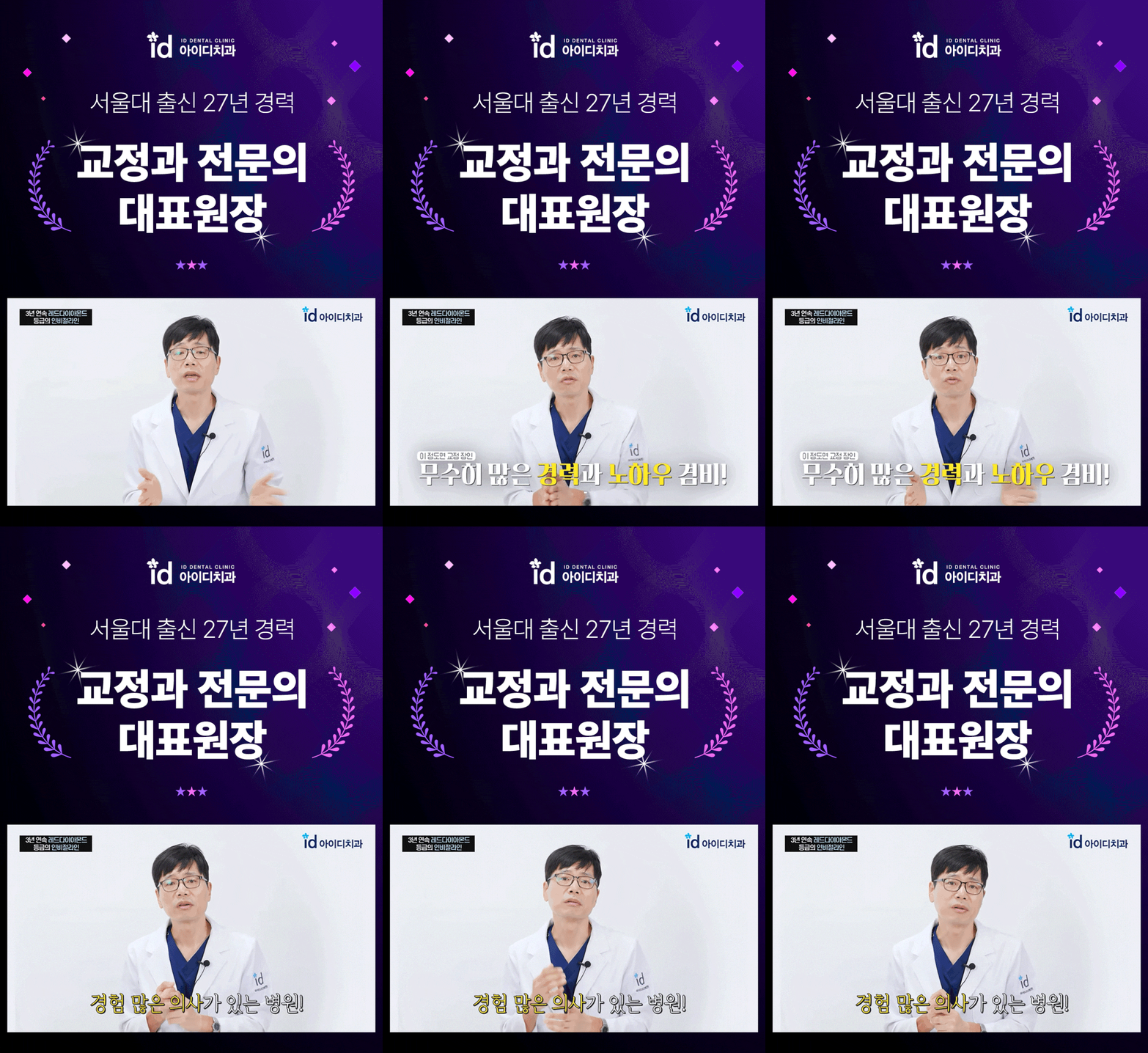
A dental specialist must go beyond this stage. After completing a one-year dental internship and three years of residency in orthodontics, they must pass the orthodontic specialist examination to obtain the qualification.
In other words, a “specialist” is someone who has earned a qualification through more in-depth study and training in a particular field.
Dentistry has specialist systems in several fields, including conservative dentistry, oral surgery, periodontics, and prosthodontics. Orthodontics is one of those fields.
Just as you would visit a specialist in conservative dentistry when treatment to preserve a tooth is needed, or a periodontist when there is a problem with the gums, seeking an orthodontic specialist for orthodontic treatment can provide access to more specialized care.
Why choosing an orthodontic specialist matters…
The reason it is important to receive orthodontic treatment from an orthodontic specialist is not simply that they have more experience with orthodontic treatment.
It is because they receive additional specialized training to comprehensively diagnose and treat tooth movement, jaw growth, occlusion, and changes in facial appearance.
As a result, they can develop customized treatment plans based on an orthodontic diagnosis suited to the patient’s oral structure. Even in complex cases, they can carefully consider the situation and work toward stable results.
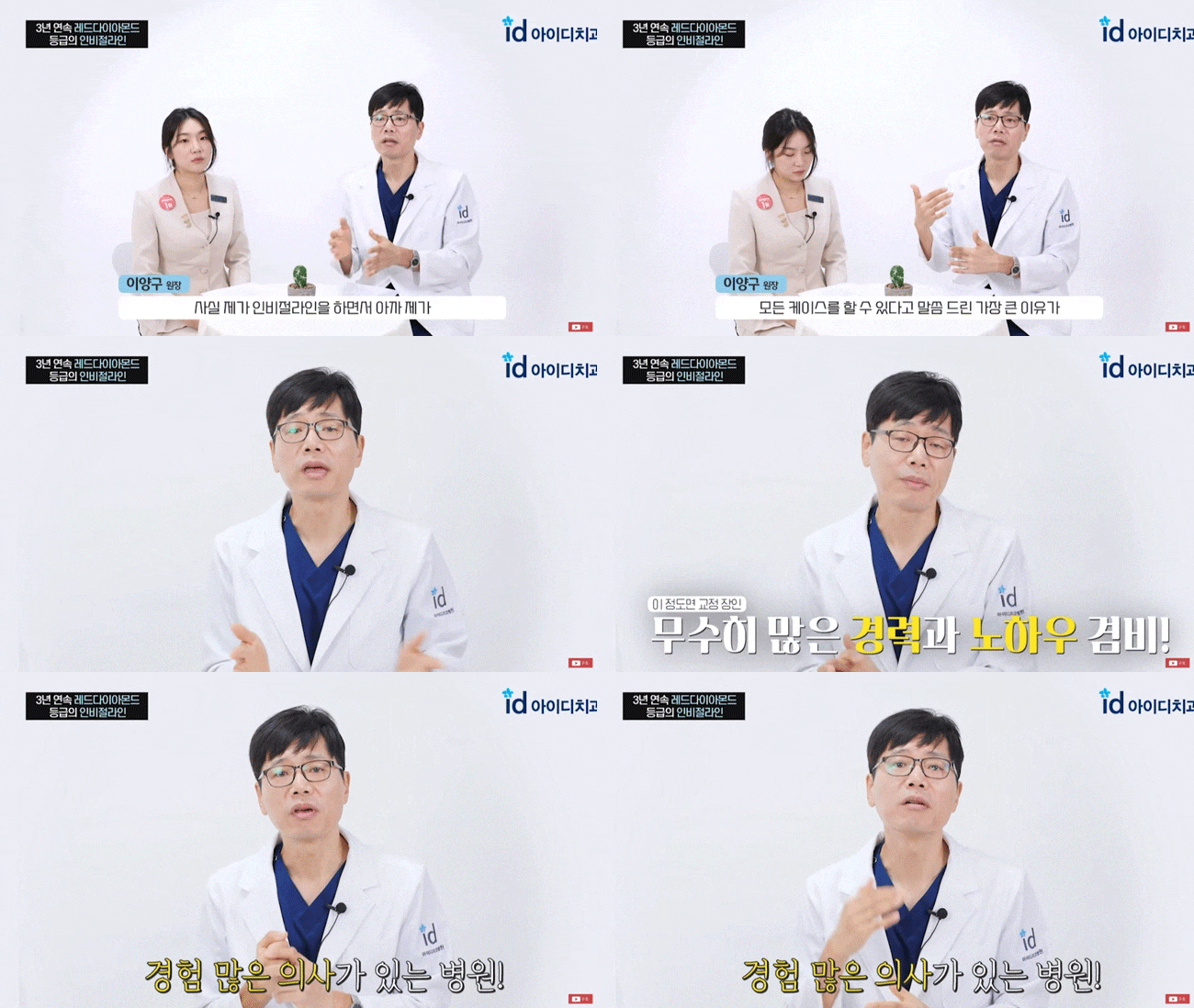
When there is severe protrusion, a recessed chin, or facial asymmetry, diagnosis, treatment planning, and the ability to address problems that arise during treatment are much more important than simply knowing how to attach wires.

Having crowded teeth does not automatically mean that extractions are necessary, nor should treatment be forced without extractions when extractions are needed.
Depending on the patient’s age, growth may also need to be taken into account. Even when two patients have the same type of protrusion, an appropriate treatment plan should consider the patient’s overall facial shape and appearance as well.
These diagnostic and treatment processes require extensive orthodontic knowledge and experience.
Straightening the teeth and properly correcting the bite are entirely different things.
That is why I would say that orthodontic treatment is much more advantageous when performed with an orthodontic specialist.
Of course, general dentists can also provide orthodontic treatment. However, as treatment becomes more complex, differences are more likely to emerge in areas such as treatment duration, decisions about extractions, bite stability, and the possibility of relapse.
The more difficult the case, the more important it is to carefully evaluate the doctor’s expertise.
Invisalign should also be provided by a doctor with extensive orthodontic experience…
Some people considering Invisalign occasionally ask, “This method is different from conventional orthodontics, so wouldn’t it be fine to go anywhere as long as they use genuine products?”
Invisalign is a method of straightening the teeth by wearing highly aesthetic appliances over the upper and lower teeth like mouthpieces. As a result, many people focus only on the appliance.
They may think that using genuine appliances and wearing them properly matters more than the doctor’s skill.
It is true that Invisalign differs from conventional orthodontic appliances. However, achieving stable results even in highly complex cases with this method requires the doctor’s expertise, skill, and extensive clinical experience to support the treatment.
In other words, good treatment processes and results can be achieved when the doctor has treated a variety of cases as an orthodontic specialist and also has a thorough understanding and expertise in the field as an Invisalign-certified provider.
Invisalign can be diagnosed using digital simulation, but the simulation does not replace the actual treatment. It is only one treatment system; the doctor’s treatment plan is what determines the actual results.

Decisions about whether to extract teeth, how far to move them, where and how to create space, how to change the bite, and what changes in facial appearance to expect can vary greatly from one doctor to another, even when they are working from the same information.
One especially important consideration is “how to make corrections when a problem occurs.”
Because Invisalign uses pre-made appliances that patients put in and take out themselves, the patient’s compliance can affect the treatment duration and results.
An orthodontic specialist with extensive clinical experience is more capable of anticipating these situations, detecting them early, or quickly modifying the plan and responding when a problem has already occurred.

Therefore, it is beneficial to receive treatment from a doctor who meets both conditions: <orthodontic specialist + Invisalign-certified provider>.
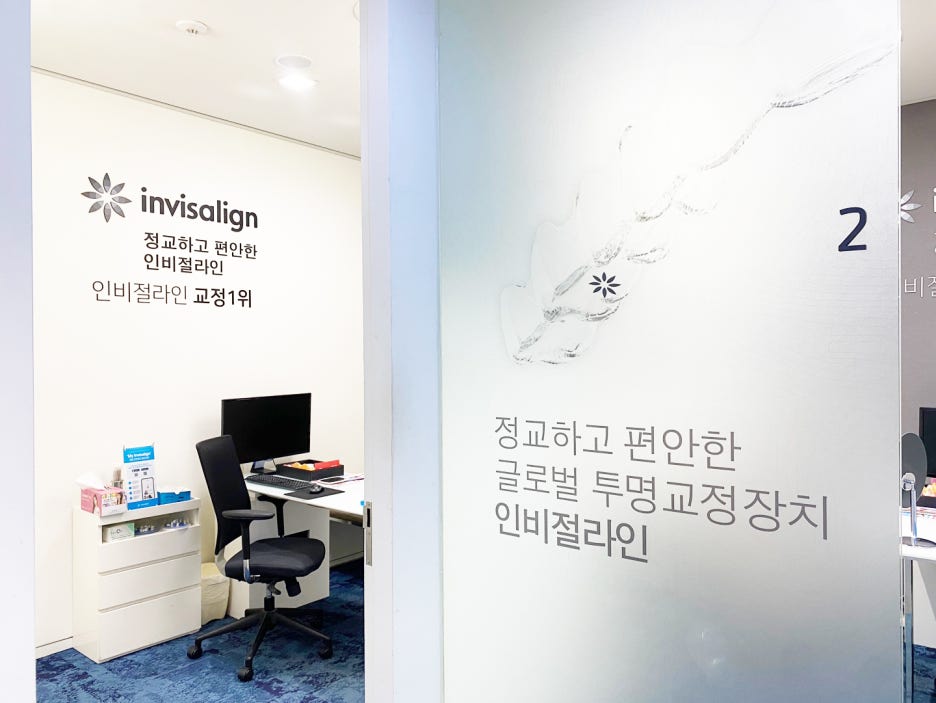
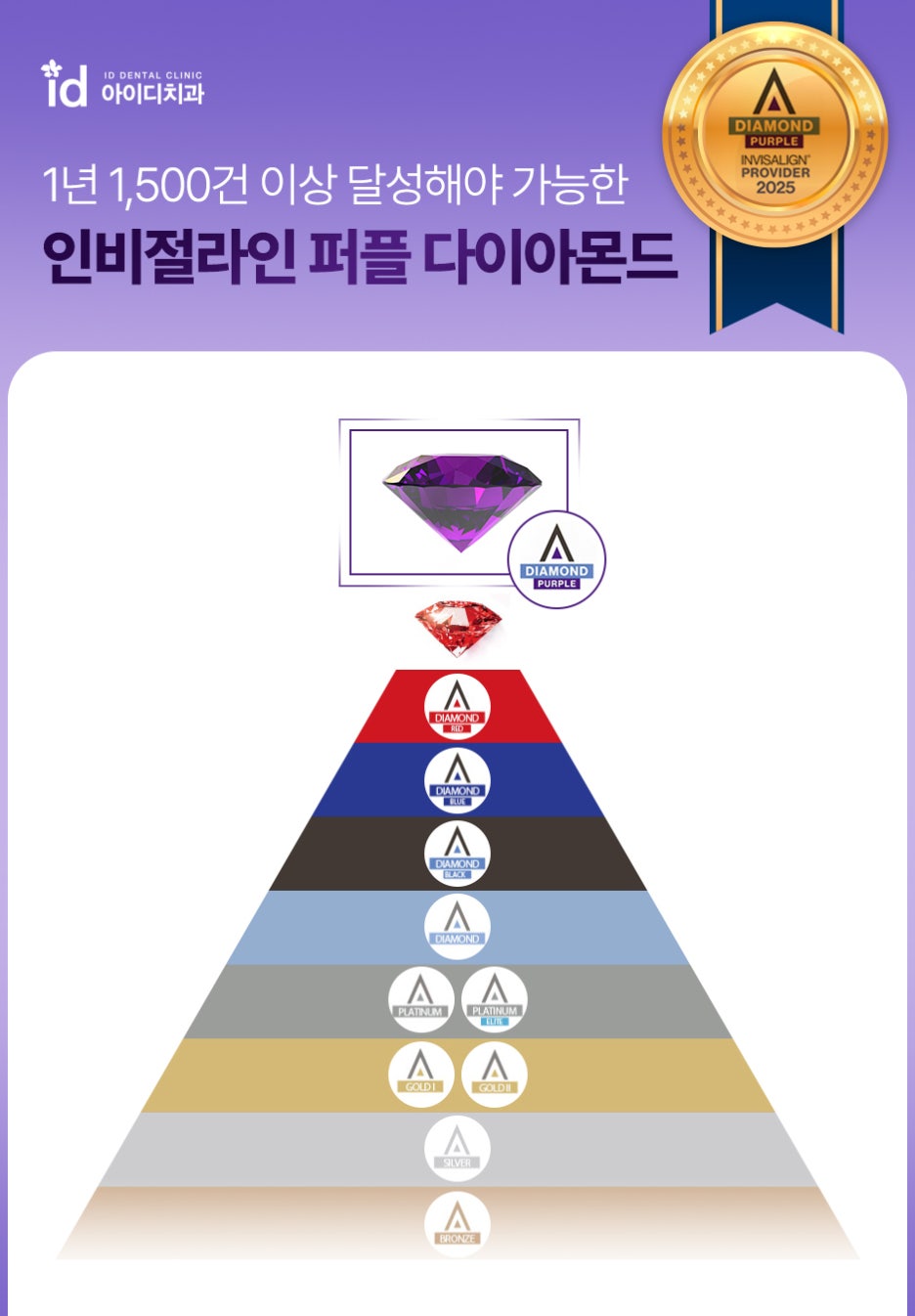
If you need a way to gauge the doctor’s experience with Invisalign, it may be helpful to check the “Invisalign tier.”
Tiers are assigned according to the number of Invisalign cases performed during the year. Checking this tier in advance can indicate how many cases the dental clinic has handled over the course of a year.

The highest tier was “Diamond Purple.”
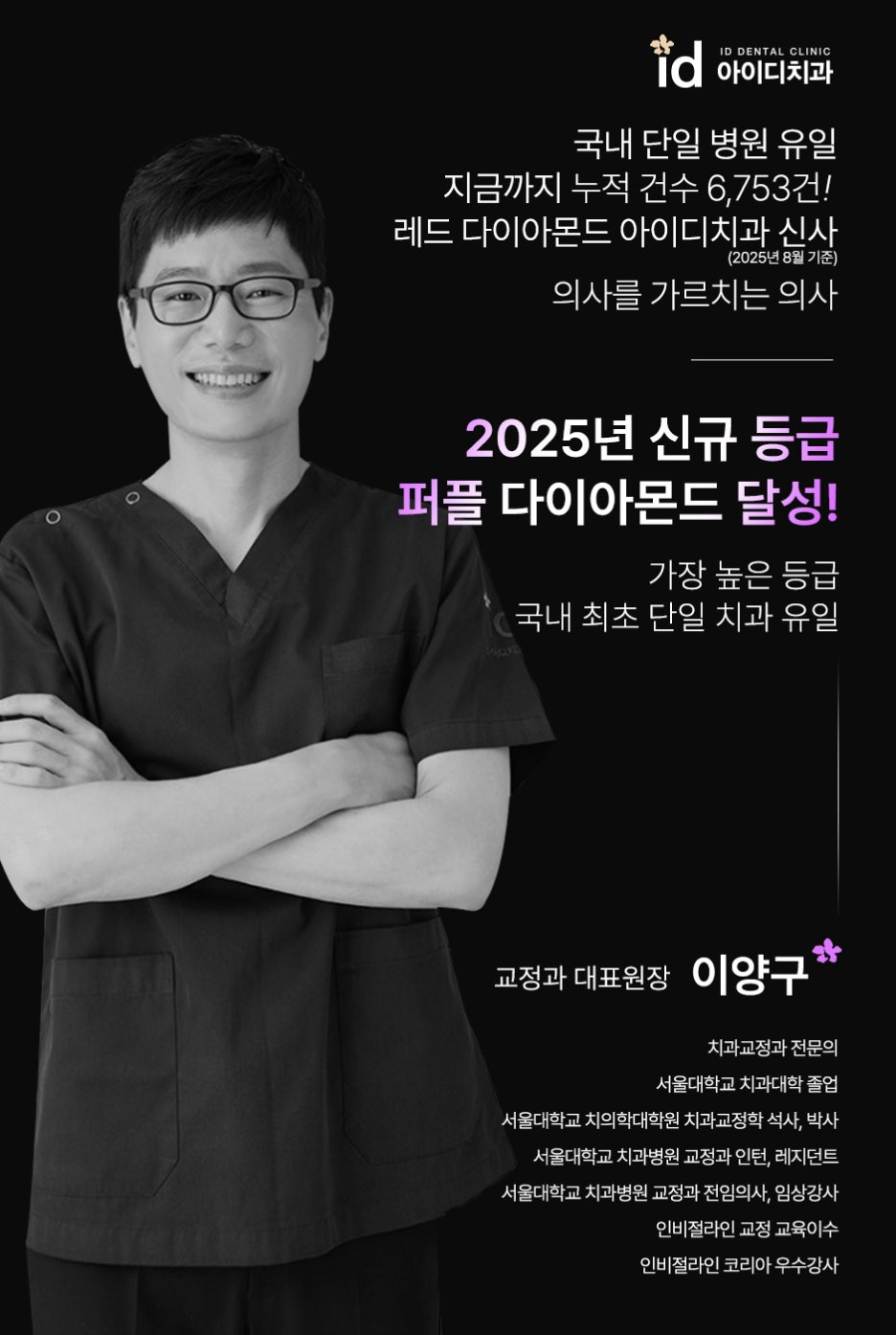
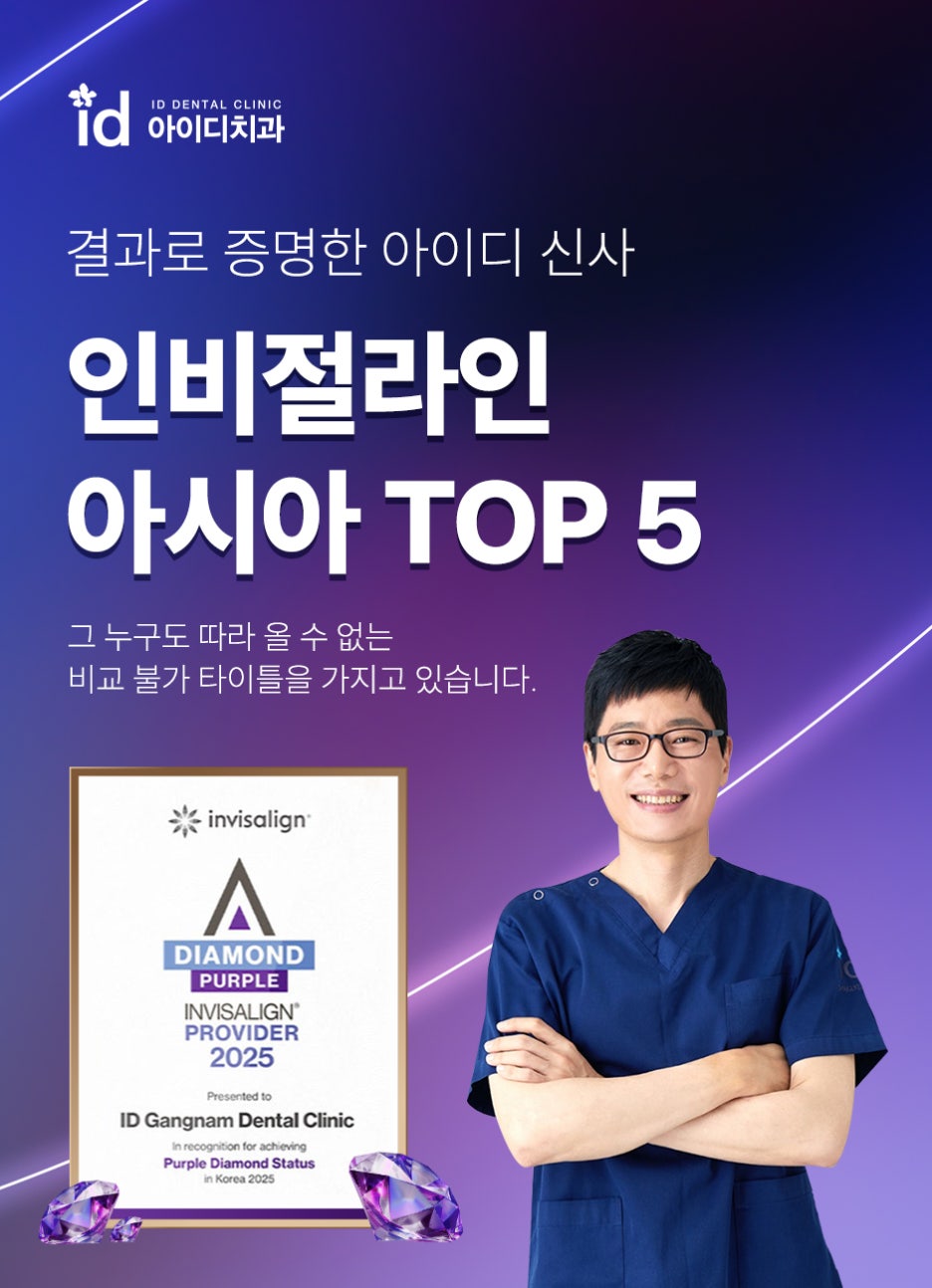
This tier can be earned by performing more than 1,500 Invisalign cases in one year, and ID Shinsa was the first in Korea to receive it.
Before Diamond Purple, the highest tier at the time was “Diamond Red.” ID Shinsa was also the first to receive this tier in 2021 and has maintained it consecutively for five years since then.
As a result, as of January this year, the clinic’s cumulative Invisalign experience had reached 7,640 cases. Of course, one might think that this record alone does not prove that treatment is performed well. However, extensive experience with a wide variety of cases inevitably leads to differences in know-how and skill. There is naturally a difference between having handled something 100 times and having handled it 7,000 times.

The clinic has also continued to share its Invisalign treatment experience, know-how, and techniques with many people through seminars and conferences, while continuing its research to advance the field. As one of the TOP 5 Invisalign providers in Asia and a flagship clinic, it is working to continue fulfilling its role responsibly.
As you can see from today’s article, it is very important who provides orthodontic treatment.
This is a field in which the role of the doctor cannot be replaced even by AI technology.
Depending on what the doctor has studied, which areas they specialize in, how long they have been providing treatment, and what treatment philosophy they hold, different treatment plans and results can arise even for the same case.
These are precisely the reasons why treatment by an orthodontic specialist matters.
I hope the information shared today was helpful to those considering orthodontic treatment and Invisalign.







Previous image
Next image










Previous image
Next image










Previous image
Next image