Hello, I’m Dr. Jo Hyun-woo, director of Ipchesung Plastic Surgery, a facial contouring clinic in Apgujeong.
There are a wide variety of surgical names for chin surgery methods, including T-osteotomy, S-osteotomy, Y-osteotomy, W-osteotomy, sandwich osteotomy, and even the lower border resection of the chin, commonly called shaving.
If you look online, you may see claims that one particular osteotomy method is better than the others.
At those times, whenever a new osteotomy method is introduced, people often attach various reasons to it, such as saying it is a more advanced technique that addresses the limitations of existing methods, that it is safer, or that it maximizes the effect.
However, as I mentioned before, the chin surgery methods you know are actually not that different in terms of surgical principle or outcome, except that the osteotomy line is slightly different.
Today, I’ll explain these chin surgery osteotomy methods in a bit more detail.
First, the most commonly compared methods are “T-osteotomy” and “shaving.”
Both T-osteotomy and shaving are surgeries that make the chin narrower and slimmer, and there is no difference in the result.
The point I summarized in a previous column was that T-osteotomy alone is only possible when chin advancement or setback is needed due to a receding chin or prognathism.
If you still do not know how each osteotomy method is performed, please refer to the video below.
And I also explained that when chin advancement or setback is not needed, shaving is recommended over T-osteotomy.
Does shaving involve a larger dissection area, so does it cause a double chin?
One of the questions patients often ask when shaving is recommended during chin surgery consultation is, “Does shaving cause a double chin?”
Patients may have heard that “shaving involves a larger dissection area than T-osteotomy,” and because of this, they think the likelihood of skin sagging will also be higher.
But if we compare them, it is true that shaving involves a slightly larger dissection area, but the difference is very small and not something you need to worry about much.
I mentioned this in a previous article about double chins after chin surgery. ^^
Also, the cause of a double chin is not only related to the amount of dissection; it is connected with muscle damage and other factors as well, so it is difficult to say that sagging will occur based on dissection alone. I’ll explain this in more detail below.
I heard that OO osteotomy is a procedure that compensates for the limitations of existing surgical methods.
When newly developed surgical methods are introduced, they are usually accompanied by the claim that they “compensate for the limitations of existing methods and are better and safer.”
However, that is also a difficult thing to say.
In fact, what we call surgical results are based on the outer surface, the skin, not the bone, so we need to consider the relationship among the muscles, tendons, and skin above the bone as well.
During chin surgery, the damage to muscles and surrounding tissues increases as the surgical process becomes more complex.
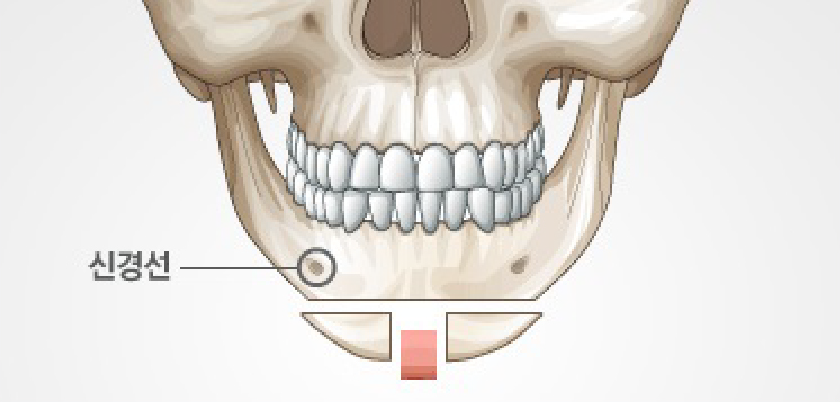
Removal of bone fragments in T-osteotomy
Let me explain with T-osteotomy as an example. In procedures like T-osteotomy, which involve removing bone fragments, the surrounding muscles are damaged once again during the removal of the bone fragment.
In addition, osteotomy methods that remove bone fragments create a secondary angle after the chin is narrowed, as shown in the figures below.
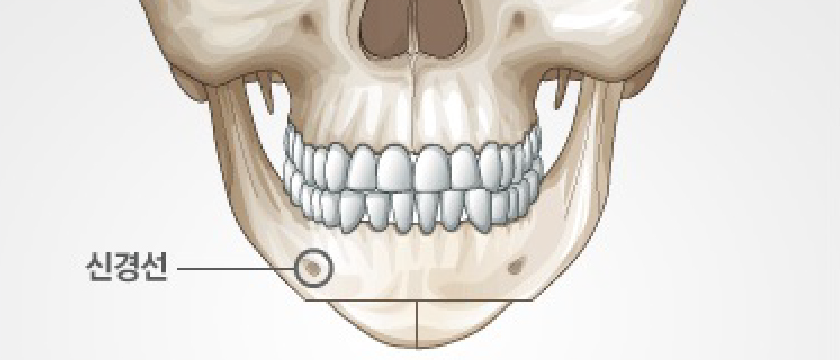
T-osteotomy, secondary angle
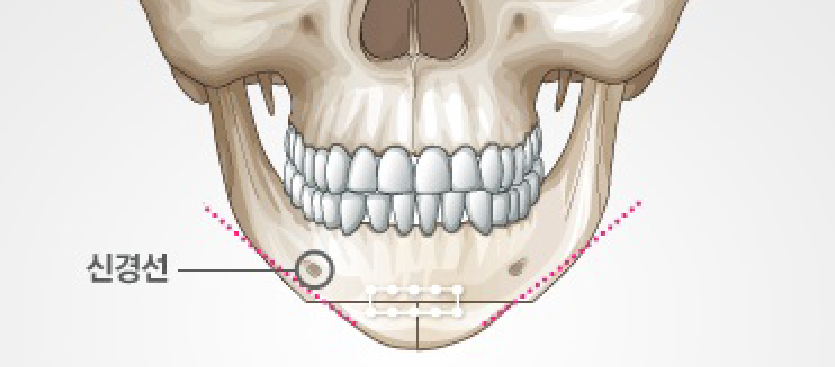
T-osteotomy, secondary angle
The formation of a secondary angle means that additional smoothing is needed during surgery, and that in turn means the muscle must be detached and smoothed.
If the muscle is significantly damaged at this stage, its length can sag and stretch, and as a result, the facial line may descend below the chin, increasing the possibility of sagging.
There is also the possibility that excess tissue may sag when the chin is moved backward.
This does not mean that T-osteotomy always causes sagging, but as you can see, it cannot be said that “because the dissection area is smaller than shaving, the chance of sagging is also smaller.”
As you have seen, each osteotomy method has its own advantages and disadvantages, so thinking that the latest surgical method is always better is a misunderstanding.
Then what is the safest surgical method?
As I always say during consultations, I believe a good surgery is one that causes the least damage to the body and ends in the simplest way.
In fact, this applies not only to chin surgery but to all surgeries.
For any surgery, if the process becomes more complex, you have to anticipate greater damage and more side effects.
If different surgeries ultimately produce the same effect, I tell patients that it is best to go as simply as possible to minimize damage and shorten the surgery time.
For this reason, when chin advancement or setback is not needed, I recommend shaving (lower border resection of the chin) rather than T-osteotomy, which has a more complex surgical process and also requires fixation pins.
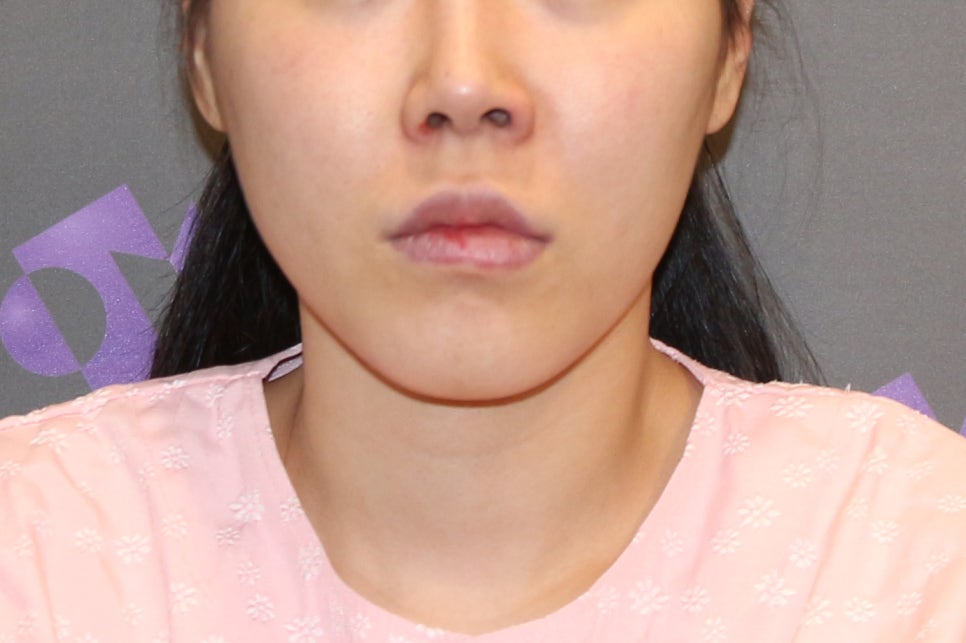
Shaving (lower border resection of the chin), before surgery
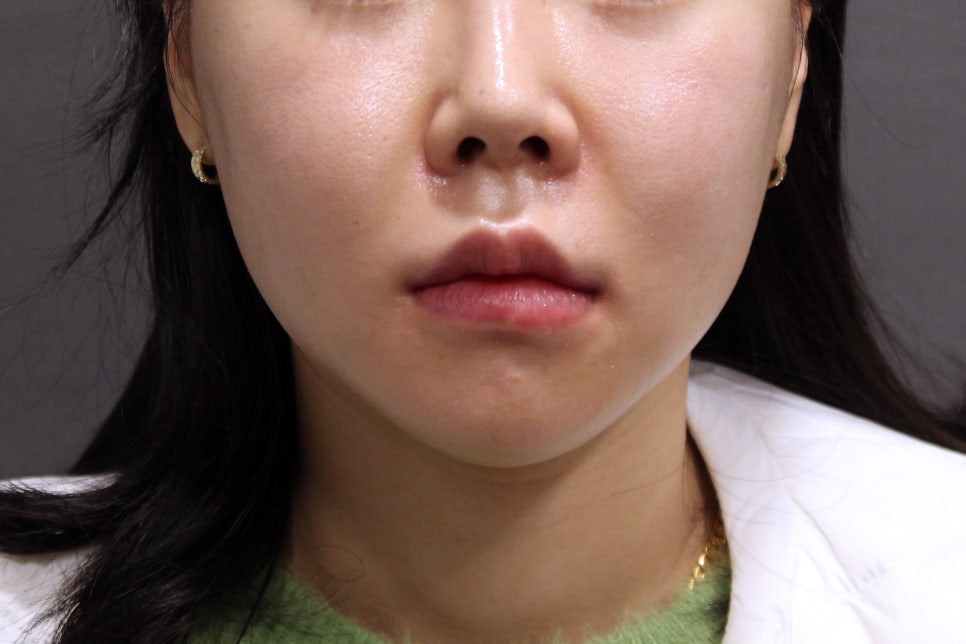
Shaving (lower border resection of the chin), 3 weeks after surgery
These days, there are a lot of marketing terms and exaggerated expressions, so please do not be overly influenced by claims that one osteotomy method is better or safer. It is best to have a careful consultation with the surgeon and choose the procedure that is most appropriate for you.
Thank you.