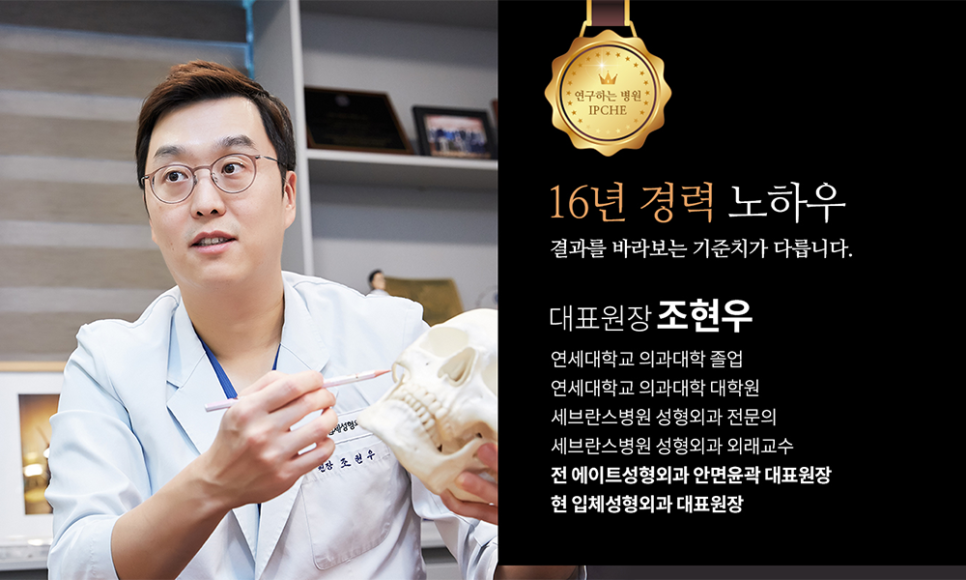
Hello. I am Dr. Jo Hyun-woo of Injeok Plastic Surgery.
Today is the fifth installment of the Facial Contouring Q&A,
covering questions related to facial contouring surgery.
I will answer the questions many of you are curious about.
Q1. My jaw is slightly rotated and asymmetrical. Can this be improved with facial contouring?
A. In principle, the solution is orthognathic surgery.
The first method we generally think of for correcting facial asymmetry is orthognathic surgery.
If the jawbone is significantly twisted, asymmetry can be improved through orthognathic surgery.
However, many patients do not want such a major procedure.
In such cases, a secondary option is to improve the asymmetry through chin surgery.
Q2. I am taking osteoporosis medication. How many months before facial contouring surgery should I stop it?
A. You do not need to stop osteoporosis medication.
After contouring surgery, some people worry about bone discomfort or osteoporosis, but there is no particular medical basis for this.
However, if osteoporosis is severe, bone fusion after surgery may be impaired, so careful evaluation before surgery is necessary.
In particular, for middle-aged and older adults in their 50s and above, facial bones may be thin, so a bone density test is essential.
Q3. I had T-shaped chin osteotomy surgery and am considering removing the fixation screws. If they are removed, will permanent holes remain in the bone?
A. To give you the conclusion first, there is absolutely no need to worry.
The holes in the bone will all fill in over time.
Even if a 3D CT shows holes or gaps in the bone, when surgery is actually performed, it is often seen that the bone is completely fused.
In fact, the longer the fixation pins remain, the more they are often covered during the fusion process of the surrounding bone and become invisible.
Therefore, it is important to monitor the progress with a CT scan after surgery, and the optimal time for pin removal is generally around one year after surgery.
Q4. I am considering facial contouring surgery. If you are older, is the recovery period longer or are side effects more common?
A. There does not seem to be a major difference in recovery time.
However, older patients may feel more sagging after surgery.
Even if they do not undergo facial contouring surgery, many people in their 30s and older regularly maintain their skin with lifting lasers or thread lifting.
If your skin elasticity is particularly poor, it is a good idea to keep postoperative lifting procedures in mind in advance.
At minimum, it may also help to consistently manage the skin with lifting lasers at regular intervals of 6 months to 1 year.
Q5. I had multiple surgeries to remove a tumor from the cerebellum and a lump, but as a side effect, the right facial nerve became paralyzed and my mouth is twisted. Can this be treated with facial contouring?
A. This is not a situation that can be treated with contouring surgery.
Facial nerve paralysis means the facial muscles do not move properly, and this is a situation that requires movement of the soft tissues.
The appropriate treatment can be determined only after understanding the current condition.
Q6. After my first cheekbone surgery, I had cheek sagging and underwent a facelift. Can I have revision cheekbone surgery without cheek sagging?
A. Problems arise when the bone is detached more than necessary.
The retaining ligaments that support the skin of our face can be severed, and the periosteum can also be torn, which leads to skin sagging.
If damage to the retaining ligaments is minimized, the dissection range is reduced, fixation is done precisely, and the periosteum is properly sutured during closure, cheek sagging can be prevented as much as possible.
When cheekbone surgery is performed correctly, I do not think noticeable cheek sagging occurs.
Q7. Are there people who should not have facial contouring surgery?
A. It is important to understand the location of the nerve line and the range of bone removal.
If the nerve line is too low, there are cases where the bone cannot be reduced as much as desired.
Also, if the head shape is large, the effect of contouring surgery may be reduced, and even if there is a lot of facial fat, the effect may be diminished.
Q8. Are there side effects other than a double chin after facial contouring surgery?
A. There are many side effects, from minor ones to major ones.
If the surgery is done precisely, most of these side effects do not occur.
In the case of the cheekbones, nonunion or cheek sagging can occur, and in the case of square jaw and chin surgery, secondary angles (step deformity) and nerve damage can occur.
Also, if the facial midline is straight but the widths of the two sides of the face are different, and if asymmetry is identified before surgery and the operation is carried out in a way that corrects it, side effects from asymmetry will not occur.
Q9. Every time I open my mouth, I feel a catching sensation and hear a sound from one cheekbone, and when I stop opening my mouth and then open it again, my jaw makes a "click" sound. It does not seriously affect daily life, but does this also require surgery?
A. The sound heard when opening and closing the mouth is most likely a sound from the jaw joint.
It is not a situation that requires surgery, and it often improves naturally over time.
If the posterior cheekbone was fixed after cheekbone surgery, there would likely be no sound. However, if it was not fixed, sound may continue until the bone hardens. You can consider this completely normal.
However, if the bone continues to move upward, it may harden in that raised position, so continuing methods that press it down may be helpful.
Q10. I am planning to have nose surgery. How much time should I leave between procedures, and in what order should they be done?
A. The order of surgery differs by clinic, but contouring surgery such as cheekbone reduction and rhinoplasty can be performed together.
If they are performed at the same time, contouring surgery is usually done first, followed by rhinoplasty.
It can be helpful for balancing the overall face to first perform bone surgery to correct asymmetry or improve facial definition, and then have rhinoplasty.
If you are considering cheekbone surgery after nose surgery, the timing varies by individual, but I think it is better to wait at least 1 to 3 months.
Q11. When can lifting procedures and facelifts be performed after facial contouring?
A. If the surgery has gone well, it is usually better for good results to wait until after 6 months.
If you undergo additional procedures or surgery immediately in order to improve the appearance on the surface, it can instead add another scar to the scar tissue, which may adversely affect recovery.
Q12. Can contouring surgery not be done after quick cheekbone surgery?
A. Cheekbones can be operated on again after the bone has healed, but if the bone is already reduced to the maximum, revision surgery will not have much effect.
In fact, many patients come to our clinic after quick cheekbone surgery at another hospital because they are dissatisfied with the results, and after receiving an additional corrective procedure called 45-degree cheekbone shaving, they are satisfied.
Q13. I want to remove a facial foreign substance. Which is better, non-incisional or incisional?
A. The procedure is performed using the appropriate method depending on the area that needs removal, the type and condition of the foreign substance.
Non-incisional methods have limitations in removing foreign substances. However, the downside of incisional methods is that incision scars remain.
First, I recommend trying to dissolve it with a laser or similar non-incisional method and remove it that way, and if that is insufficient, then proceeding with an incision.