Hello. I’m Director Jo Hyun-woo of Inbita Plastic Surgery.
Today’s topic is zygoma reduction surgery, which many people are curious about.
In a typical zygoma reduction surgery, the 45-degree zygoma area to be osteotomized is dissected through an intraoral incision, and surgery is performed through a skin incision or scalp incision to osteotomize the lateral cheekbone.
If the 45-degree zygoma is well developed or the cheekbone itself is significantly developed, performing a standard zygoma reduction surgery can produce a definite effect. However, for people whose 45-degree zygoma is not prominent but whose lateral cheekbones stand out a lot, zygoma reduction surgery can be performed through a scalp incision without making an intraoral incision.
Because there is no need for an intraoral incision, the surgery time and recovery period are shorter, so it is called quick zygoma reduction surgery.
Quick zygoma reduction surgery is a procedure that reduces only the protruding lateral cheekbones by osteotomizing them and pushing them inward.
Therefore, quick zygoma reduction surgery has the limitation of not addressing the 45-degree zygoma.
The 230-degree three-dimensional zygoma reduction surgery performed at our hospital involves partial osteotomy of the 45-degree zygoma, complete osteotomy of the lateral cheekbone, and then pushing the lateral cheekbone inward.
Up to this point, the surgical method is the same as quick zygoma reduction surgery.
In addition, instead of osteotomizing the 45-degree zygoma, we smooth it down through a shaving process to reduce it.
The shaving process can maximize the effect on the 45-degree zygoma area that could not be addressed with quick zygoma reduction surgery.
Using the shaving method, the cheekbone can be reduced by 2 to 3 mm. This can be considered an effect equivalent to more than 80% of 3D cheekbone surgery.
For more details, please refer to the column below.
The 230-degree three-dimensional zygoma reduction surgery is performed under sedation anesthesia, and the surgery takes about 20 to 30 minutes.
You may have many questions about this non-fixation zygoma reduction surgery.
First, even if you undergo 230-degree three-dimensional zygoma reduction surgery, side effects such as the bone growing back are very rare.
Even with standard zygoma reduction surgery, if the cheekbone in front of the ear is not pushed inward properly, it can reappear.
Therefore, it is best to have the surgery performed by a director with extensive experience and know-how.
There is also a common belief that the bone heals cleanly only if it is fixed, but in fact, this is a claim made by many people who perform fixed zygoma reduction surgery.
I also perform fixed zygoma reduction surgery, but when looking at photos of patients who came in for revision surgery after fixed zygoma reduction surgery, I could see that even with fixation, the bone does not always perfectly unite 100%.
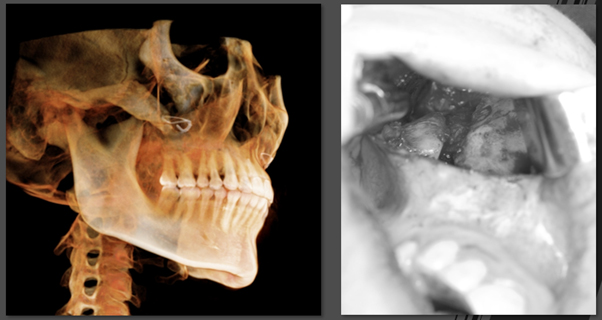
For perfect fixation, zygoma reduction surgery must be performed through a scalp incision. However, this leaves a lot of scarring, so the procedure is usually done through an intraoral incision. Because the back part of the cheekbone cannot be fixed through an intraoral incision, separation at the posterior part can sometimes occur.
What you need to understand accurately here is that even if the bone appears separated on 3D-CT, it does not necessarily mean there is a problem.
Fibrous tissue forms between the bones and firmly stabilizes them, so unless they are greatly separated, there is no issue at all.
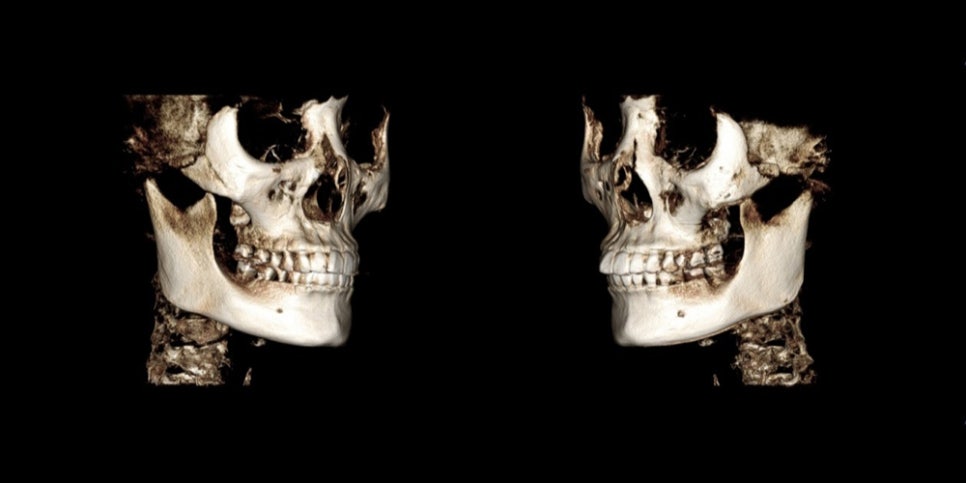
Because 230-degree three-dimensional zygoma reduction surgery is performed without fixation, there may be some distance between the bones. However, since the surgery does not involve osteotomizing the entire 45-degree zygoma, and the lower part of the front cheekbone is connected by the periosteum, it becomes almost completely healed about one month after surgery.
If I show you actual CT images,
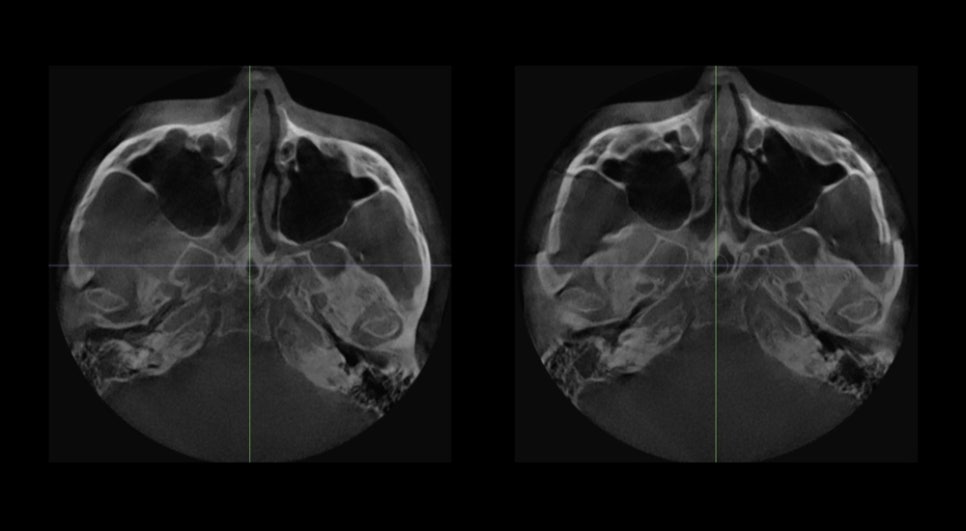
(Left) Before surgery (Right) 6 weeks after surgery
In the photo above, you can see that the rounded lateral cheekbone was completely osteotomized and moved inward, and the 45-degree zygoma was thinned through the shaving process.
Many people wonder whether the completely osteotomized lateral cheekbone heals well.
After about 6 weeks following surgery, the bone begins to harden gradually and no longer moves.
During the 6 weeks while the bone is hardening, it is best to avoid opening the mouth wide or eating hard and chewy foods.
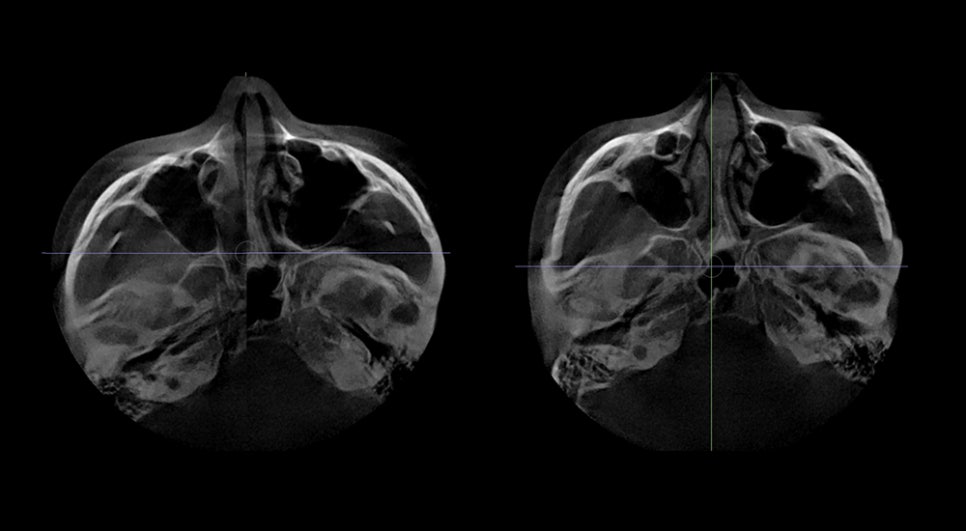
(Left) Before surgery (Right) 3 months after surgery
About 3 months after surgery, even without using fixation pins, fluid-like tissue comes out from the bone and makes it look as though the bones are connected.
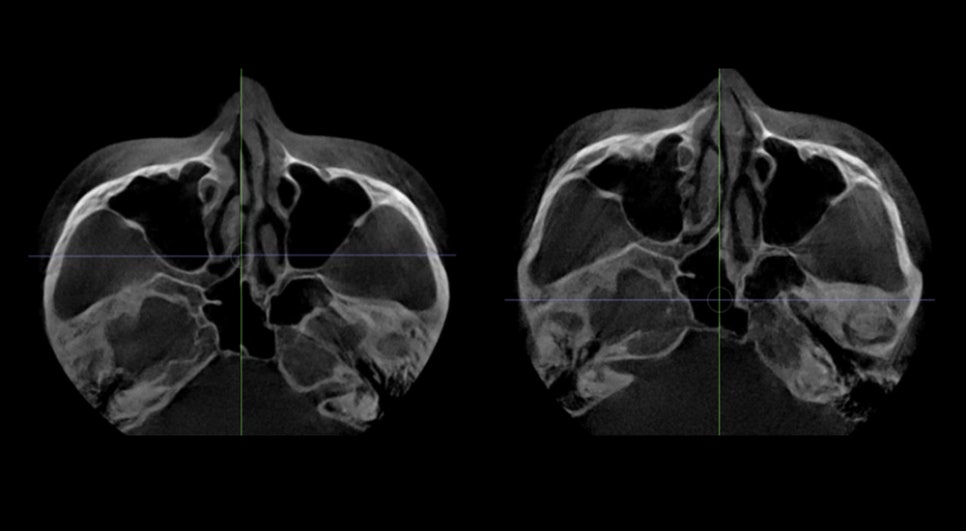
(Left) Before surgery (Right) 6 months after surgery
You can see that the bones are completely united 6 months after surgery.
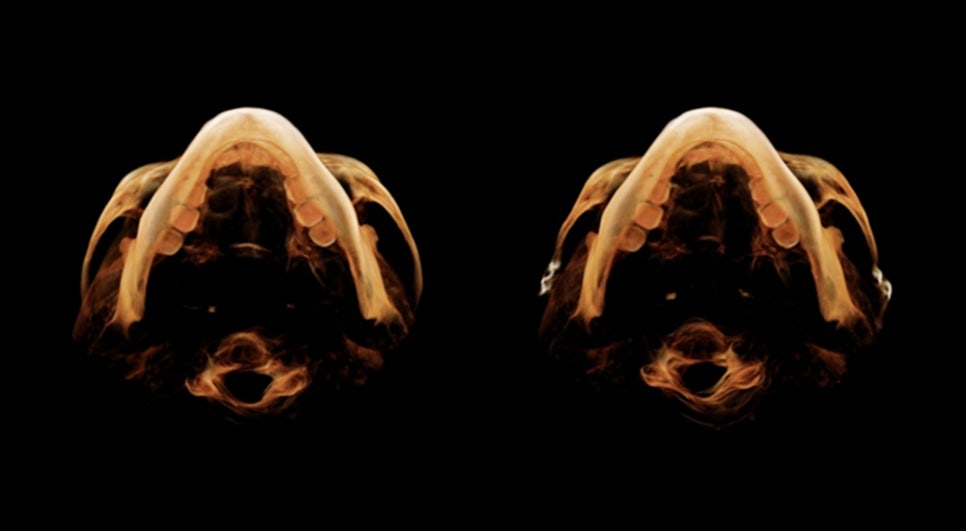
(Left) Before surgery (Right) After surgery
People who are worried about whether the cheekbones will heal properly sometimes use fixation pins.
We are also often asked whether general anesthesia is absolutely necessary for zygoma reduction surgery.
In the case of zygoma reduction surgery through an intraoral incision, blood enters the mouth, so it may be difficult to breathe smoothly under sedation anesthesia.
Therefore, it is a surgery that essentially requires general anesthesia.
However, in the case of 230-degree three-dimensional zygoma reduction surgery, since a scalp incision is made, there is no problem at all in maintaining breathing, and the time needed to osteotomize the bone is less than one minute, so the procedure can be performed without difficulty.
Therefore, you do not need to worry about sedation anesthesia.
230-degree three-dimensional zygoma reduction surgery can be a suitable procedure with good results for people whose 45-degree zygoma is not very developed but whose lateral cheekbones are especially prominent, or for those who do not want an intraoral incision or general anesthesia, or who want a quick recovery.
Thank you.