Hello. I’m Director Jo Hyun-woo of 입체성형외과.
These days, patients come in already knowing a lot of information, so most people are familiar with the concept of facial contouring surgery.
However, some people still ask, “Is contouring surgery the same as double-jaw surgery?” or “How are double-jaw surgery and contouring surgery different?”
So in this column, I’ll organize the basic concepts of how these two surgeries differ.
In general, facial contouring is a broad term for facial bone surgery and can be described as “facial bone surgery.”
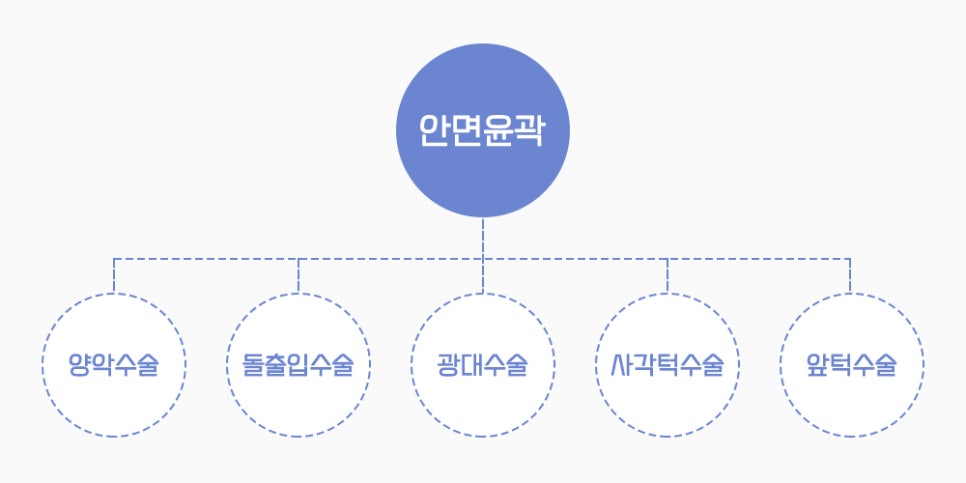
If you look at it in a table like this, the category of facial contouring includes double-jaw surgery, which many people already know, as well as all surgeries that deal with facial bones, such as cheekbone surgery, square jaw surgery, chin surgery, and protruding-mouth surgery. Therefore, double-jaw surgery and general cheekbone or square jaw surgery are completely different procedures.
Strictly speaking, double-jaw surgery is one type of orthognathic surgery.
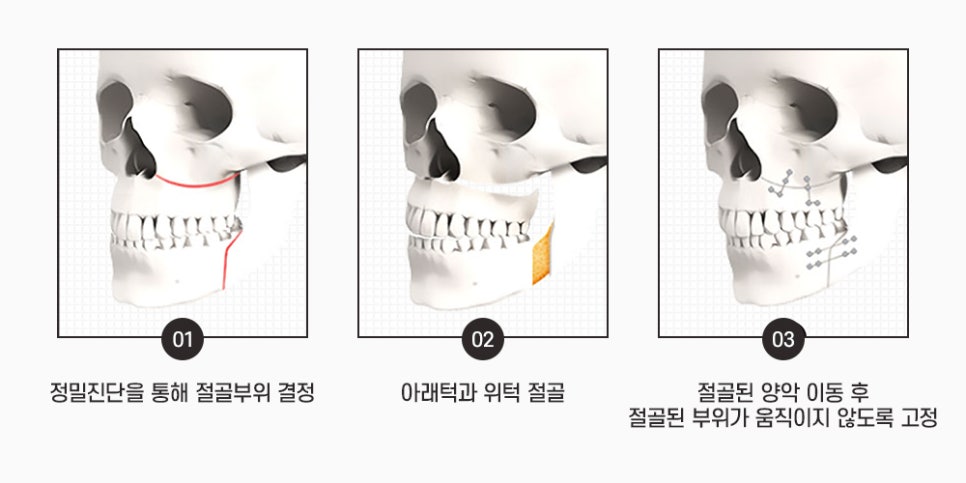
Orthognathic surgery moves the teeth and bones to align the bite and change the position of the bones.
Because the upper and lower jaw bones themselves are moved, the degree of change can be very large.
A surgery that moves both the upper and lower jaws at the same time is called double-jaw surgery, while a surgery that moves only the lower jaw is sometimes called mandibular orthognathic surgery.
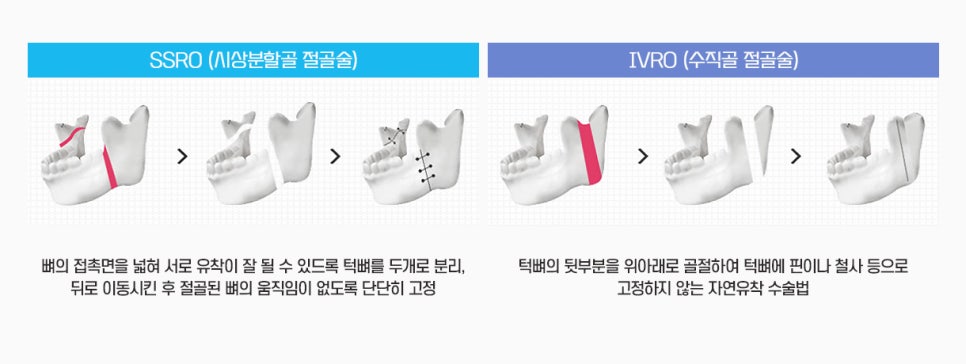
There are broadly two ways to fix the mandible.
These are sagittal split ramus osteotomy, called SSRO, and intraoral vertical ramus osteotomy, called IVRO, and it seems that the procedure is performed depending on the surgeon’s preference.
Orthognathic surgery is very effective in cases of severe malocclusion, such as class III malocclusion.
It can also be performed effectively in cases where the upper jaw bone is long or when there is significant left-right asymmetry.
Next, let’s look at protruding-mouth surgery.
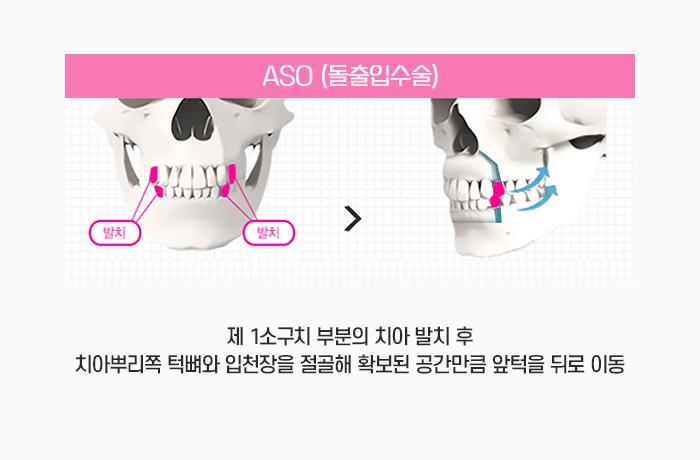
Simply put, protruding-mouth surgery can be considered a scaled-down version of double-jaw surgery.
To set back a protruding mouth, tooth extraction is necessary, and after extraction, the upper and lower jaw bones are moved backward by the amount of space created and fixed in place.
For this type of protruding-mouth surgery, wearing braces is essential.
It was a procedure performed very often from the 2000s onward because it is more approachable than double-jaw surgery, but it seems to be performed somewhat less often now.
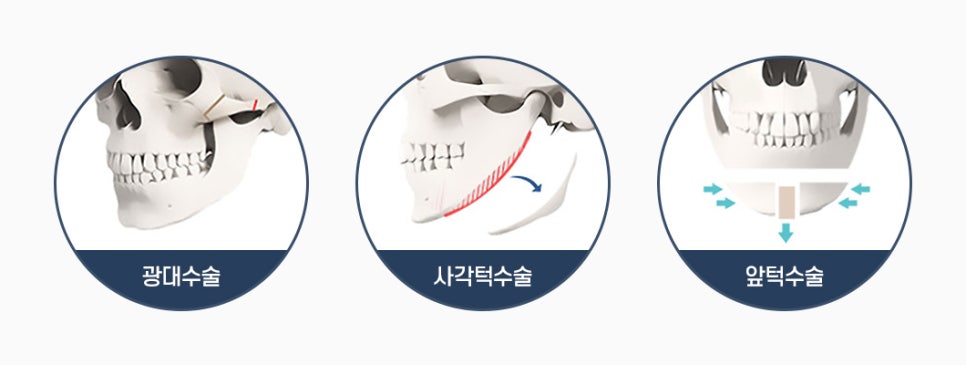
Next is the so-called three major contouring surgeries.
These are cheekbone reduction surgery to reduce the size of the cheekbones, square jaw surgery to trim the angular lower jaw bone, and chin surgery to adjust the shape of the chin bone.
You can think of these as the three major procedures.
I have explained contouring surgery many times through columns and YouTube, so I will leave that out in this column.
Today, I briefly organized the basic concepts of facial contouring surgery and double-jaw surgery.
Of course, for many people this may be familiar information, but I hope it can be helpful for those who find it a bit confusing.
Thank you.