Hello, this is Dr. Jo Hyun-woo of 입체성형외과.
Today, I’d like to explain the sutures used in plastic surgery.
Patients who have had surgery often ask whether the sutures dissolve or need to be removed.
This time, I’ll organize everything at once and explain it clearly.
Sutures come in many different types.
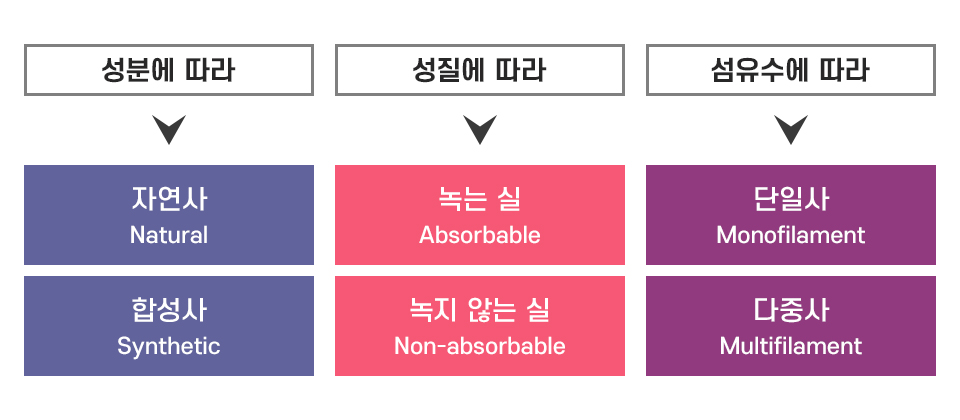
If we classify sutures by composition, they can be divided into natural sutures made from natural substances and synthetic sutures made from chemically synthesized materials.
By their properties, there are sutures that dissolve over time and sutures that do not dissolve.
They can also be divided by the number of fibers they contain into monofilament sutures and multifilament sutures made by twisting several strands together.
First, natural sutures are made using materials that exist in nature, while sutures made more recently are generally considered synthetic sutures.
Examples include chromic, made using sheep intestines, and silk, made from the protein fiber of silkworm cocoons.
These sutures are soft and easy to handle and have been used for a very long time, but because of the possibility of tissue reaction, inflammation, and infection, they are gradually being replaced by synthetic sutures.
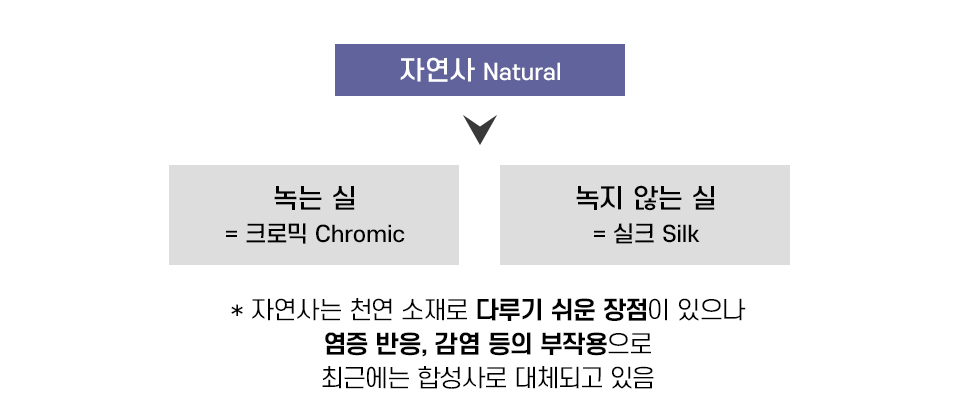
Among natural sutures, there are both dissolvable and non-dissolvable types.
Chromic is a dissolvable suture, while silk is a non-dissolvable suture.
In cosmetic surgery these days, synthetic sutures are used in almost all cases, and because their composition and properties vary, it is important to choose the right product for each situation.
Compared with natural sutures, synthetic sutures are more elastic and smoother, so skill is needed to handle them well, but it is true that they have fewer inflammatory reactions, which are a drawback of natural sutures.
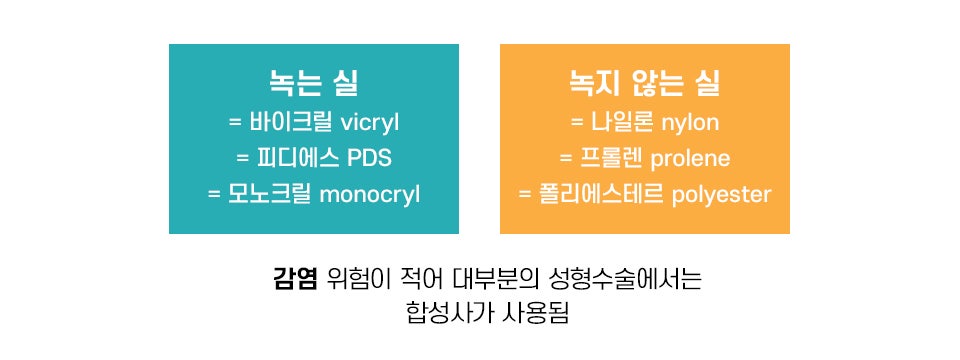
So, in which areas would dissolvable sutures be used, and in which areas would non-dissolvable sutures be used?
In the field of plastic surgery, non-absorbable sutures are used in almost all cases.
This is because absorbable sutures can take as little as 20 days or as long as 6 months to be absorbed, so they cannot remain visible on the skin for that long.
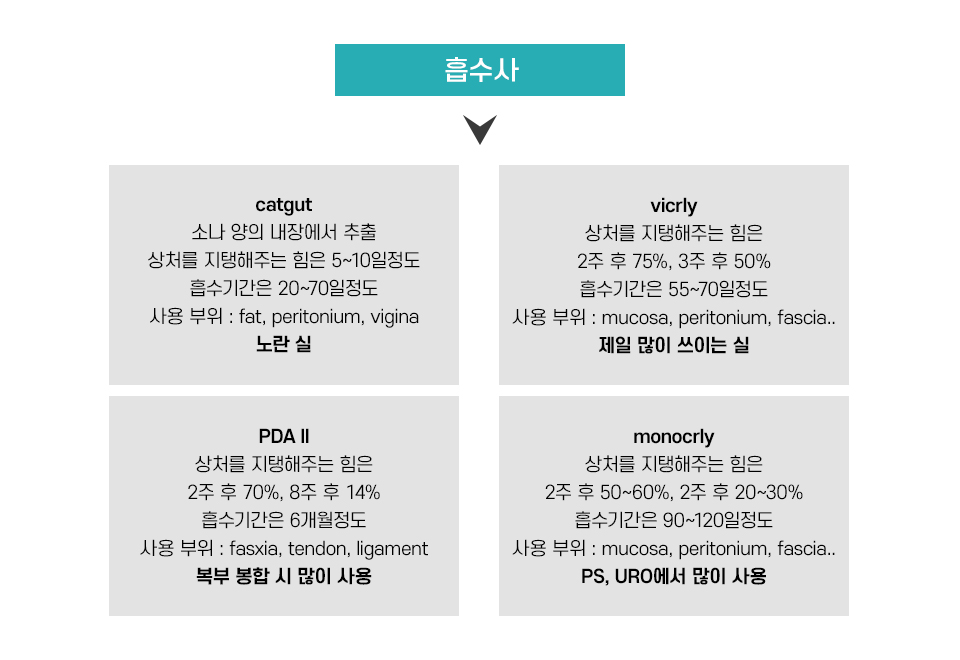
If you look at the table above, you can see how slowly dissolvable sutures dissolve.
Patients often think that dissolvable sutures are better, but you can see that this is not necessarily the case.
For non-absorbable sutures used on the skin, typical examples are silk, a natural suture, and nylon, a synthetic suture.
In most cases, these two types of sutures are used, and a suture called proline is sometimes used as well.
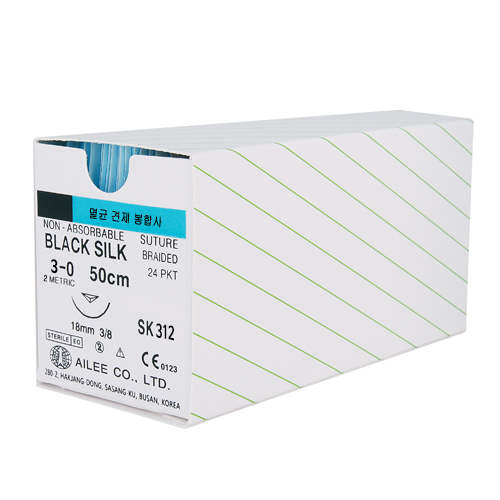
Silk
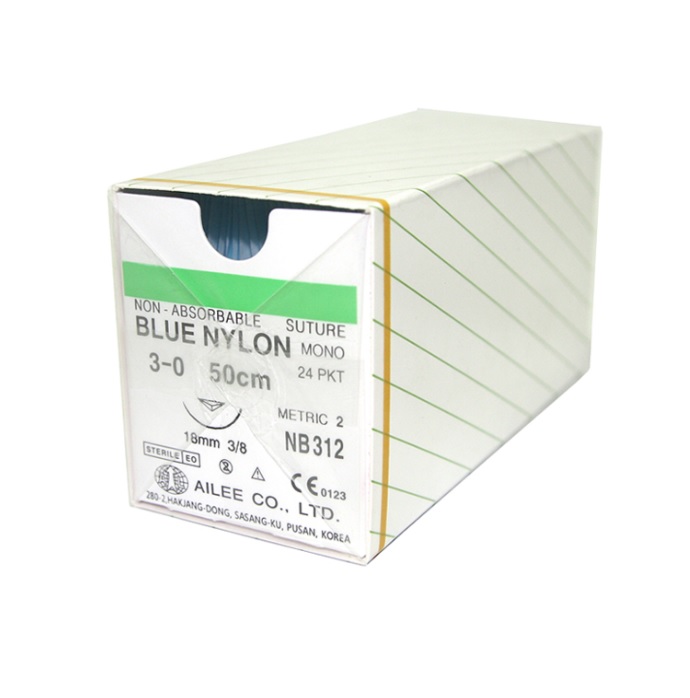
Nylon
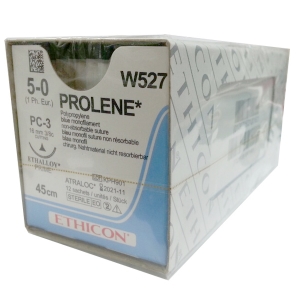
Proline
Absorbable sutures are mainly used to bring together tissues beneath the skin,
and in the field of plastic surgery, dissolvable sutures are also used in mucosal areas.
For contour surgery, dissolvable sutures are used in the mucosal area of the oral incision.
Because the mucosa has many fragile areas, absorbable sutures are used, and Vicryl is mainly used.
In cases where the sutures cannot be removed, natural chromic, which dissolves quickly, is sometimes used.
Also, during nose surgery, dissolvable sutures are often used in the mucosal area inside the nose.
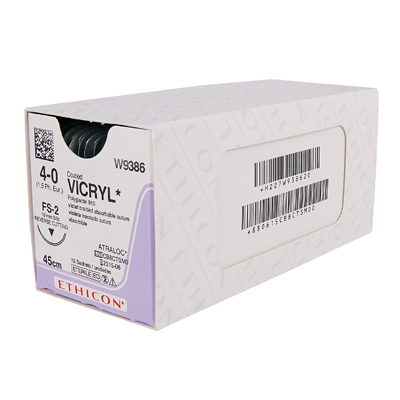
Vicryl
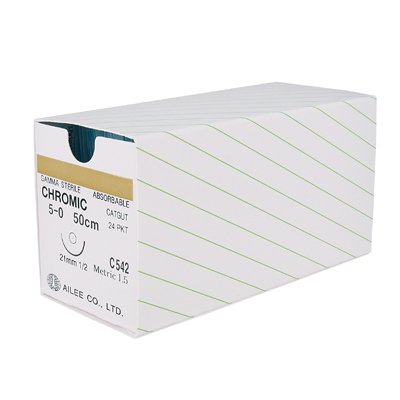
Chromic
In conclusion, for plastic surgery, visible areas almost always use non-dissolvable sutures,
while hidden areas such as inside the mouth or inside the nose use dissolvable sutures.
Even absorbable sutures take a long time to dissolve, as shown in the table above, so if you want to avoid scarring, it is best to remove them all.
So far, I’ve gone over the types of sutures in detail.
If you remember only what I explained at the end, you will be able to understand well which sutures are used when you have surgery with me.
Thank you.