Hello. I’m Director Jo Hyun-woo of Ipcheok Plastic Surgery.
Today, I’d like to talk about side effects after chin surgery.
The side effects that can occur after chin surgery include nerve-related complications, a double chin, chin dimpling, and, although uncommon, altered tooth sensation.
The most commonly known side effect after chin surgery is probably nerve-related complications.
This is also one of the areas that requires the most caution during surgery, and it is important to carefully check each step to prevent nerve damage.
In general, sensory nerves recover as you heal from contouring surgery, starting around 6 months and up to as long as 1 year.
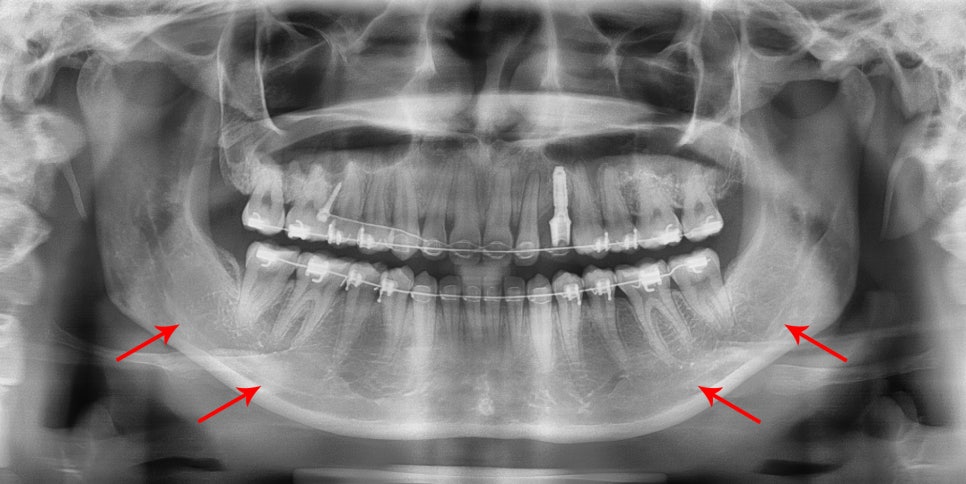
Inferior alveolar nerve (the nerve distributed to the lower jawbone and teeth)
The nerve that must be watched most carefully during lower jaw surgery is the inferior alveolar nerve.
It is one of the branches of the facial nerve that is responsible for sensation in the lower jaw area.
It is responsible for sensation in the lower jaw’s teeth, gums, tongue, and lips.
The inferior alveolar nerve is a nerve that must be thoroughly protected during surgery, but due to surgical stimulation, most sensation generally recovers within 3 to 6 months. However, if too much bone is cut or excessive cortical shaving causes nerve exposure, this can last for more than 1 year. If the inferior alveolar nerve is severed, sensory changes and pain may remain for life.
To address this, nerve repair surgery for a severed inferior alveolar nerve may be considered, but it does not guarantee a 100% result.
Therefore, surgery should be performed in a way that preserves the nerve well through a safe surgical method.
Right after surgery, if patients feel that the chin sensation is dull but the chin is itchy or tingling, that is a sign that the nerve is recovering.
It is a good sign, so there is no need to worry.
Also, even after several years, many people complain that the chin feels swollen and hard, or that it feels tight.
The fixation pins used in contouring surgery can be the cause.
Even if the pins are harmless to the body, they are still foreign materials, so the body may react sensitively, and a defense mechanism against foreign materials can sometimes lead to persistent scar tissue.
The nature of scar tissue is to pull on surrounding tissue, leaving a constant feeling of tightness and constriction.
If you have these symptoms, removing the pins may dramatically improve them for some people, so it may be worth considering.
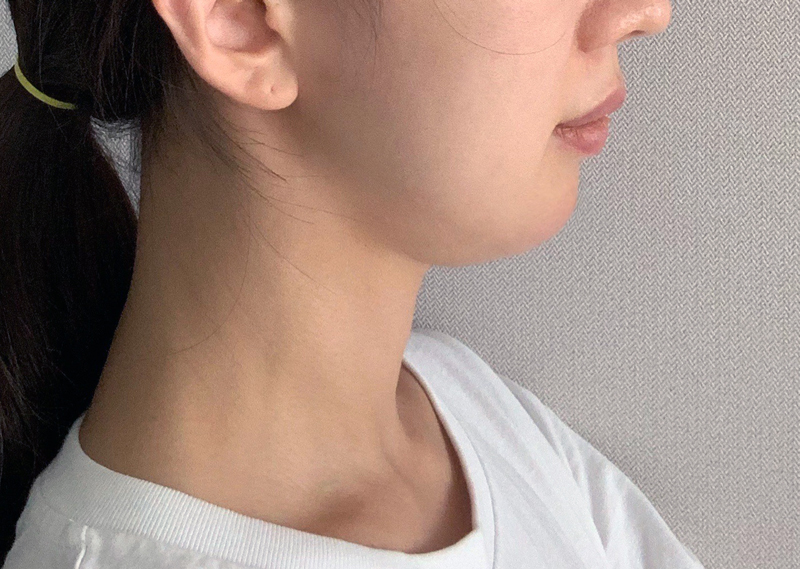
Another side effect after chin surgery is a double chin.
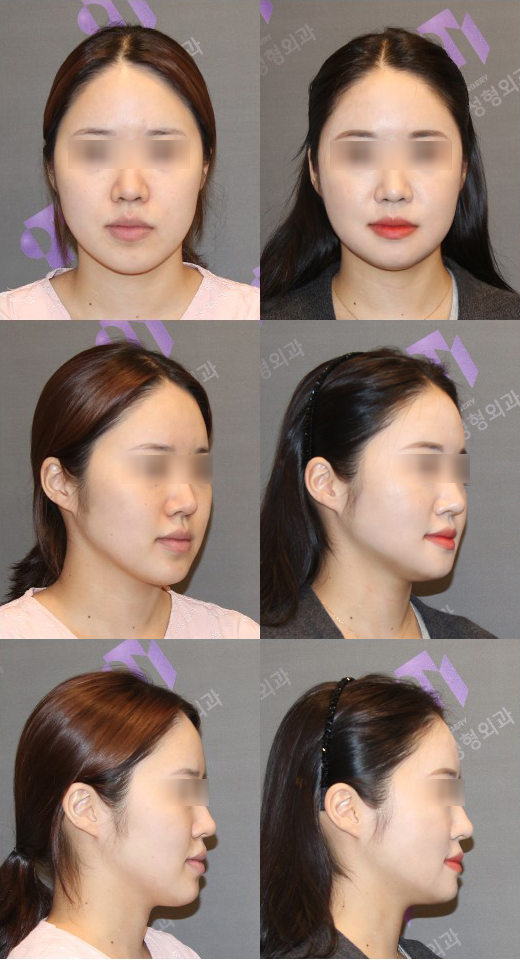
Before and after chin surgery (chin length reduction)
Although this can happen when there is extensive soft tissue dissection during surgery or when the patient has low skin elasticity, it can also appear when too much bone is reduced, causing the muscles and soft tissue under the skin that cover it to sag downward.
This can be corrected simply by pulling and suturing the periosteum during surgery, or by liposuction if there is a lot of fat, or by a lifting procedure if there is excess skin, so there is no need to worry too much.
Recently, dramatic improvement has also been possible through surgery that ties the double-chin muscles together.
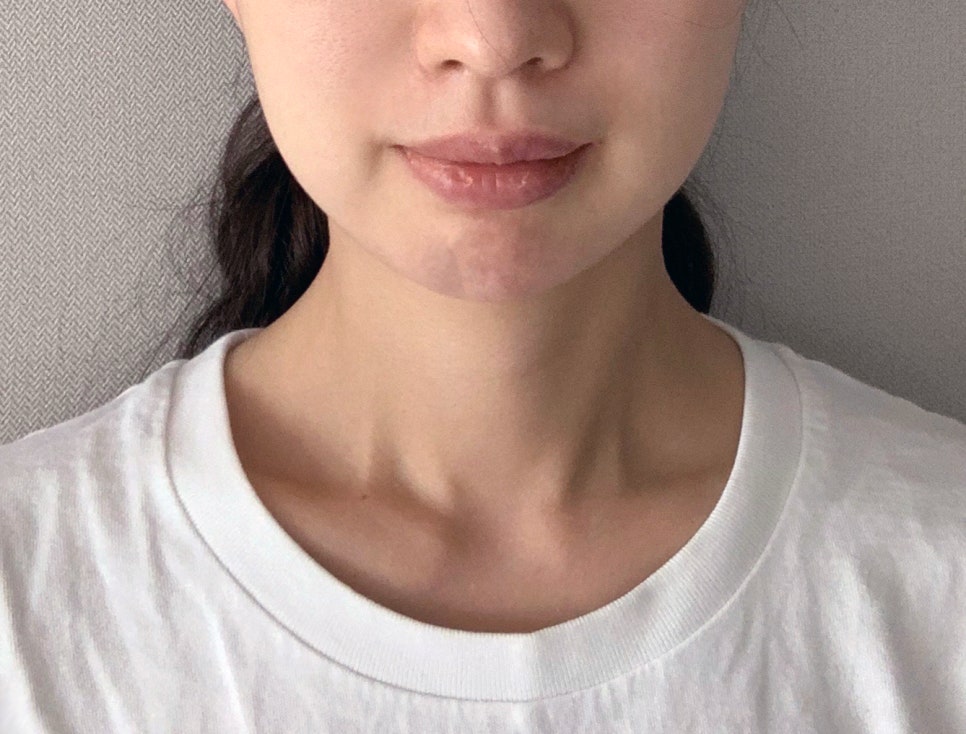
Another possible side effect to consider is chin dimpling.
This is mainly seen as a side effect that can occur after T-osteotomy surgery.
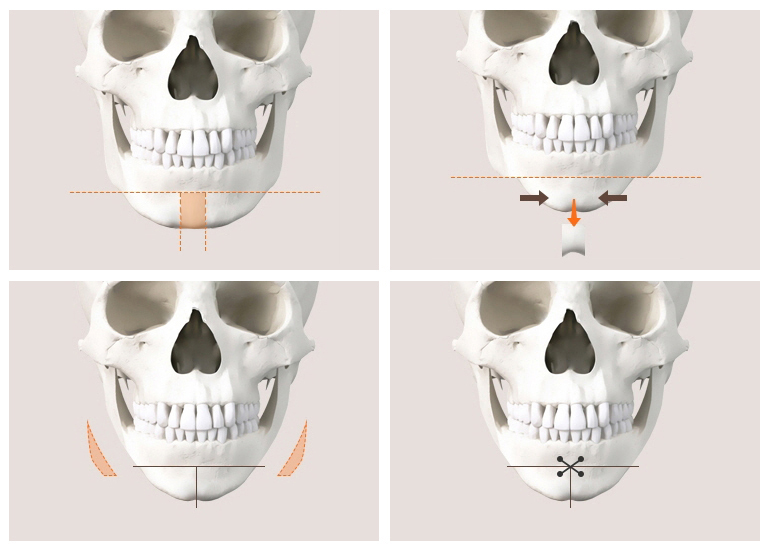
T-osteotomy surgical process
As shown in the illustration, T-osteotomy surgery cuts the middle bone and brings the two outer bones toward the center.
While the muscles of the cut middle bone remain in place, the muscles on both sides are drawn together, so people with a lot of muscle may feel that the dimpling has become more noticeable.
It seems there is no fundamental way to solve this. If the muscle is cut away, another side effect may occur.
However, a simple Botox treatment can greatly improve this wrinkle.
Botox does not produce a permanent effect, but there are reports that if it is done periodically 3 to 4 times, habitual movement decreases and muscle volume also decreases, so it seems like the best way to address it.
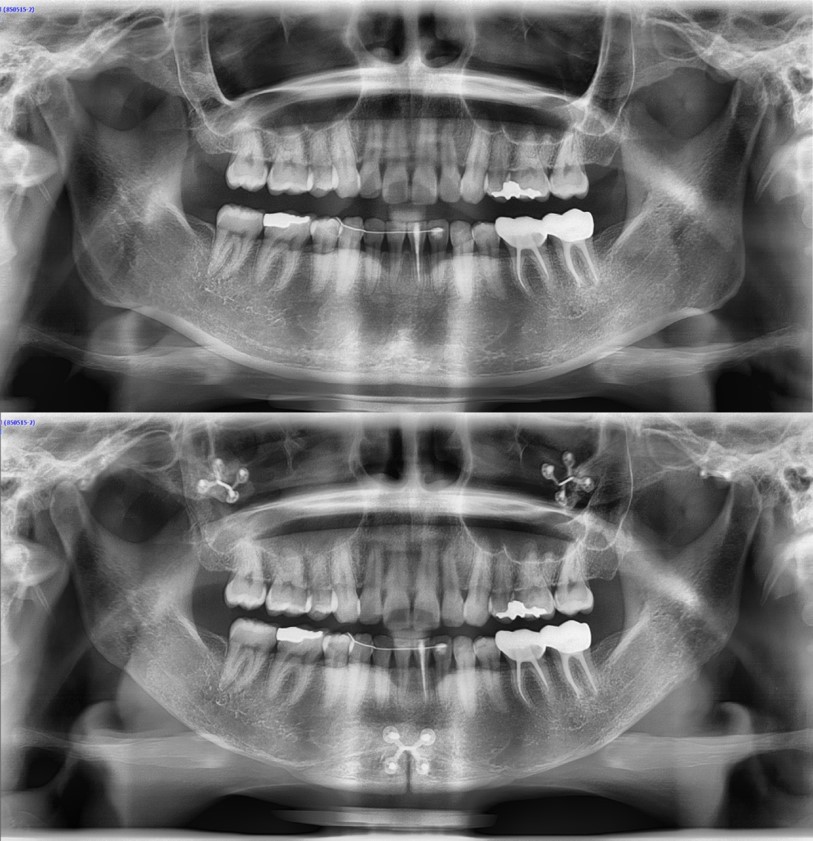
Before and after T-osteotomy surgery
The last side effect I’ll mention is tooth-related side effects.
As in the X-ray, when T-osteotomy is performed, fixation pins are used.
However, if the osteotomy is made too high, the screws can reach the tooth roots.
In this case, the teeth may hurt and tooth pain may be reported, so an X-ray should definitely be taken to check whether the fixation pins are pressing on the tooth roots.
Sometimes, even when the fixation pins are in the correct position, some people complain of altered sensation in the lower teeth.
This seems to be because part of the sensory nerves was lost when the oral mucosa was incised.
These symptoms improve as recovery progresses, so there is no need to worry too much.
So far, I have talked about the side effects that can occur after chin surgery.
There may be other side effects as well, but these are probably the ones patients are most curious about.
Even when surgery is performed accurately, temporary sensory changes and similar issues can still occur. Please do not worry too much about side effects, and it may be helpful to watch the recovery process while thinking that there are solutions for each issue.
Thank you.