Hello, I’m Dr. Jo Hyun-woo from Injeong Plastic Surgery.
One of the questions often asked by people inquiring about 230-degree zygomatic reduction is: “If shaving (grinding down) is done, does the dissection range become wider and does muscle damage cause the facial tissues to sag more?” Quite a few people ask this question.
Today, I’ll tell you the truth about this question.
At Injeong Plastic Surgery, we perform 3D zygomatic reduction through an intraoral incision and 230-degree zygomatic reduction through a scalp incision.
We perform these surgeries in roughly equal proportions.
I believe doctors should build experience through many patients’ surgical cases.
If shaving the 45-degree cheekbone causes sagging, could we keep doing this kind of surgery?
Is shaving and non-fixation surgery for the 45-degree cheekbone easy?
As many plastic surgeons would agree, the first contouring surgery most people encounter is 3D zygomatic reduction.
Because 3D zygomatic reduction is a surgery in which the bone is directly seen and cut, once enough experience has been gained, accurate dissection is possible, and it is a procedure that can produce very good results depending on the amount of bone cut and the angle of fixation.
230-degree zygomatic reduction truly requires a great deal of experience.
When performing the surgery for the first time, know-how is developed through numerous cases: how far to dissect with an endoscope without damaging the muscles, which areas to perform osteotomy on, and how much force is needed for partial osteotomy.
That is why I tell patients that 3D zygomatic reduction is much easier.
Since this conclusion was reached by studying shortcomings in contour surgery and improving them over time, I believe you can trust and follow it.
This type of 230-degree zygomatic reduction can be a suitable and effective surgery for people whose 45-degree cheekbones are not very prominent but whose side cheekbones are especially developed, or for those who find an intraoral incision or general anesthesia burdensome, or who want a quick recovery.
Of course, if someone approaches this surgery from the beginning, errors can naturally occur, but I think that comes down to differences in experience.
If you shave the 45-degree cheekbone, does the dissection range become wider and does muscle damage occur?
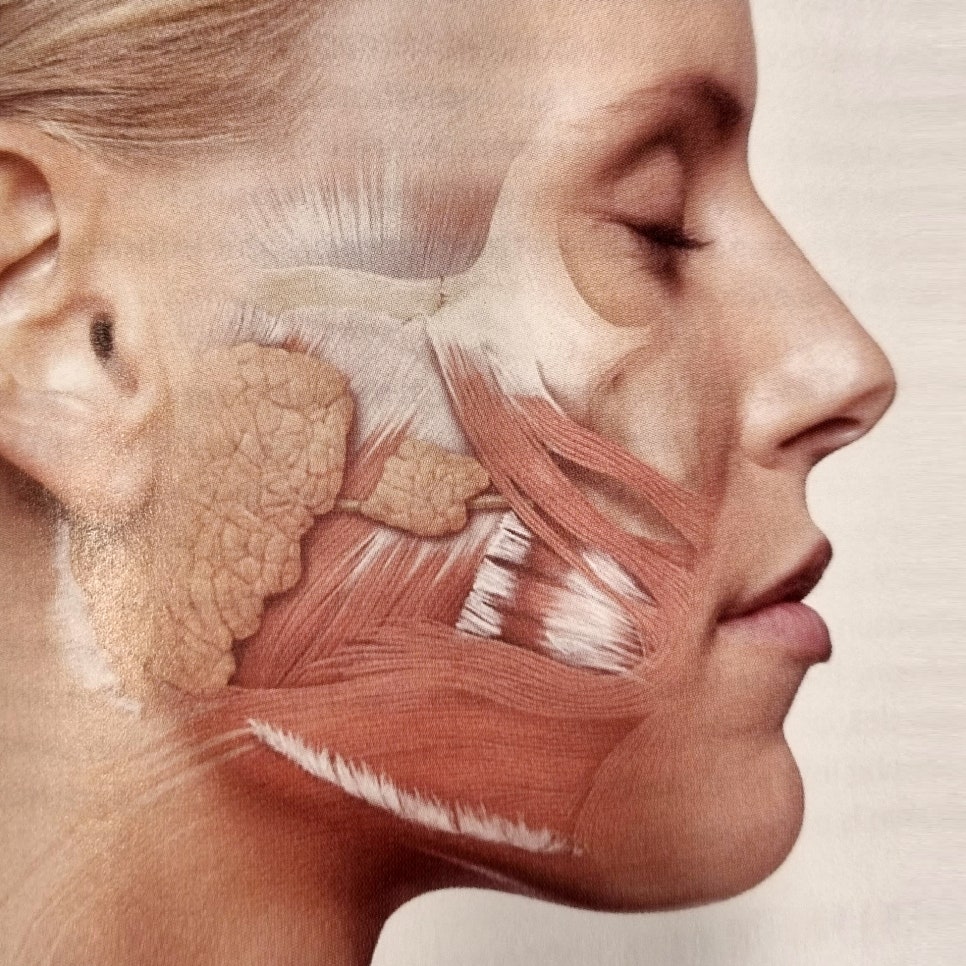
Cheekbone surgery involves dissection.
There may be individual variations, but in most cases the muscles are attached behind the cheekbone.
Therefore, even in 3D zygomatic reduction, we do not dissect too far backward, which makes it possible to carry out dissection without muscle damage and prevent cheek sagging.
Then what about shaving?
A surgeon with a lot of experience will shave on the side without muscles, without causing muscle damage.
This can certainly be a difference in experience, but if experience is lacking, dissection may be done more than necessary and muscle damage may be significant.
Then are all cheekbone surgeries that involve shaving okay?
Carefully, I think this method carries some risk.
As you can see in the illustration above, there is an area where the muscle is attached, but some clinics shave not only the 45-degree cheekbone but the entire cheekbone as well.
The side cheekbone area is only about 5 mm of bone, so it is thin; shaving that area weakens the bone.
Also, because all of that muscle is removed, I think the chance of sagging can increase.
Let me show you a few cases that received 230-degree zygomatic reduction at Injeong Plastic Surgery.
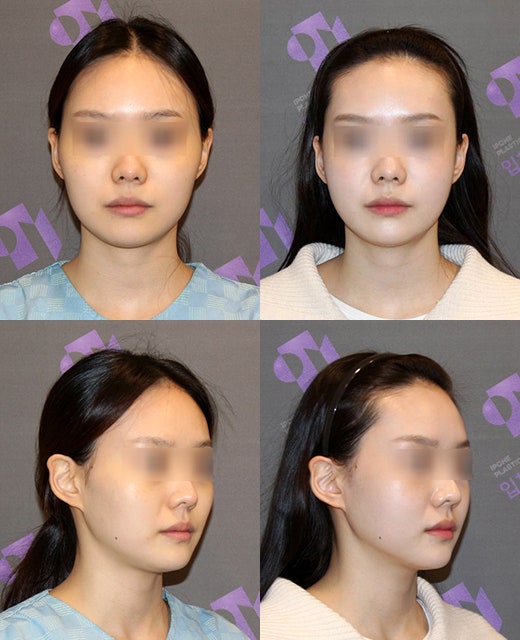
Before surgery / 2 months after surgery
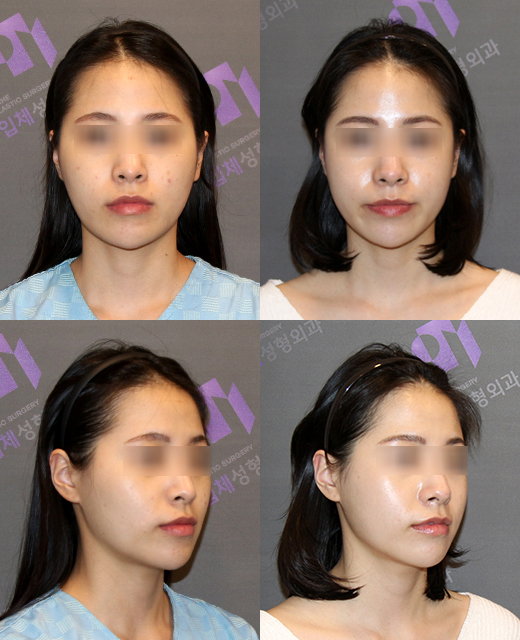
Before surgery / 6 months after surgery
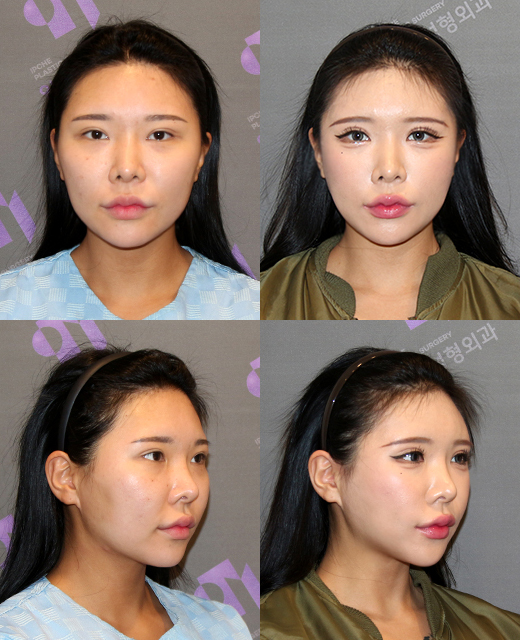
Before surgery / 1 year after surgery
Do you notice cheek sagging?
I can say with confidence that the sagging after 230-degree cheekbone surgery is clearly less than the sagging after 3D cheekbone surgery.
Rather than saying that the surgical method I use is the best method, I believe that if it is the method suitable for the individual, many patients can be satisfied and achieve good surgical results.
We live in an age flooded with so much information that finding the truth is really difficult, but if you think carefully, I believe you can make the right choice.
If you are currently considering cheekbone reduction surgery, you should first understand what type of cheekbones you have so that you do not undergo unnecessary surgery.
This is because the degree of reduction achieved and the surgical method differ depending on each person’s cheekbone development.
Therefore, it is important to perform surgery safely with the method appropriate for you, and for a more satisfying surgical result, accurate diagnosis and sufficient consultation are essential.
I believe doctors should not neglect researching surgery and producing good results with good methods.
You cannot get good results with a bad method, can you?
Today, I talked about cheekbone shaving and sagging, and I will come back with another useful topic next time.
Thank you.