Hello, I’m Director Jo Hyun-woo of Iple Plastic Surgery.
Today, I’d like to talk about square jaw surgery.
Square jaw surgery is broadly divided into square jaw surgery using an intraoral incision and square jaw surgery using a behind-the-ear incision.
Rather than one method being better than the other, there are differences in the surgical method and results, so it is best to choose the surgery method that suits you case by case and proceed accordingly.
In my case, I prefer the intraoral incision method over behind-the-ear square jaw surgery.
In the case of patients who come to us for revision square jaw surgery, many of them often did not see the front-view effect after their previous surgery.
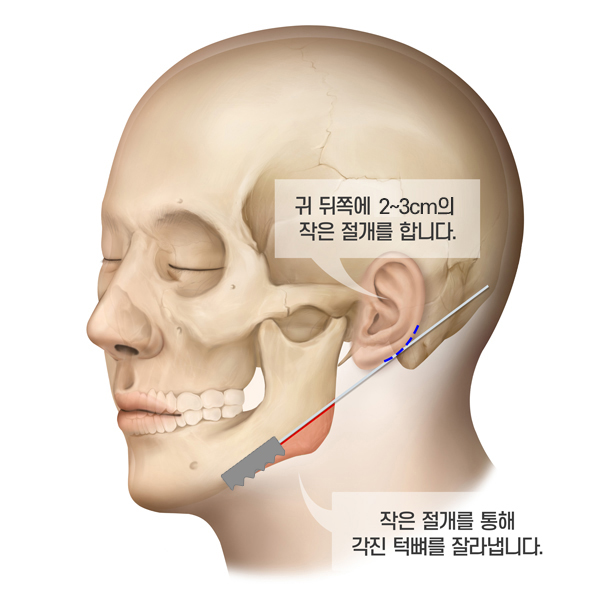
Behind-the-Ear Square Jaw Surgery Method
Behind-the-ear square jaw surgery is performed by making a skin incision of about 3 cm behind the ear and approaching the square jaw area through that incision.
Because the incision site is exposed externally, a subtle scar may remain, and compared with square jaw surgery using an intraoral incision, the surgical effect is somewhat smaller.
The downside of behind-the-ear square jaw surgery, in my opinion, is that cortical osteotomy is extremely difficult, and because the bone is cut with a straight saw, it is very difficult to cut the bone in a long curved line.
Also, because masseter muscle resection is difficult, there will naturally be side-view improvement, but the front-view effect is very limited.
Of course, for an experienced specialist who is skilled in behind-the-ear square jaw surgery, there may be surgical methods that can overcome these shortcomings, but it can be considered very challenging.
As an example, I will show you a CT image.
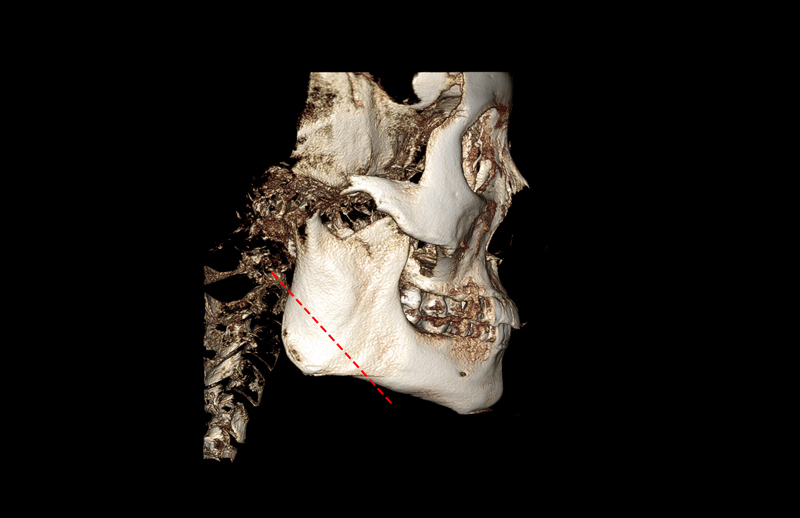
Example of Behind-the-Ear Square Jaw Surgery
This is a CT image of a patient with severe square jaw prominence on the side.
If a person has the square jaw bone shown in the image above and undergoes
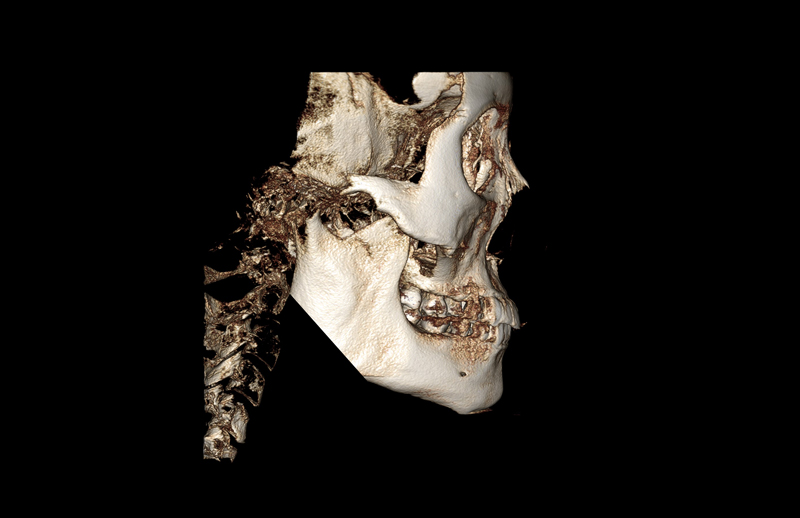
Example of Behind-the-Ear Square Jaw Surgery
behind-the-ear square jaw surgery like this, the bone cannot be cut as long as in long-curve resection, so it can be effective for patients whose square jaw is especially severe, but there is a high risk of a secondary angle forming, and the front-view effect is reduced.
However, because there is no intraoral incision, eating after surgery is easier, swelling in the jaw is generally less, and recovery is faster. It is also performed under sedation anesthesia. In addition, the surgery time is relatively short at about 30 minutes.
If I show you an actual case,
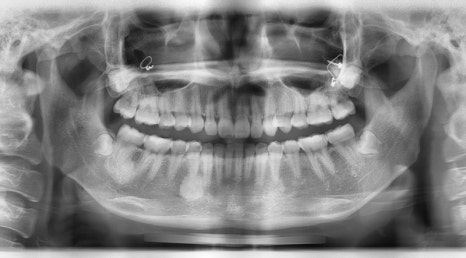
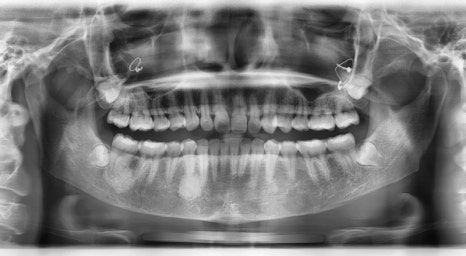
Revision Behind-the-Ear Square Jaw Surgery
This patient had undergone behind-the-ear square jaw surgery 5 years ago, but came to us because their face still looked large and flat.
If you look at the photos before revision surgery, the lower face is wide on both sides, and there is volume in the lower jaw.
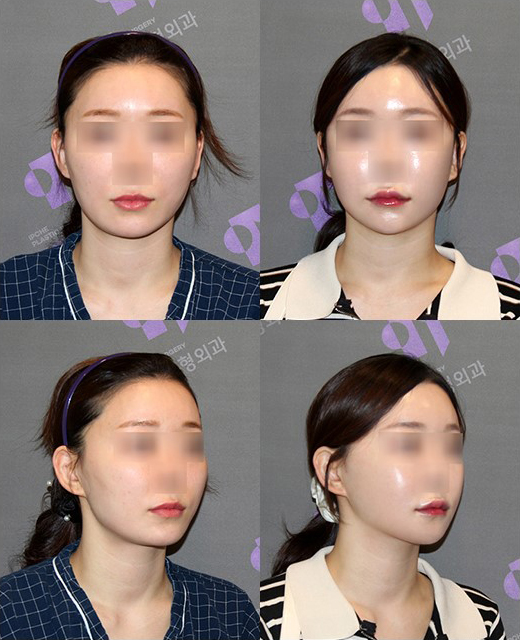
(Intraoral Incision) Long-Curve Square Jaw Surgery Patient
Long-curve square jaw surgery removes the areas that were problematic above as well, so when viewed from the front, the face width is reduced and a slimmer line can be created.
Because it cuts from below the ear all the way to the chin in one continuous line, it can also address lower jaw asymmetry with a natural line.
Of course, the method of behind-the-ear square jaw surgery itself is not the problem.
For a satisfying result, sufficient consultation with an experienced board-certified plastic surgeon is necessary, and the surgery must be performed in a way that is appropriate for the individual. Only then can revision surgery be prevented and a satisfying result achieved.
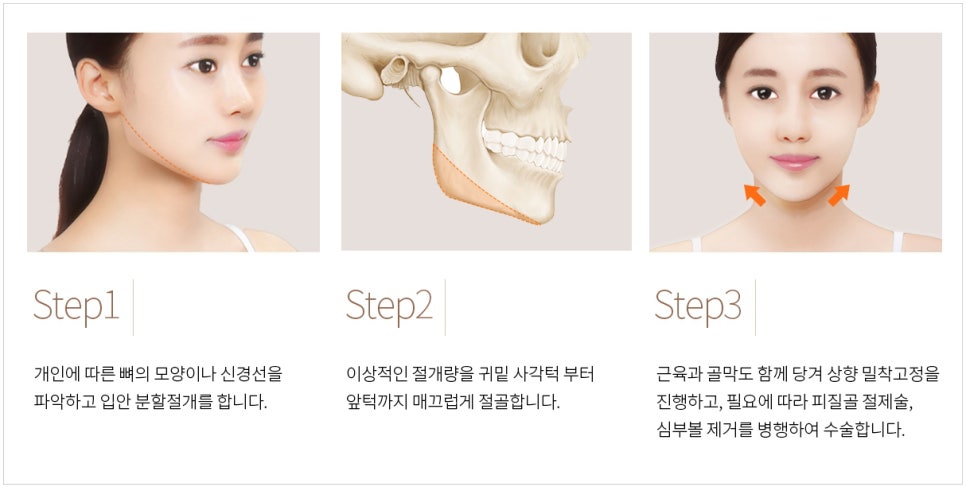
Next, one of the surgeries many people undergo is square jaw surgery with an intraoral incision.
Intraoral incision square jaw surgery is performed at many plastic surgery clinics because it is safe and produces strong front-view and side-view effects after surgery.
The surgery is performed by making an incision of about 3 cm in the mucosa between the lower gums and the lips through the inside of the mouth.
After moving aside the masseter muscle covering the outside of the jawbone and dissecting the periosteum, the jawbone is easily exposed, allowing the surgery to be performed while avoiding major nerves and blood vessels.
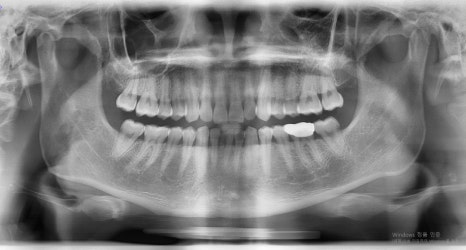
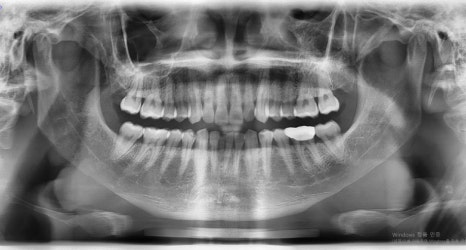
(Intraoral Incision) Long-Curve Square Jaw Surgery
In the case of intraoral incision square jaw surgery, the field of view is wide and the surgery is performed while directly viewing the jawbone. Because the square jaw is resected in a long curved line, it is safe and less likely to cause a secondary angle.
Bone resection varies depending on the individual, but compared to behind-the-ear square jaw surgery, a more satisfying result can be expected.
Intraoral incision square jaw surgery is performed under general anesthesia, and the surgery time is about 1 hour.
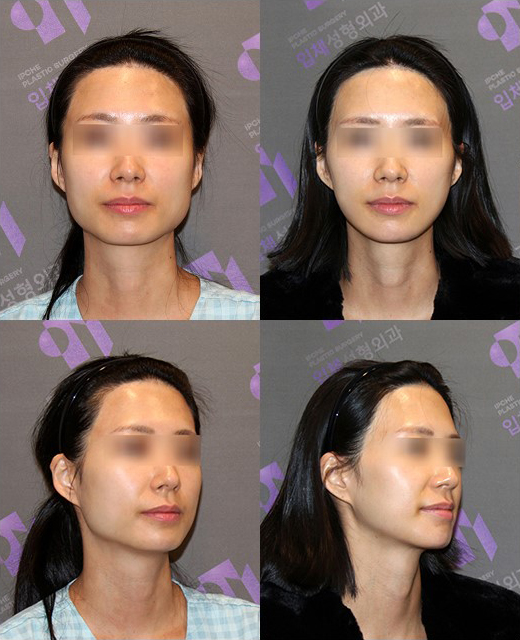
(Intraoral Incision) Long-Curve Square Jaw Surgery Patient
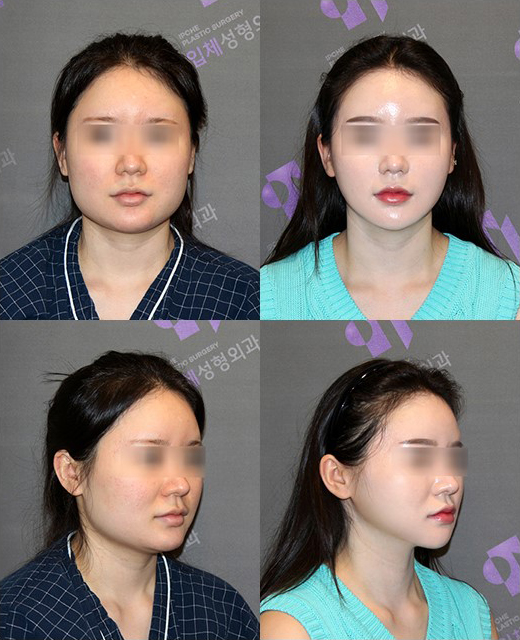
(Intraoral Incision) Long-Curve Square Jaw Surgery Patient
Everyone wants to see a front-view effect after square jaw surgery.
If square jaw surgery is combined with delicate cortical osteotomy through an intraoral incision, a sufficient front-view effect can be achieved.
Of course, it is difficult to say that cortical osteotomy is necessary for everyone, but in my experience, in many cases, addressing this area leads to a slimmer result.
It is best to receive the most appropriate surgery for you through a careful consultation with the operating surgeon.
Thank you.