Hello.
I am Dr. Heo Jae-won, a board-certified plastic surgeon at 3D Plastic Surgery, where I perform facial rejuvenation surgery.
Following the previous post, today I will continue with the story of second-generation lower blepharoplasty.
If you read the previous post first, it may help you understand this one better.
The first generation, which simply removed under-eye fat, eventually ran into a wall: under-eye hollowness, a sunken appearance, and a look that clearly seemed operated on.
So a new direction was needed: not removing the fat, but moving it to where it was needed and using it there.
That is how second-generation lower blepharoplasty emerged.
And further along, third-generation lower blepharoplasty developed, preserving even the muscle and restoring the structure.
From here on, let’s take a step-by-step look at how this shift in thinking was implemented as surgical technique, and how it continued to evolve over time to solve additional problems.
Second-generation lower blepharoplasty: The beginning of surgery that does not remove fat, but preserves it
If under-eye fat is bulging while the tear trough is hollow, simply reducing the fat is not enough.
Second-generation lower blepharoplasty emerged to address this complex problem.
The first-generation surgery focused on removing protruding fat.
But after removing the fat, the hollow area underneath sometimes became more noticeable.
In fact, if too much was removed, it could leave a more tired-looking impression.
To overcome these limitations, in 1981 Robert Loeb proposed the concept of fat repositioning.
Instead of removing the fat, it was pulled downward to fill the hollow area (the tear trough).
Later, in the 1990s, Hamra developed this technique further and introduced a procedure that releases the arcus marginalis and places the excess fat beneath the hollowed area. This approach opened a new era in lower blepharoplasty by improving under-eye hollowness as well.
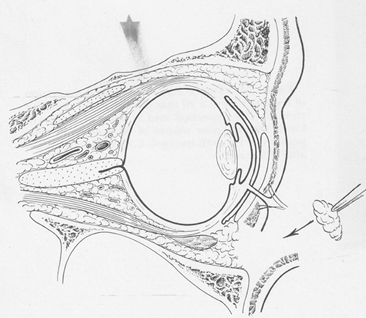
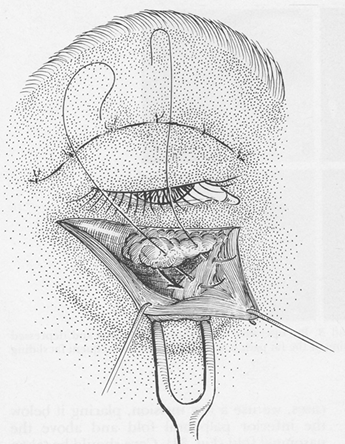
Conceptual diagram of first-generation fat removal vs. second-generation fat repositioning
(Source: Loeb, R. (1981). Fat Pad Sliding and Fat Grafting for Leveling Lid Depressions. Clinics in Plastic Surgery, 8(4), 757–776.)
Second-generation lower blepharoplasty: Two approaches
Second-generation lower blepharoplasty is based on the philosophy that fat is not something to remove, but an asset to preserve and use.
- Transcutaneous approach: After making an incision just below the eyelashes, the skin and muscle are lifted and the fat is moved.
The arcus marginalis is incised and the fat is repositioned into the tear trough; if needed, canthopexy is performed at the same time.
- Transconjunctival approach: Without making a skin incision, the fat is repositioned through the conjunctiva on the inside of the eye.
In the 2000s, Goldberg demonstrated that arcus marginalis release was also possible with this method.
Because it leaves no visible scar, it is preferred for younger patients.
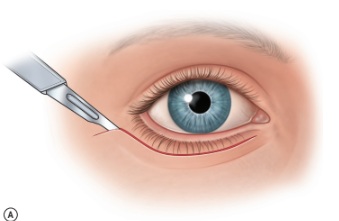
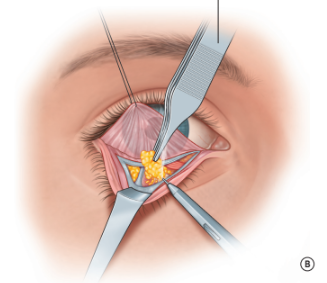
Schematic comparison of the transcutaneous and transconjunctival surgical approaches
(Source: Nelligan 4th ed. Vol 2 ch 9 blepharoplasty)
According to a 2004 study by Barton, among 71 patients who underwent arcus marginalis release and fat repositioning, 95% showed aesthetic improvement, and serious side effects such as ectropion were rare.
The achievements and limitations of second-generation lower blepharoplasty
The second generation was clearly a groundbreaking advance. It effectively overcame the two limitations of under-eye hollowness and tear trough depression.
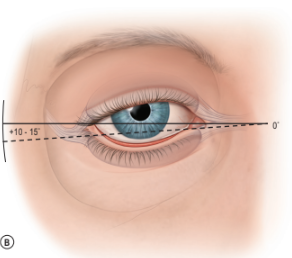
However, the loss of the aegyo-sal and ectropion still remained as limitations.
(Source: Nelligan 4th ed. Vol 2 ch 9 blepharoplasty)
The operated look caused by reduced orbicularis oculi tone, which had been one of the limitations of the first generation, was not fully overcome.
In addition, the sagging of the midface extending from the cheekbone to the nasolabial fold and the front cheek could not be fully resolved by fat repositioning alone.
These limitations became the catalyst for the emergence of third- and fourth-generation surgery.
The core of third-generation lower blepharoplasty: muscle preservation and suspension
In one word, third-generation surgery is a procedure that preserves the function of the eye.
It evolved beyond simply moving fat and toward preserving facial expression, function, and the aegyo-sal.
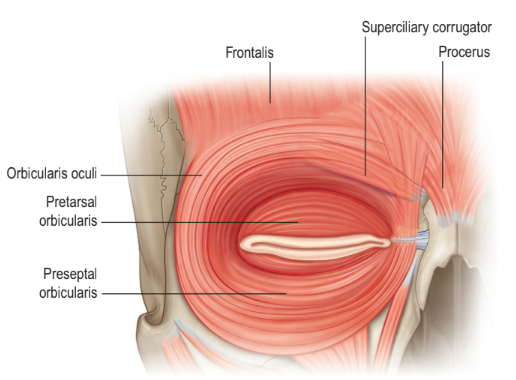
The orbicularis oculi muscle surrounding the area below the eye plays a role in closing the eye, pumping tears, and, above all, forming the aegyo-sal.
This muscle is broadly divided into two parts.
-
Pretarsal: The area just below the eyelashes, which forms the aegyo-sal (do not incise)
-
Preseptal: The area where incision is possible
(Source: Nelligan 4th ed. Vol 2 ch 9 blepharoplasty)
In third-generation surgery, only the preseptal area should be incised, and it is especially important not to damage the medial canthal region (the inner one-third of the eye), where there is abundant nerve distribution.
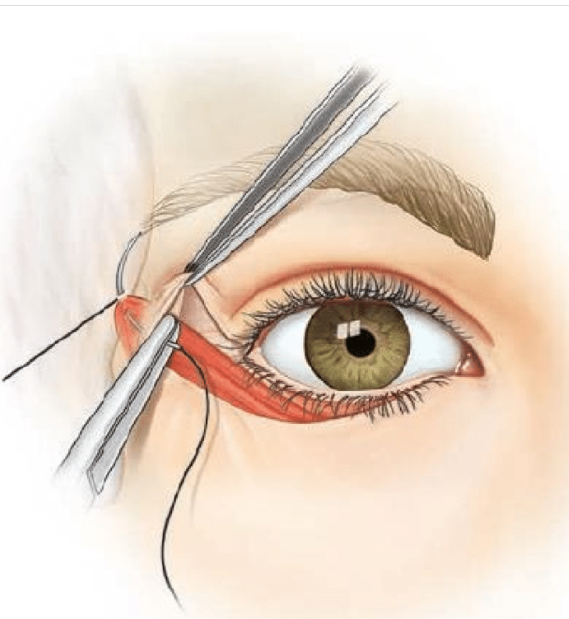
In addition, the key concept of third-generation surgery, orbicularis oculi suspension, is introduced.
This technique involves suspending the sagging orbicularis oculi muscle to the periosteum above with a thin suture without cutting it.
(Source: Ashkar, Riham & Alboudi, Sinan & Alhassanieh, Anwar. (2021). Recurrence of Lower Eyelid Fat Pads (Herniated Fat) after Blepharoplasty: An Analysis of Different Operative Techniques. Modern Plastic Surgery. 11. 63-69.)
This made it possible to maintain the three-dimensional contour under the eyes, prevent ectropion, and preserve a natural facial expression.
Dr. Zoumalan’s research also reports that this technique satisfies both functional preservation and aesthetic improvement.
The fat repositioning technique used in second-generation surgery is still retained as well.
The difference is that even during fat movement, the approach has become more cautious, with muscle preservation in mind.
Still remaining challenge: Y-shaped grooves and midface atrophy
Although muscle preservation and aegyo-sal maintenance were successful, it was still difficult to completely resolve the three-pronged hollowness of the tear trough, lateral trough, and Indian fold.
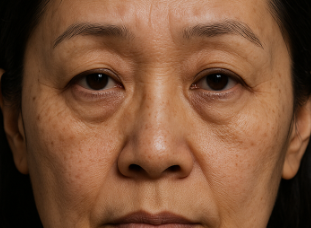
These depressions are associated with overall volume loss in the midface, and fat repositioning alone has its limits.
Accordingly, fourth-generation lower blepharoplasty expands in the direction of SOOF lifting, release and resuspension of retaining ligaments, and restoration of volume throughout the midface.
To summarize, second-generation lower blepharoplasty was a shift from "surgery that removes fat" to "surgery that uses fat," and third-generation surgery was an evolution that added the goals of muscle preservation, maintaining natural facial expression, and enhancing the aegyo-sal.
The result became more natural, and complications were reduced, but it was still insufficient for addressing the overall facial structure.

In the next post, I will introduce fourth-generation lower blepharoplasty, which goes beyond these limitations: a procedure that lifts and restores the entire midface.
If you would like more detailed information, please visit the link below as well. Thank you for reading.
Sincerely,
Dr. Heo Jae-won, Board-Certified Plastic Surgeon.