Hello.
I am Huh Jae-won, a board-certified plastic surgeon at 입체성형외과, where I perform rejuvenation surgery.
In Part 1, I talked about the anatomical reasons eyebrows droop and the innovation of endoscopic techniques.
Today, as promised, I’ll go through the actual surgical process step by step and show you what kind of changes are possible through a real patient case I personally performed!
Step 1: Precise Planning
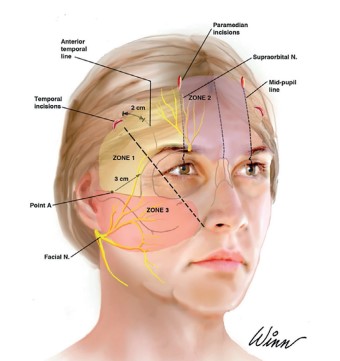
Endoscopic forehead lift surgery is performed under sedation anesthesia and takes about 1 hour.
After evaluating the position and symmetry of the eyebrows with the patient sitting upright, the incision lines are designed while considering the locations of the major nerves.
Usually, there are 3–5 incisions in total: about 2–3 in the frontal area and 1–2 in the temporal area, each about 1–2 cm long.
But with these small incisions alone, the entire forehead can be dissected!
Step 2: Beginning the Subperiosteal Dissection
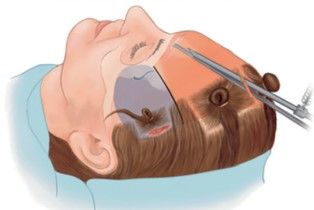
Dissection into the subperiosteal plane is the key part of this surgery.
This layer is the deepest and safest approach because it does not disturb the skin, fat, or muscle. Here, fixation of the frontalis muscle and control of the brow depressor muscles are performed at the same time.
Step 3: Precise Handling of Important Structures
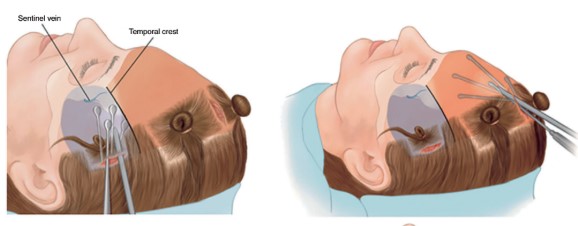
The thick periosteal attachment called the temporal fusion line must be precisely released so that the outer part of the eyebrow can move freely.
On the other hand, outside the temporal fusion line, the frontal branch of the facial nerve runs through the area, so the dissection must proceed more superficially in the suprafascial plane rather than the subperiosteal plane.
Step 4: The Key to Muscle Control
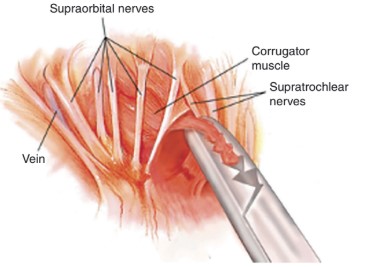
The procerus, corrugator, and depressor supercilii muscles, which pull the eyebrows downward, are removed or partially weakened while being viewed endoscopically. Of course, the frontalis muscle, which lifts the eyebrows upward, must be fully preserved.
Step 5: Stable Fixation
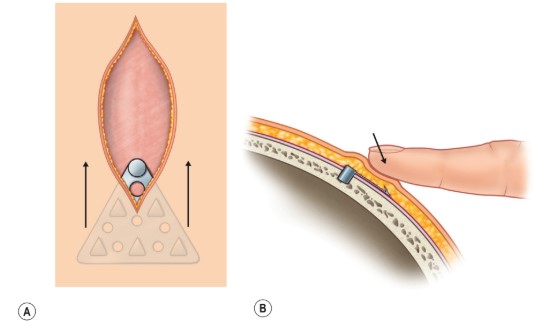
Finally, absorbable fixation devices such as Endotine or Fixtine are used to stably maintain the elevated eyebrow position.
These devices naturally dissolve after 3–6 months, and during that time the tissue securely adheres to its new position.
A Real-World Example of the Change - A Female Patient in Her 60s
Today, I’d like to introduce the case of a woman in her mid-60s whom I operated on personally.
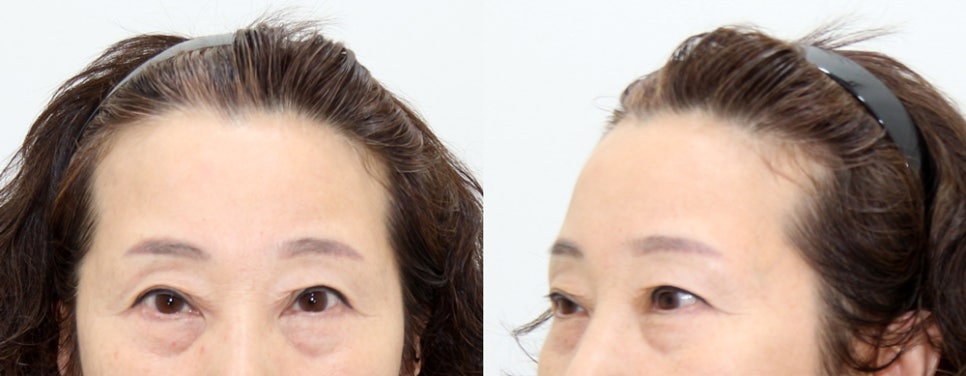
Before surgery
Her forehead had drooped downward, pressing on the eyelids and causing extra folds in the double eyelids. She also had horizontal wrinkles across the glabella, and the skin around the eyes sagged significantly downward, to the point that the skin on both sides was touching and becoming irritated.
What treatment was needed?
In cases like this patient’s, where the entire forehead has collapsed downward, simple upper eyelid surgery alone is difficult to solve the problem.
So I first performed an endoscopic forehead lift and lower blepharoplasty.
After correcting the forehead droop, I explained that if desired, upper blepharoplasty could be considered as a second-stage procedure for the remaining concerns.
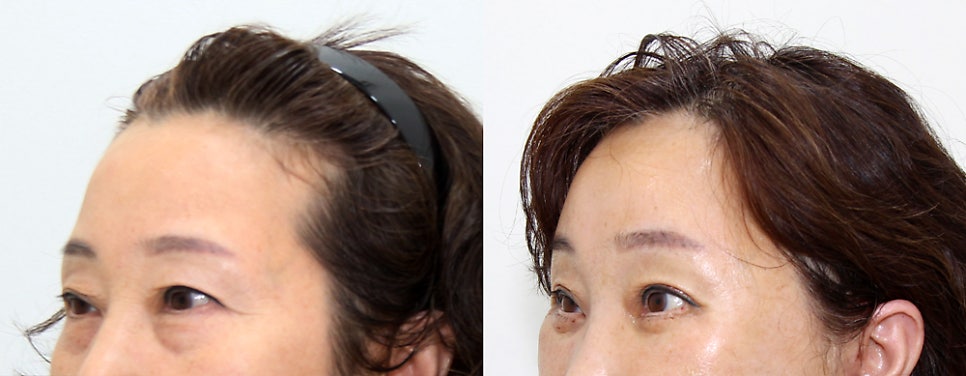
Before and after endoscopic forehead lift and lower blepharoplasty
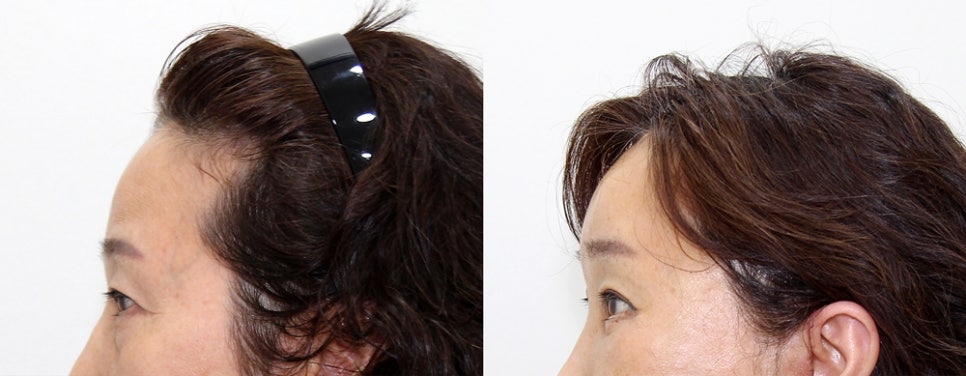
Before and after endoscopic forehead lift and lower blepharoplasty
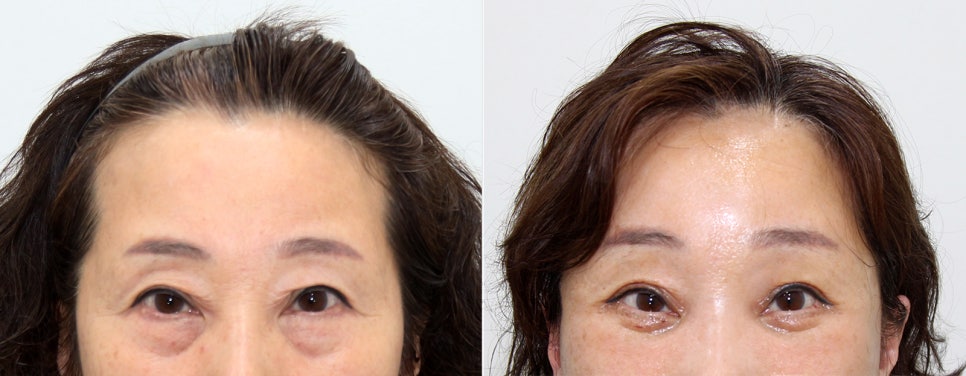
Before and after endoscopic forehead lift and lower blepharoplasty
Five points that changed 10 days after surgery
-
Her tired and depressed-looking expression became much brighter and clearer.
-
The eyebrows rose by about 5–6 mm, opening up the previously heavy-looking eye area, and the severe eyelid droop improved, eliminating the irritation caused by rubbing skin.
-
The wrinkles between the eyebrows were softened, and the double eyelid line that had been pressed down and hidden became clearly visible again.
-
The sunken forehead area above the eyebrows regained volume and became softer and rounder, and forehead wrinkles also decreased.
-
The extra folds above the double eyelids improved much more than before surgery.
At this stage, the result can now be refined with upper blepharoplasty.
If only upper blepharoplasty had been performed from the beginning, the eye area would likely have ended up looking sharp and harsh rather than softly and youthful.
Who Is This Surgery Suitable For?
Endoscopic forehead lift surgery is not recommended for everyone.
However, especially good results can be expected in the following cases.
✔ When the eyebrows have descended below the bony structure around the eyes
✔ When the distance between the eyes and eyebrows is originally narrow
✔ When a person unconsciously raises the eyebrows often, causing deep forehead wrinkles
✔ When simple upper blepharoplasty alone cannot resolve the heaviness of the eyes
✔ When glabellar wrinkles have become fixed
✔ When people are often told that their eyes look small and heavy
When the eyes keep feeling heavy and the eyebrows seem to be dropping, the weight often actually starts from the forehead.
In these situations, correcting the problem from above rather than with eyelid surgery or an incision below the brow is a much more natural way to restore a younger-looking impression.
Recovery and Care – Important Points to Follow
- The first 2–3 days after surgery
Apply ice packs and take pain medication as prescribed.
Because sensation is reduced, ice packs should be applied for 1–2 minutes and then paused for 30 seconds, repeating this pattern.
Also, sleeping with your head elevated can greatly reduce swelling and pain.
- Suture removal and return to daily life
Stitches are usually removed after about 10 days, and light daily activities are possible within 5–7 days, but going out in public is more appropriate after about 2 weeks.
If you would like more detailed information, please leave a comment anytime.
Thank you.