Hello.
I am plastic surgeon Huh Jae-won, performing youthful-look surgery at Inpae Plastic Surgery.
In previous posts, we looked at the history of forehead reduction surgery and the incision techniques used to minimize scars, right?
Today, I’ll take a closer look at the core technique of forehead reduction surgery, galeotomy, and the fixation methods, and show how they are applied through a real case.
The Magic of Galeotomy
How much can the scalp stretch? This is one of the key questions in forehead reduction surgery.
As you can see if you try pulling it yourself, “the scalp does not stretch as easily as the skin.”
One reason is the anatomical difference.
The main method I use for forehead reduction surgery is subgaleal dissection.
The technique used to make this more effective is galeotomy.
The galea aponeurotica is a tough, less elastic fibrous tissue layer in the deep part of the scalp. This layer limits scalp movement.
The scalp is made up of five layers, and to make it easy to remember, it is referred to by the acronym “SCALP.”
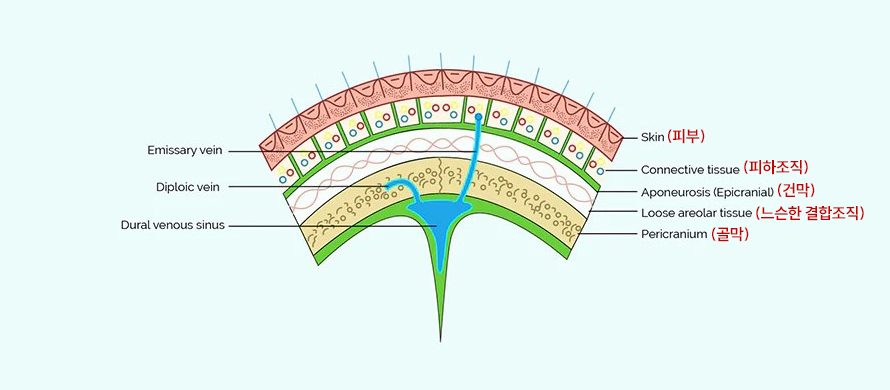
The periosteum lies underneath, so you do not need to worry about it, and from the scalp’s perspective, the “A” layer, the galea, is the stiffest and least elastic, making it the main factor that limits how much the forehead can be reduced.
Galeotomy involves making several parallel linear incisions in this layer.
This allows the inelastic tissue to stretch, increases local tissue mobility, and reduces tension at the wound edges.
If I say it like that, you might not know what it means, right? (Haha)
Let me explain with food.
Sausages or sundae have a tough casing that does not stretch much, while the inside is soft, right? So when you grill a sausage and score it with cuts, it stretches, doesn’t it?
That is the kind of principle at work here.

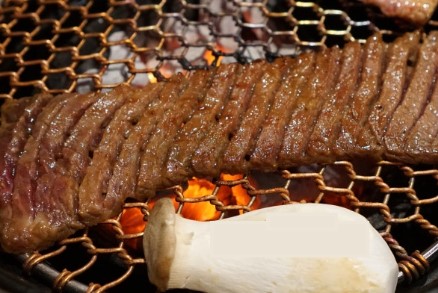
To give another example, when we cook and want something to stretch more, we make cuts in it.
A representative example is seasoned galbi: if you slice it too thick, the outside burns before the inside cooks, so we score it and stretch it out to cook it, right?
So you can think of galeotomy as a technique that makes the scalp stretch better by scoring it.
Early galeotomy generally required wide incisions and extensive dissection.
Naturally, this increased the risk of damaging blood vessels or nerves responsible for scalp sensation.
However, in recent years, techniques have been developed that can successfully perform galeotomy with only small incisions while minimizing nerve transection,
and I use this method as well.
In general:
-
The first galeotomy is performed about 25 mm behind the scalp margin.
-
The second galeotomy is performed 10–15 mm behind the first incision.
-
After each galeotomy, traction is applied for 60 seconds to obtain additional scalp movement.
Galeotomy is especially useful when the scalp does not have enough elasticity or when a large degree of correction is needed.
With this technique, the hairline can be lowered more predictably and effectively, which can improve patient satisfaction.
The Evolution of Fixation Devices
In forehead reduction surgery, the method used to fix the scalp after pulling it forward is also very important.
In early forehead reduction surgery, only simple sutures were used to fix the scalp after it was advanced forward.
But there was a problem. Over time, the scalp tended to pull back.
To solve this problem, devices such as Endotine/FixTine clips were introduced.
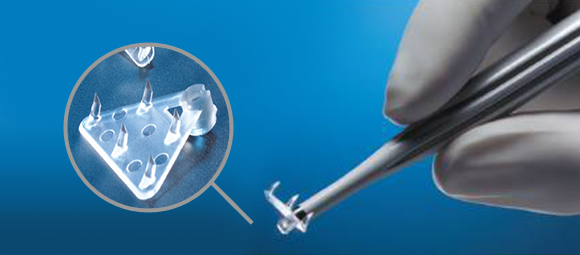
Endotine
Endotine/FixTine is a fixation device made of bioabsorbable material. It has small hook-shaped projections that firmly secure the scalp, helping prevent the hairline from moving backward.
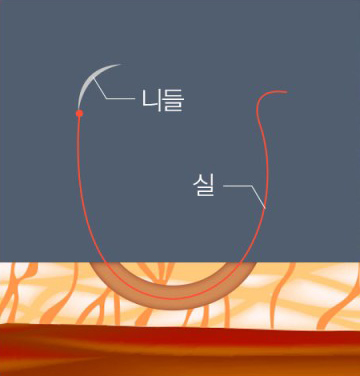
Bony tunneling
Another method is bony tunnel suture fixation.
This involves drilling a small hole in the bone and passing a suture through it to secure the scalp flap.
It is a good alternative, especially for patients who cannot use Endotine.
In studies that quantified the average amount of reduction achievable with forehead reduction surgery, results varied from 1.3 to over 2 cm.
In some special cases, up to 5.5 cm was reportedly possible, but that required enough skin elasticity (=something you have to be born with) and a more aggressive operation.
Also, as expected, there are research findings showing that after forehead reduction surgery, the proportions of the forehead and face become more harmonious.
Potential Complications
Common reported complications include:
Temporary scalp numbness/paresthesia, mild seroma (fluid accumulation), and temporary hair loss around the incision site (shock loss).
Finally, I’ll finish by showing you one case.
A female patient in her 20s visited us because the high hairline in the central area was a source of concern for her.
This is the 2-week follow-up after forehead reduction.
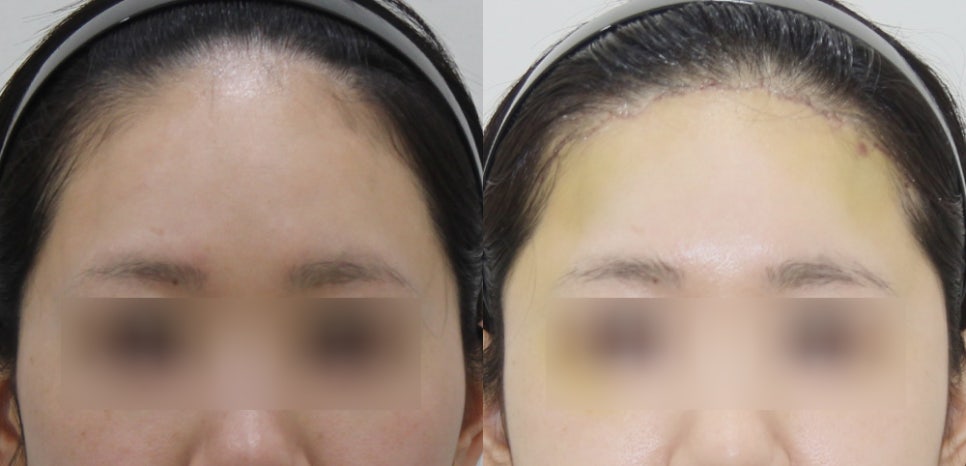
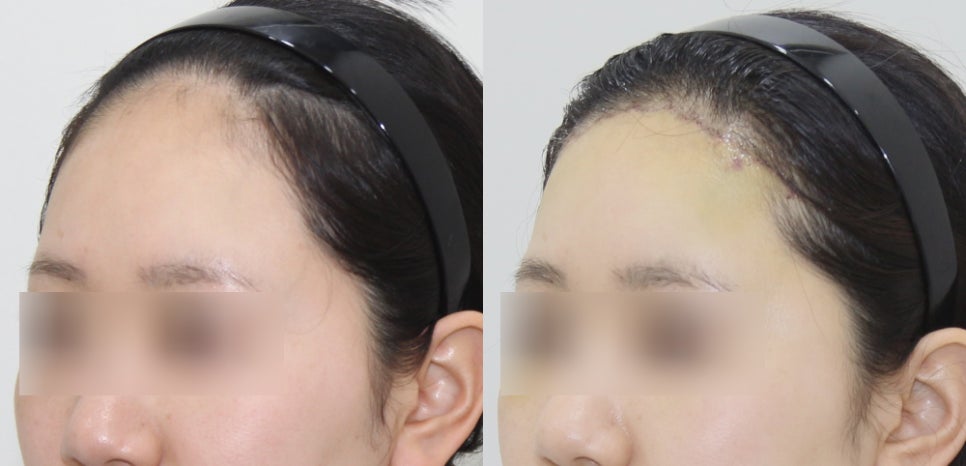
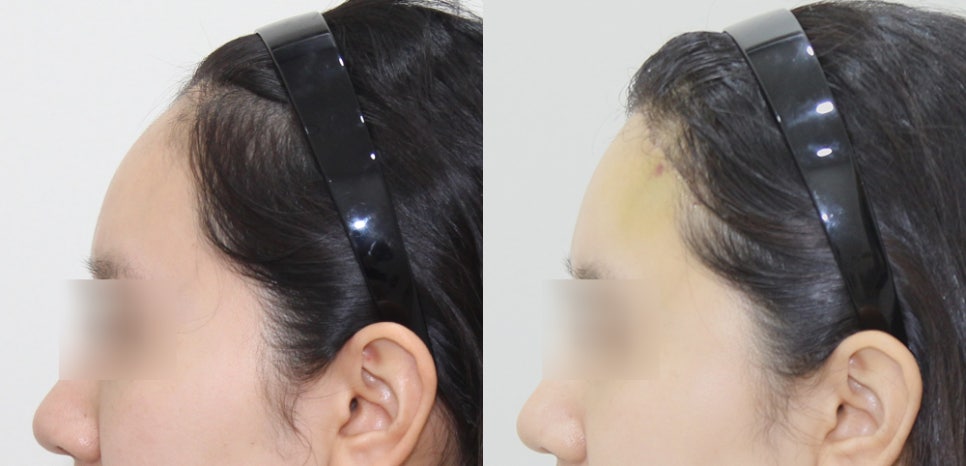
The pointed impression of the forehead has been greatly reduced, and the face appears smaller. From the oblique view as well, the forehead now looks rounder.
The so-called Hwang Bi-hong forehead curve, where the hairline seems to recede backward, has also been reduced, and the border of the forehead has become more modern.
From 3 months to 6 months, the scar gradually fades, and hair begins to grow out from the incision line.
By 6 months, the scar remains only as a slight white line, and even that is covered by short hairs growing out.
Forehead reduction surgery is not simply a procedure to shorten the forehead.
It requires delicate technique that connects “design,” “incision,” “fixation,” and “recovery.”
If you have any questions, please feel free to ask in the comments anytime!
Thank you.