Hello.
I am Dr. Huh Jae-won, a board-certified plastic surgeon at 3D Plastic Surgery, where I perform youthful-looking facial surgery.
In the last two posts, I explained in detail what a submental lift is and who it is suitable for.
"So how is the surgery actually done?"
"Where is the incision made?"
"Do you really not cut the skin?"
I’ve received these questions very often.
Today, I’d like to talk about the actual surgical technique for this submental lift, also known as double chin soft contouring.
I perform the surgery based on Dr. Marten’s paper, and I’ll explain it using his research as the foundation.
Step 1: There is only one incision, but the location matters
The first thing people are most curious about is the incision site.
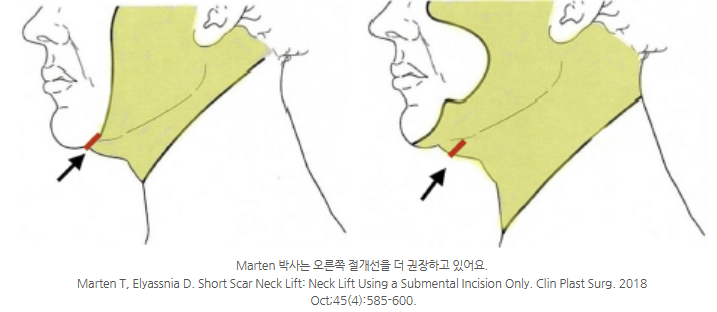
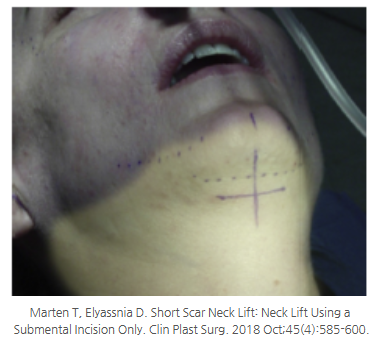
A small incision of about 3 cm is made only once, in the center under the chin, in the middle of the area we call the double chin.
But there is an important point here.
"I have a crease where my double chin folds, so I guess the incision would be placed along that crease," you might think. But in reality, it should not be done that way.
Why should the crease under the chin be avoided?
According to Dr. Marten’s research, if the incision is made at the crease under the chin, it can actually emphasize the shadow of the double chin, making the incision line itself stand out like a scar.
So Dr. Marten recommends placing the incision 1 to 1.5 cm behind the crease under the chin, slightly away from the shadow.
This location
• provides a better surgical field
• makes the scar much less noticeable
• allows for a more natural recovery
It may seem like a small difference, but details like this determine the surgical result.
- Fat removal, but it should not be removed indiscriminately
After the incision, the first step is fat removal.
But the important thing here is that it is not about removing all the fat.
There are two types of fat in the neck.
- Superficial fat
• A thin layer of fat 바로 under the skin
• Helps create the neck’s soft contour
- Deep fat
• Fat located deep beneath the muscles in a lump-like form
• The main cause of a double chin
A natural line is created only when these two are clearly distinguished and only the necessary areas are removed in an appropriate amount.
- Superficial fat
• Enough to improve the contour
• But not so much that the skin becomes too thin
• A safe thickness must always be preserved
- Deep fat
• Removed to the extent that it helps improve the contour
• Boldly, but without compromising function
If too much is removed, the person may actually look older, and if too little is removed, it is difficult to achieve the desired effect.
That is why this step requires very delicate judgment and a lot of experience.
- Refining the salivary gland and muscles: preserving function while shaping the form
Now we come to the real core step.
Two major structures that affect the neck line must be addressed.
These are the submandibular gland and the digastric muscle.
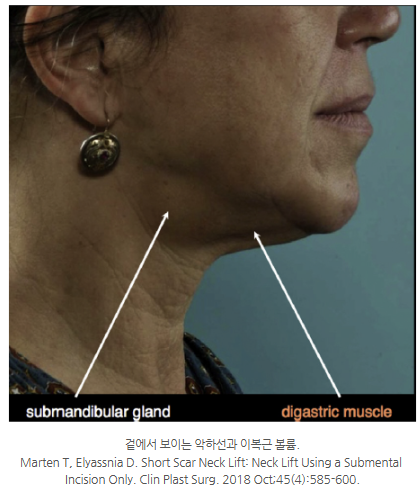
The submandibular gland is a salivary gland under the jaw, and if it is too large or positioned awkwardly, the area under the chin can look bulky.
Dr. Marten emphasizes that this area is reduced only partially.
• Carefully reduced to less than half of the whole
• A reduction concept, not complete removal
• Salivary function must be preserved
The same applies to the digastric muscle. Only the necessary parts are refined.
It is not completely removed, but adjusted to the point where it smooths the contour.
Of course, this varies from person to person.
If the salivary gland is very large
• If more than half needs to be removed → submandibular gland excision
• If only about 30% needs to be reduced → salivary gland Botox can also be a good alternative
• Preserve function while refining only the shape.
This is the philosophy of the submental lift.
- Platysma suturing: the key to double chin muscle tightening
Finally, we reach the last step.
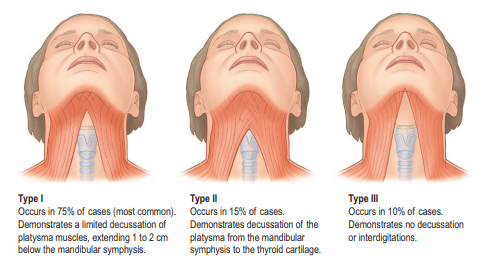
We refine the platysma, the broad, sheet-like muscle that wraps around the neck.
As we age, this muscle splits in the middle, and that is what creates the so-called "neck bands."
Also, when this muscle sags, the overall contour does not look good no matter how much is refined below it.
In a submental lift, the separated parts of this muscle are sutured together again at the midline.
This is what people commonly call "double chin muscle tightening."
Surgical process
-
Bring the separated platysma toward the midline
-
Suture with appropriate tension
-
Smoothly wrap the refined contour from below with the platysma
Surgical results
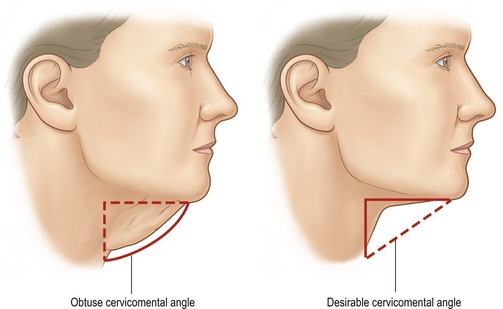
• The double chin shadow disappears
• The neck line becomes neatly defined
• A natural chin-to-neck boundary is created
It has the effect of tightening a loosened corset again.
To summarize the key points of the submental lift
4-step process
-
Minimal incision at the correct location
-
Selective and precise fat removal
-
Function-preserving refinement of the salivary gland and muscles
-
Final contouring through platysma suturing
Core philosophy
• The skin is not cut at all
• Function is preserved while only the form is improved
• Natural recovery and lasting effects
Ideal candidates
• Those who are young and have enough skin elasticity
• Those whose main cause is structural issues
• Those who want a definite result without a major surgery
On the other hand, if the skin is significantly sagging, combining it with a facelift may be a better choice.
Although a submental lift may look simple, it is actually a highly refined and delicate procedure.
In particular, how much to remove at each step and how to suture are aspects that depend greatly on the surgeon’s experience and aesthetic sense.
So if you are considering the surgery, it is most important to consult with a board-certified specialist who has sufficient experience and know-how.
If you read this post and are wondering, "Is this the right surgery for me?" please feel free to leave your current condition or any questions in the comments, and I will answer sincerely. Thank you