Hello. I am Huh Jae-won, a board-certified plastic surgeon at 입체성형외과, where I perform anti-aging surgery.
In the previous post, I covered the first question about the SMAS fascia, and after answering it, I received a second question.
This question was also really good, so I wanted to share it with you.
Second question: How procedures affect the SMAS
Q. Could the SMAS be damaged by procedures I had before, so that it may not be clearly visible? I heard that liposuction procedures like AccuSculpt melt the SMAS, and if the SMAS is weak or absent like this, would the skin sag more easily than in people whose SMAS is clearly visible?
That is a keen observation.
First, to answer the question, “Can the SMAS be hard to see because of previous procedures?” yes, it can. In fact, it does happen.
When fat grafting or liposuction has been performed, especially with devices that deliver energy directly, such as AccuSculpt, we often see during surgery that the SMAS is not clearly visible and that the muscle layer itself has been destroyed.
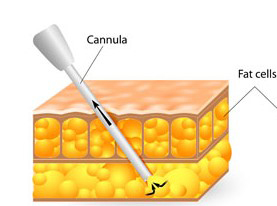
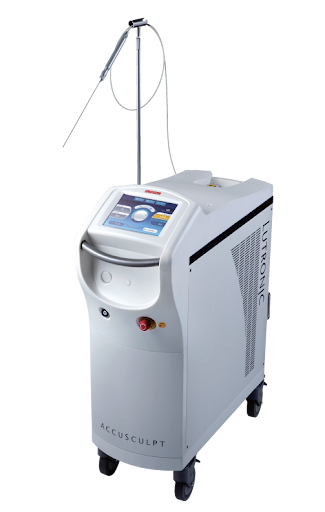
A significant part of what we call the “SMAS” is actually the platysma muscle.
However, in areas that have undergone liposuction, this muscle is not distinct, and the tissue appears scattered like fragments.
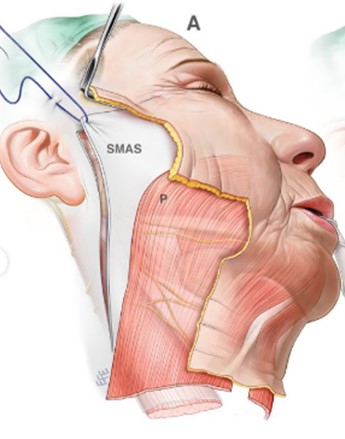
This corresponds to p in the photo.
Many patients come to me after having fat grafting in the face and liposuction under the chin, and when I actually examine them, the anatomical structures in both areas are not intact. This is not just a theoretical point; it is something I can confirm directly in the operating room.
In particular, devices that use radiofrequency or ultrasound energy affect not only fat but also surrounding tissues, so the existing anatomical structure is often altered.
SMAS damage and the relationship with sagging
That said, it is not true that “if the SMAS is absent, sagging will be worse.” It is a little different.

When volume decreases, there are cases where sagging is reduced because the skin does not need to support as much weight.
But conversely, if the contents decrease but more skin remains, then in skin with reduced elasticity, it can actually look more saggy.
In the end, there is a tug-of-war between the direction in which reduced weight improves things and the direction in which reduced skin elasticity makes things worse.

Because of these complex variables, an individualized approach has become even more important.
Surgical plans should be made by comprehensively considering each patient’s procedure history and current condition.
The surgical approach may differ between a patient whose SMAS is intact and one whose SMAS has already been altered.
Therefore, you must be sure to tell the operating surgeon about this before surgery.
Questions like these also gave me another chance to think things through once again.
If you have any questions, please feel free to leave a comment.
Thank you.