Hello.
I am Director Heo Jae-won, a board-certified plastic surgeon at Lip Plastic Surgery, where I perform rejuvenation surgery.
These days, the level of questions I receive has gone up a lot.
Actually, I prefer these academic, in-depth questions.
The detailed points I usually think about and study often end up turning into, "So will it make me prettier or not?" when I explain them elsewhere... (haha)
In those cases, I usually find it better to show before-and-after photos rather than explain in words.
Today, I received a truly high-level question, and I wanted to share it here, so I’m putting it into writing.
A sharp question from a patient who had really done their homework. In a recent consultation, I met someone who had studied forehead lifts in great depth.

“Hello, Director. I’m looking into forehead lift surgery and trying to find a clinic that properly performs dissection and fixation. That’s how I came across your blog.
To explain my situation, my eyelid-opening strength is normal, but my brow compensation is very severe.
When I try to open my eyes naturally, deep forehead wrinkles form, and the muscles above my eyebrows bulge out, making the area uneven.”
This kind of symptom is the most classic indication for a forehead lift.
But the questions this patient asked were astonishingly sharp.
Q1. Extent of dissection - how far should it go for a real effect?
“Rather than dissecting only up to just above the eyebrows, I heard that the proper surgical effect only comes if dissection is carried down to the eyelid area below the eyebrows. What do you think, Director?”
You really understood it accurately.
From a surgeon’s perspective, this is one of the 기준 for judging whether a forehead lift is being performed properly.
As I always emphasize, based on the principle that "you can never expect an effect in an area that was not touched by surgery,"
to address the bulging in the upper eyelid area, you have to approach that region directly.
The problem is that the periosteum is tightly attached to the bone.
To reach the upper eyelid area, you inevitably have to separate the periosteum at a certain depth and enter beneath it.
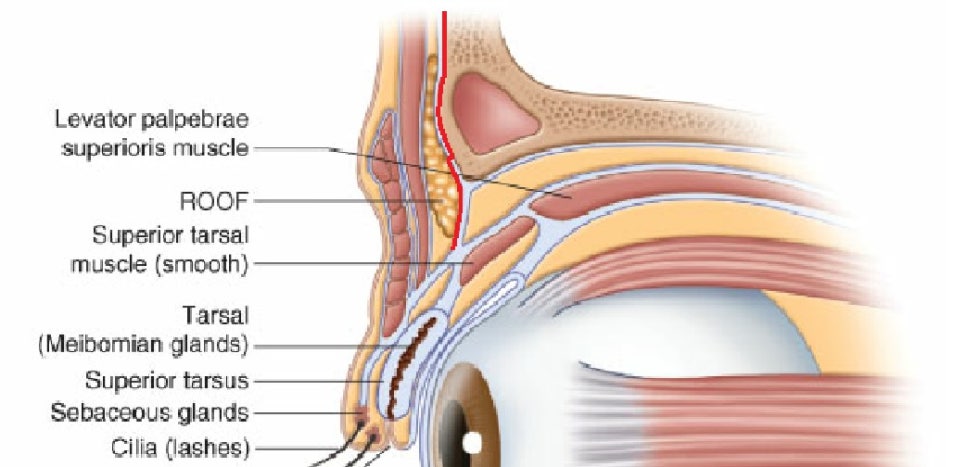
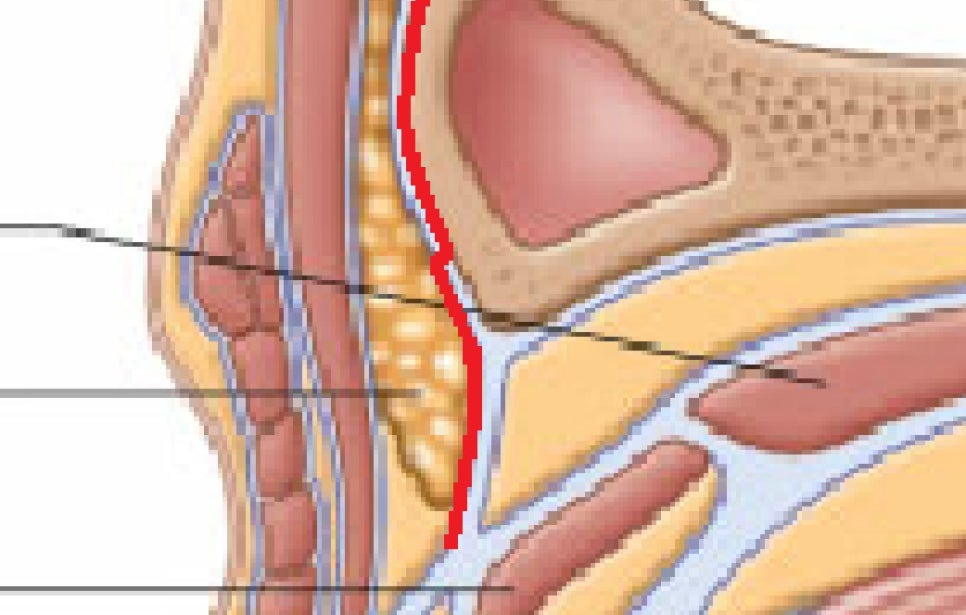
Once the periosteum is opened, ROOF, one of the fat compartments in the upper eyelid area, becomes visible from above in the surgical field.
That is why, during surgery, I carefully check with my hand while actually feeling the eyelid to make sure the dissection has properly reached the area above the eyelid.
Q2. 3-point vs. 5-point - the truth about the number of fixation points
“Some say that dissection must extend to the temples for the forehead to lift properly and for drooping at the outer corners of the eyes to improve. Does that mean a clinic that does not make an incision near the temples is not properly dissecting the temple area?
I see many clinics making incisions only at three points in the center of the forehead.
And I heard LOT dissection is related to lifting the outer corners of the eyes, but you never mention LOT.”
Some of that is correct, and some of it is not.
It is true that enough temple dissection is needed. But even with 3-point access, the temple area can still be dissected sufficiently.
Because an endoscope is used, the dissection range can be extended enough to LOT through the outer point among the three points.
Of course, if you add one more opening at the temple with a 5-point approach, the surgery becomes much easier.
When you want to pull the temple at a 45-degree angle like in a temple lift, fixation is sometimes done through the additional incision as well.
However, Koreans rarely undergo temple lifts.
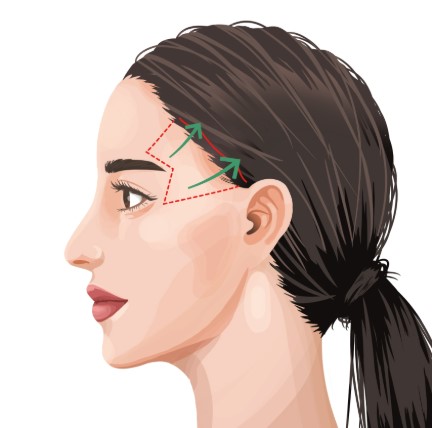
Having the outer corners of the eyes and the ends of the eyebrows lifted into a seagull-like shape is a Western standard of beauty.
In Korea, a fox-eye style is not preferred as much as it is in the West.
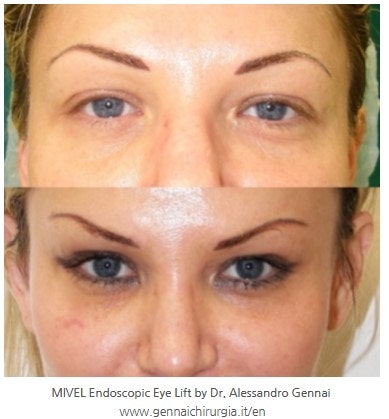
So from the standpoint of dissection, 3-point access is enough to dissect to LOT,
and if you do not need a temple lift that pulls horizontally, the meaning of additional fixation is also reduced,
so in most cases, 3-point vertical lifting and fixation are sufficient.
That said, if you want a fox-eye style, 5 points are more advantageous.
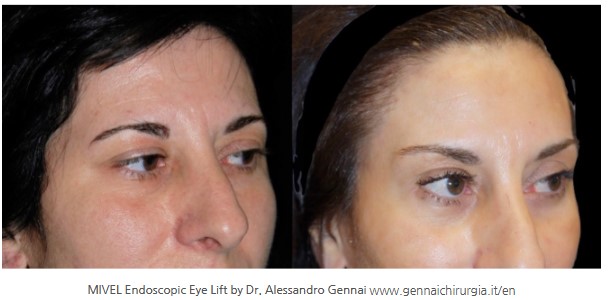
In practice, when I operate on patients who want the outer corners of the eyes lifted, or on Western patients, I also use 5-point access and add separate fixation on the lateral side.
In the next post, I’ll cover more in-depth topics such as how much the corrugator muscle should be removed, and which is better between bone tunneling and Endotine.
Thank you.