Hello.
I am Dr. Huh Jae-won, a board-certified plastic surgeon at 입체성형외과, where we perform anti-aging surgery.
Continuing from my previous post, I will keep answering in-depth questions about forehead lifting.
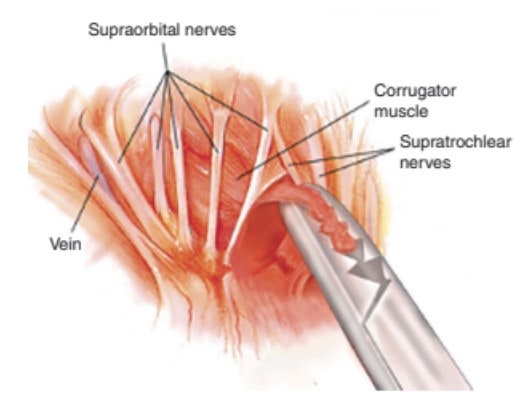
Corrugator muscle resection
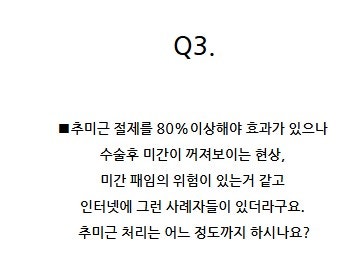
I have not yet seen an exact paper stating what percentage of the corrugator muscle should be resected to be effective.
Corrugator muscle resection is broadly divided into complete resection and partial resection, and in my experience, complete resection clearly caused a sunken glabellar area.
So these days, I avoid complete resection.
Instead, when deciding the amount of resection, I check in real time with an endoscope while lifting the forehead tissue to see where the strongest tension is coming from.
In other words, I selectively remove only the muscle fibers that are mainly pulling the forehead downward.
In numerical terms, I aim for roughly 50 to 80%.
In fact, I think it is more important which area is resected and how much than the exact percentage.
So during surgery, I believe the most ideal method is to actually feel the muscle tension and selectively cut only the necessary parts.
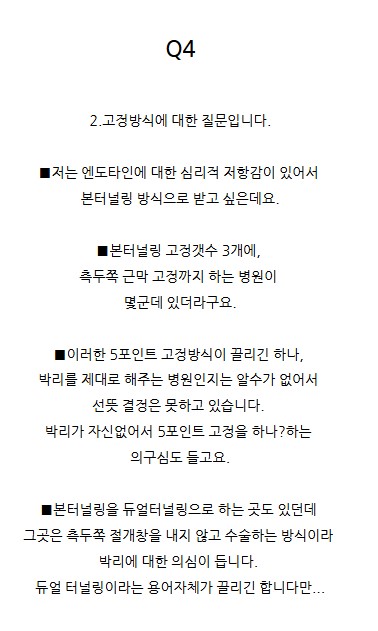
Both blind tunneling and Endotine-type fixation devices have their own pros and cons.
But in my experience, 90% of the surgical outcome is determined by the dissection.
No matter which fixation method is used, if the dissection is insufficient, it is difficult to achieve the desired result.
If the dissection is thorough enough, the fixation device does not account for a very large portion of the overall outcome.
However, looking at published papers, Endotine-type fixation devices are reported to be somewhat better than blind tunneling in terms of fixation strength and durability.
That is why I mainly recommend surgery centered around a fixation device.
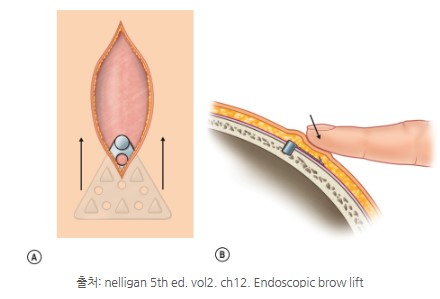
Endotine
However, it is true that there can be discomfort such as feeling it by touch, so if the patient feels psychologically burdened, we can also proceed with blind tunneling. If you have a preference, please let us know during the consultation.
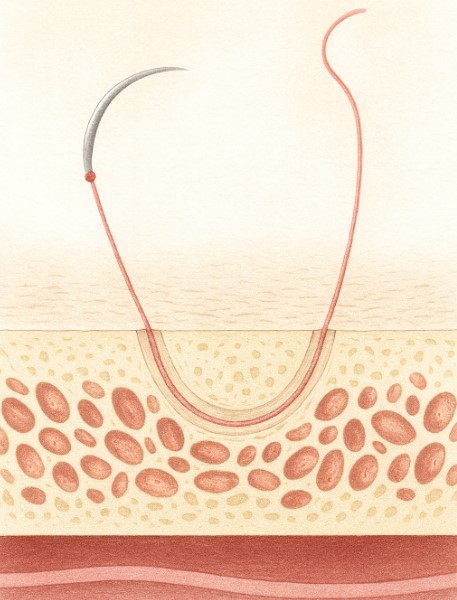
Blind tunneling
What is important is to check whether the clinic performs proper dissection.
No matter how many times I emphasize it, it is not enough: the most important part of forehead lifting is accurate and sufficient dissection.
The fixation method comes after that.
If strong fixation is performed without dissection, recurrence will occur and the result will not be satisfying. But if the dissection is done properly, both blind tunneling and Endotine can produce excellent results.
However, in terms of fixation strength and controlling the amount of lift during surgery, Endotine-type fixation devices have some advantages, while blind tunneling has some advantages in terms of postoperative discomfort.
I hope this helps those who are considering forehead lifting.
Thank you.