Hello.
I am Dr. Huh Jae-won, a board-certified plastic surgeon at Sillim Plastic Surgery Clinic, performing rejuvenation surgery.
In a previous post, I explained how to achieve contouring effects with a lifting procedure.
I mentioned that, when a specific technique is applied together with a facelift, there are cases in which the face can be improved beyond simply lifting sagging tissue, almost as if contour surgery had been performed.
I have decided to call this approach a contouring facelift.
Let’s continue from the previous article and look at a specific case in detail.
First, why we need to identify the contour line
When looking at a patient’s face, the first thing to do is sketch the contour line.
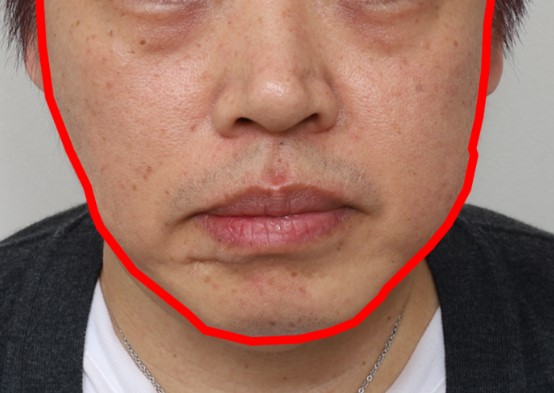
This makes asymmetry much clearer.
It is important to first identify contour issues and then check volume-related issues.
In this patient’s case, the mandibular contour was tilted toward the patient’s left side.
Because orthognathic surgery was not possible in this situation, we planned to refine the left contour to restore balance.
Problems found in the volume distribution
After the contour line, we need to look at how volume is distributed.
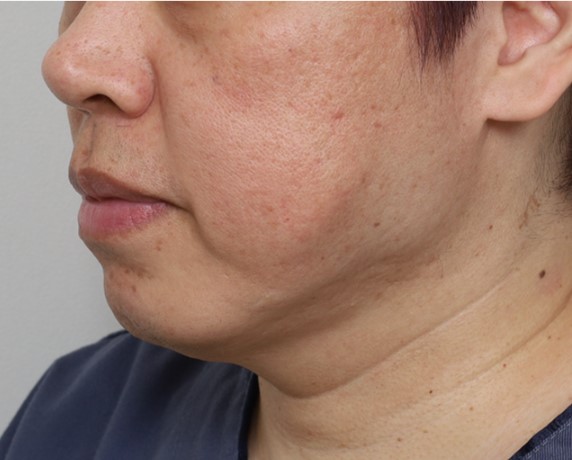
What do you notice?
What caught my eye first was the area marked below.
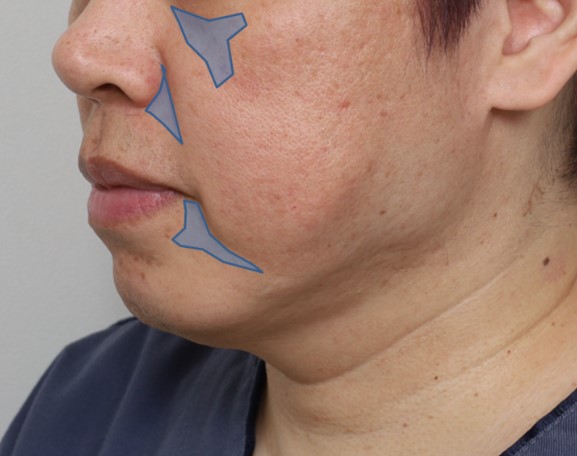
The volume below the eyes, in the nasolabial fold area, and around the mouth was significantly deflated.
This was the result of midface sagging combined with age-related volume loss in the perioral tissues.
If you would like to read about midface sagging, please refer to the article below.
Therefore, we included midface lifting along with volume restoration for the nasolabial fold and mouth area in the surgical plan.
On the other hand, there were also areas where the volume was excessive.
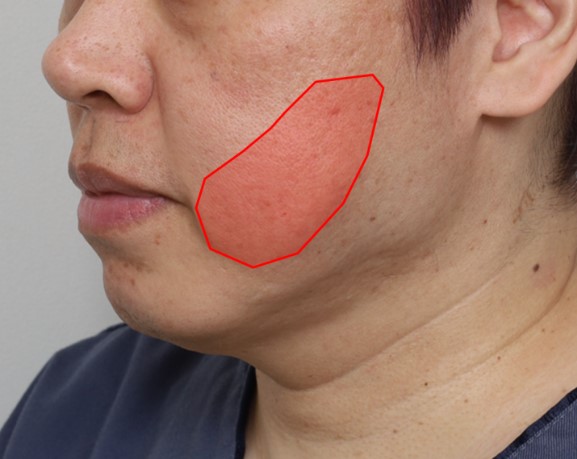
Many people may think, “They just gained weight,” or “It’s sagging,”
but the surgeon performing the procedure must know exactly what the anatomical cause is.
To give you a reference,
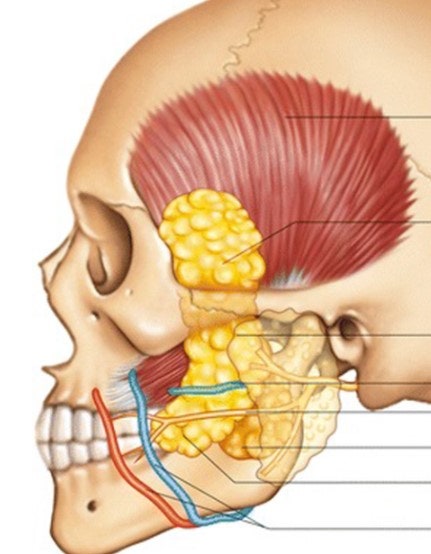
The yellow mass here is the buccal fat pad.
Because of the mandibular asymmetry, the buccal fat pad had been displaced outward.
The important point here is precise planning.
If you remove a healthy buccal fat pad without care, the cheek may end up looking sunken.
Recently, people sometimes confuse the jowl, often called the “marionette pouch” or “bulldog sag,” with this buccal fat pad,
and if the approach is wrong, the jowl may remain while only the cheek becomes hollow.
In short, the plan was as follows:
Midface lifting + soft contouring of the jawline + volume supplementation in deficient areas + removal of the left buccal fat pad
Only after all of these steps do we proceed with the facelift.
These are unedited photos taken two weeks after surgery.
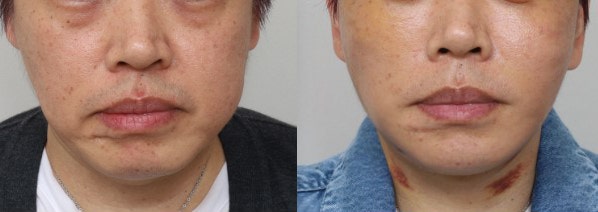
What changes do you notice?
The most obvious change is that the asymmetry of the frontal contour itself has been significantly corrected.
The overly angular left square jawline has been transformed into a slimmer, softer contour.
The right side was barely touched, so there is not a large difference in volume.
The second point to note is the change achieved through midface lifting.
Can you see that the highlight area of the cheek has been lifted upward?
The previously hollow area under the eyes and the front cheek now has a naturally restored sense of volume.
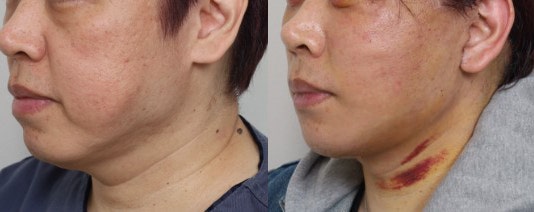
The protruding buccal fat pad contour was also improved naturally.
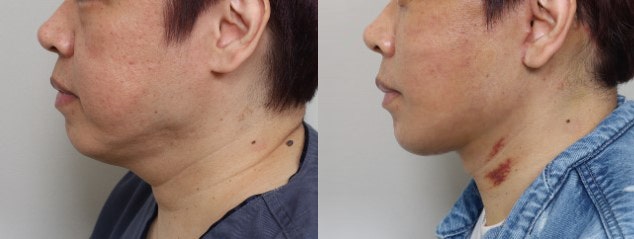
If you look at the side profile, you can see that the contour looks much more youthful.
The process of realizing the limitations of lifting alone
Here is an important point: results like these cannot be achieved with a simple lifting procedure alone.
To be honest, I used to perform lifting surgery by itself in the past. Back then, I was not able to fully consider these detailed factors.
But as my experience grew and I treated more cases, I realized something.
These detailed elements are ultimately what determine patient satisfaction and surgical outcomes.
So now, along with lifting surgery, I comprehensively consider the overall facial contour and volume and additionally apply customized techniques for each patient.
I have integrated all of these processes and named them the contouring facelift.
Rather than a one-size-fits-all menu, it combines the necessary procedures according to each person’s facial characteristics to create the best result.
The reason I am explaining this at length is that no two faces are the same.
Even if the procedure is called the same facelift, some people may need only simple lifting, some may also need contour correction, and for others, volume restoration may be more important. A contouring facelift is an integrated approach that takes all of these individual needs into account.
Next time, I will introduce various ways this approach can be applied through another case.
If you have any questions, feel free to leave a comment anytime. I will answer carefully.
Thank you.