Hello.
I am Dr. Huh Jae-won, a board-certified plastic surgeon at Sti Plastic Surgery, where I perform rejuvenation surgery.
When consulting with people who are considering a facelift, the factor that creates the biggest reluctance is the scar in front of the ear.
A temple incision can be hidden in the hair, and a behind-the-ear incision is also concealed by the area behind the ear, but an incision in front of the ear cannot be hidden anywhere.
That is why this area is the one most affected by incision design.
As time passes, it fades anyway, so what is the problem?
In fact, no matter how the incision is designed, after about a year most scars fade and become hard to see.
There are even people whose straight incision in front of the ear is barely visible after one year.
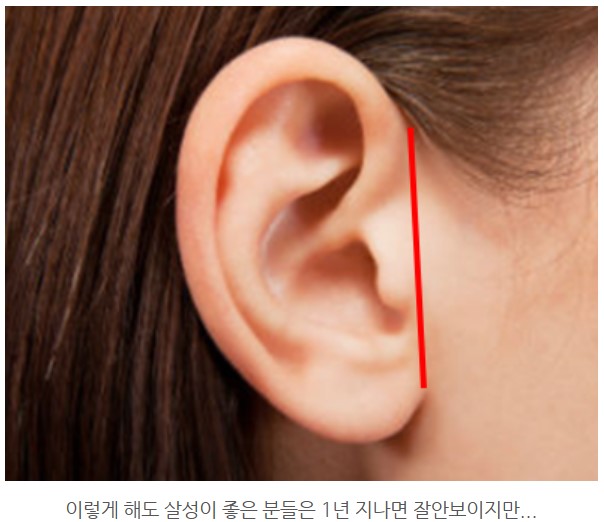
Then is there really a need to design it so carefully? The problem is right here.
If you make the incision too simply like that, it will be affected too much by the tissue quality.
For some people, even a straight incision is barely visible, but for others that area turns white, sinks in, or becomes raised due to a hypertrophic scar.
That should not happen.
Principles of incision design
So the principle I established for incision design is very clear: it must be placed somewhere that is not visible from the start.
The incision should be made in a place where the suture line is already difficult to see even while the stitches are in place.
Then even if the tissue quality is not ideal, it will still be hidden in a structurally less visible location and therefore remain hard to see.
I conducted extensive research based on this principle and developed an incision design that makes scars as inconspicuous as possible.
In fact, some patients in their 60s or older have told me that when they did their own wound dressing at home, they did not know there was a suture there and therefore did not disinfect that area.
This is what the most unsightly one-month mark looks like
Scars are most noticeable at one month, when the tissue response becomes strongest.
I will show you photos from that period.
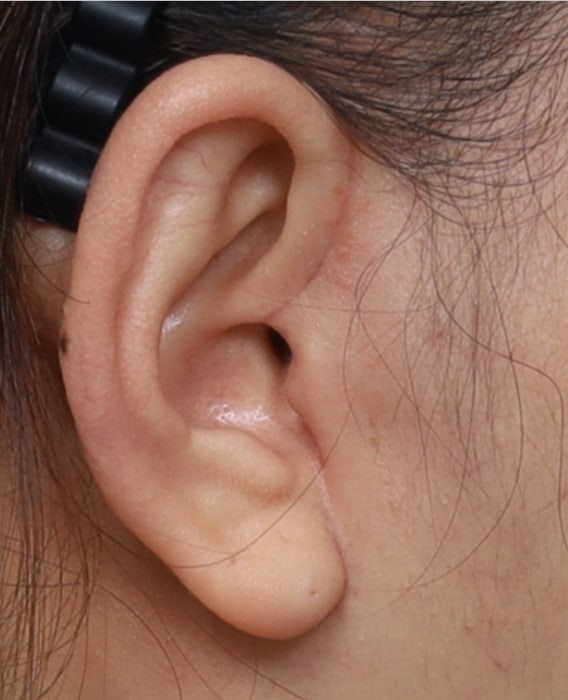
If it looks this noticeable at the most visible stage, once you pass the three-month mark, it truly fades so much that no one will know.
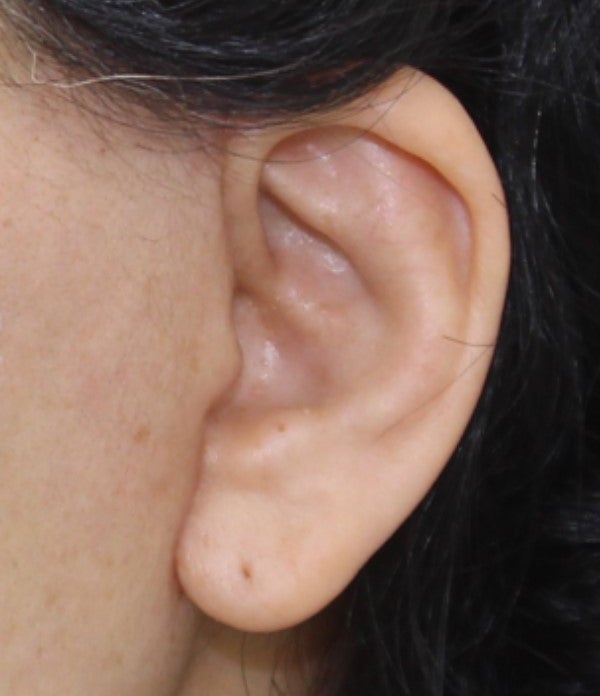
From a slight side angle, it begins to look like a natural ear.
The downside of this method is that it takes a lot of time.
Like leather crafting, the skin must be cut and shaped stitch by stitch to match the ear’s form.
It requires about 15 to 20 extra minutes of work per ear, or 30 to 40 minutes for both ears.
For a simple eye procedure, that is additional time that can be added. The reason most places do not do it to this extent is precisely because of that time.
The area in front of the ear is, after all, a place that is not easy to see yourself, and even if there is a scar, it usually fades after 6 months to 1 year. So from the surgeon’s perspective, it is easier to just make the shape roughly acceptable and say, “Scars like this are normal, and they will fade if you wait 6 months to 1 year.”
But as I mentioned, while some people may have good tissue quality and end up with a scar that is not visible, others can end up with a noticeable scar if it is done that way.
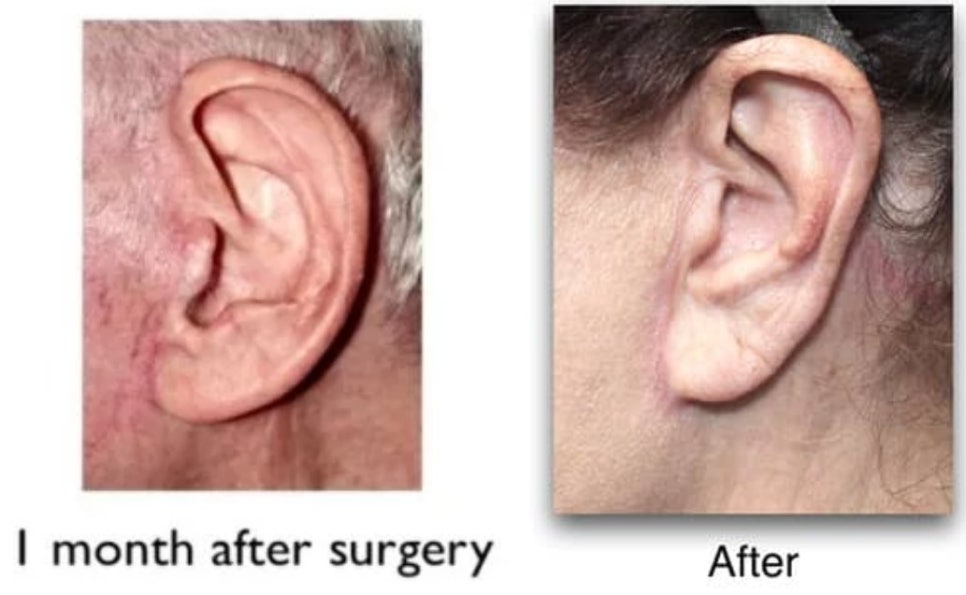
This is a photo uploaded overseas, saying it healed well and the scar is not visible.
White scars, sunken scars, raised scars... there are all kinds. Given my personality, I cannot leave something like that behind.
If a scar can be made less visible, but it is left that way because of time, I do not feel good about it.
The timing of suture removal and the follow-up care after removal also have a very large effect on scar formation, so all of that know-how is necessary.
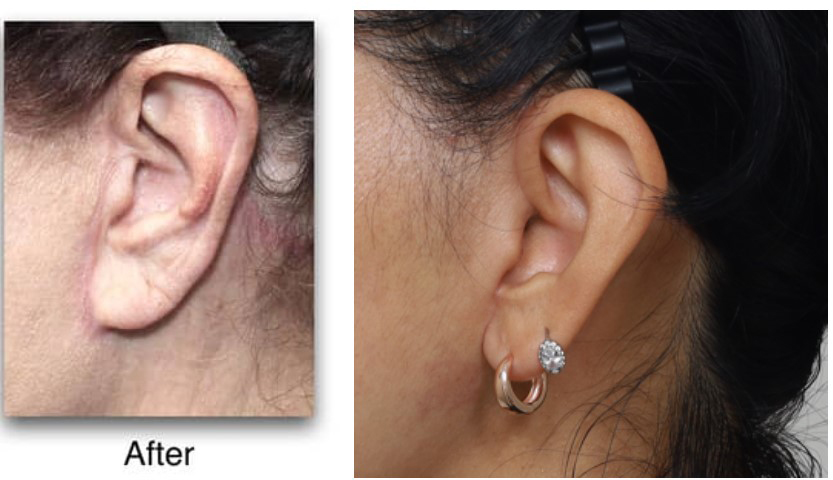
The left is the overseas photo I mentioned earlier, and the right is a photo of my patient from a similar time period.
"Doctor, people can’t tell where I had the surgery." Sometimes I keep working today just to hear those words.
Another downside of this method is that because people do not realize I had surgery, it can somewhat work against word-of-mouth spread.
Some people who really have good results choose to hide the fact that they had a facelift... but with this incision, even after just three months, it becomes difficult to tell that they had surgery.
As a result, there is a side effect in that the surgery is hidden effectively and word-of-mouth spreads less.
The bottom line is that the more care you put in, the less visible the scar can be.
Today I introduced the design of scars in front of the ear for facelift surgery.
If you have any questions, please let me know in the comments. Thank you.
Please also visit the blog below!