Hello.
I am Jae-won Heo, a board-certified plastic surgeon at Ipjeok Plastic Surgery, where I perform youthful facial plastic surgery.
Recently, in the clinic, I have often been seeing patients who are worried because a double chin remains even after chin surgery or square jaw surgery.
This is because, although contouring surgery improves the shape of the facial bones, it often does not create the sharp jawline or balanced side profile that patients expected.
The reason people say, “The CT looks good, but the actual face feels disappointing”
After contouring surgery, I often hear comments like these:
“The jawline looks pretty on the CT, but something still feels lacking in real life.”
“After chin surgery, the double chin seems even more noticeable.”
“I reduced my square jaw, but the jawline is not as sleek as I expected.”
This happens because the overall facial contour cannot be determined by bone shape alone.
In the double chin area, multiple layers of soft tissue lie over the bone, and even if contouring surgery reduces the bone volume, the skin, fat, muscle, salivary glands, and other tissues covering it do not shrink at the same time.
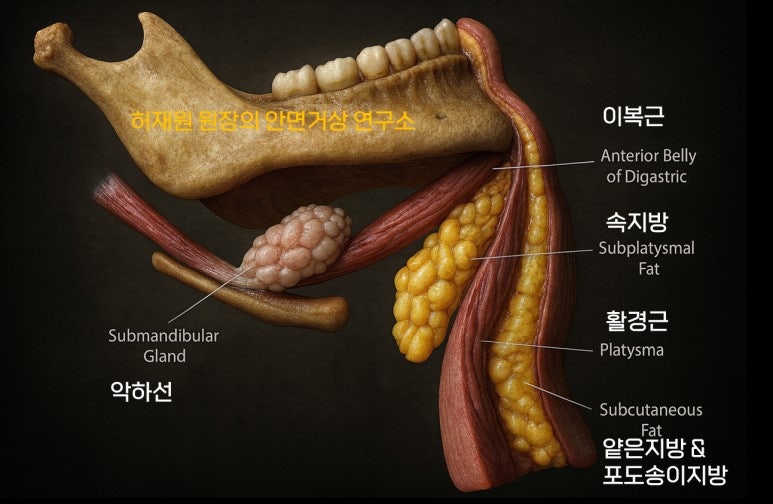
The chin and square jaw correspond to the deepest layer of the face, that is, the skeletal structure.
Above that are layered skin, fat, muscle, connective tissue, and salivary glands.
Contour surgery changes only one component, the “bone,” so even if the bone shape improves, the overall impression may change only slightly if the layers above remain the same.
In most cases, contouring surgery is performed to make the jaw smaller and slimmer.
Square jaw reduction, masseter muscle reduction, and cortical bone shaving are representative methods for reducing the angular areas of the jaw, and for the chin, procedures such as T osteotomy, ㅅ-shaped osteotomy, and contour shaving are often used to reduce width and length.
The problem is that when the bone is reduced in this way, the soft tissue above it does not shrink proportionally.
As a result,
-
People who originally had less soft tissue show a much more dramatic change after surgery, whereas
-
In cases with thicker soft tissue, the double chin or chin fullness may appear relatively more prominent.
Three main causes of a double chin after contouring surgery
The reasons a double chin remains or worsens after contouring surgery can be explained by the following three structural factors.
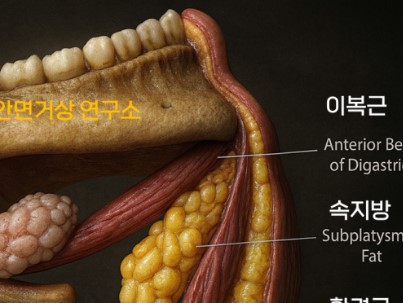
- Detachment of the digastric muscle
During some chin reduction procedures, the digastric muscle may become detached from the bone.
In this case, the muscle sags downward and bunches up under the chin, like a broken spring, forming a double chin.
Therefore, in revision surgery, the digastric muscle needs to be fixed again, and at the same time, fat reduction is required.
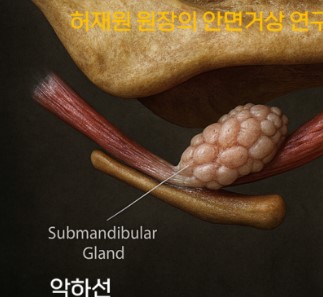
- Prominence of the submandibular gland
After square jaw surgery, the submandibular gland that was previously concealed by the jawbone may become exposed, and the volume of the salivary gland may show through the outer contour.
This is why the jawline may look smooth on a CT scan, but in the mirror the area under the chin appears uneven or saggy.
This type of submandibular gland prominence is difficult to correct with Botox injections, and actual surgical reduction or partial excision of the gland may be necessary.
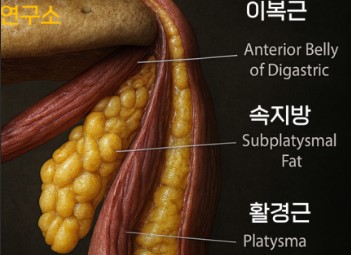
- Accumulation of subplatysmal fat
When the jawbone is reduced and the space becomes smaller, the fat beneath the muscle can be compressed and gather into the shape of a double chin.
This fat cannot be removed with simple liposuction alone, and precise layer-by-layer dissection and removal through a submental incision are essential.
A multilayer approach that can be addressed with a 2–3 cm incision
Fortunately, these problems can all be corrected through a submental approach alone, using a 2–3 cm incision.
Through a single incision, subplatysmal fat removal, digastric muscle refixation, and submandibular gland reduction can be performed at the same time.
In fact, when you look at the amount removed during surgery, you can see that the volume is larger than expected.
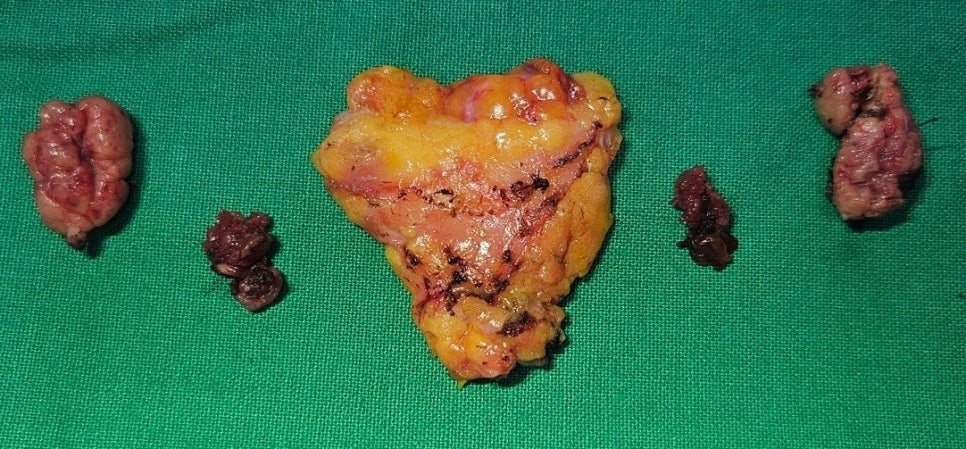
This multilayer corrective surgery (submental rejuvenation) is the key treatment for double chin problems after contouring surgery that cannot be solved by simple liposuction alone.
A double chin left after contouring surgery is not just a simple fat problem.
Contour surgery is a powerful way to refine the facial skeleton, but the answer to every problem is not only in the bone.
Especially in patients who have already undergone two-part contouring surgery (chin and square jaw), controlling the remaining soft tissue is very important aesthetically.
When treating a double chin, the following three structures must always be considered together.
-
Subplatysmal fat
-
Digastric muscle
-
Submandibular gland
Only when these three are accurately identified and included in the surgical plan can the “pretty jawline” seen on CT truly be recreated in the actual face.
If you would like to know more, please visit the blog below.
Thank you.