Hello, this is Director Jo Hyun-woo of Cube Plastic Surgery.
Today, let’s look at what side effects can occur due to excessive bone resection during contouring surgery.
In the past, there was a time when it was trendy to cut away as much as possible during contouring surgery.
If contouring surgery used to be about removing a lot of bone and creating dramatic changes, recently there seems to be a growing tendency to pursue safer surgery because of the side effects caused by excessive resection.
So what kinds of side effects can result from excessive removal?
Zygoma Reduction Surgery
The area of the cheekbone from which bone is removed is the 45-degree cheekbone area.
In the early days of cheekbone surgery, the amount of resection in the 45-degree cheekbone area was sometimes extremely large.
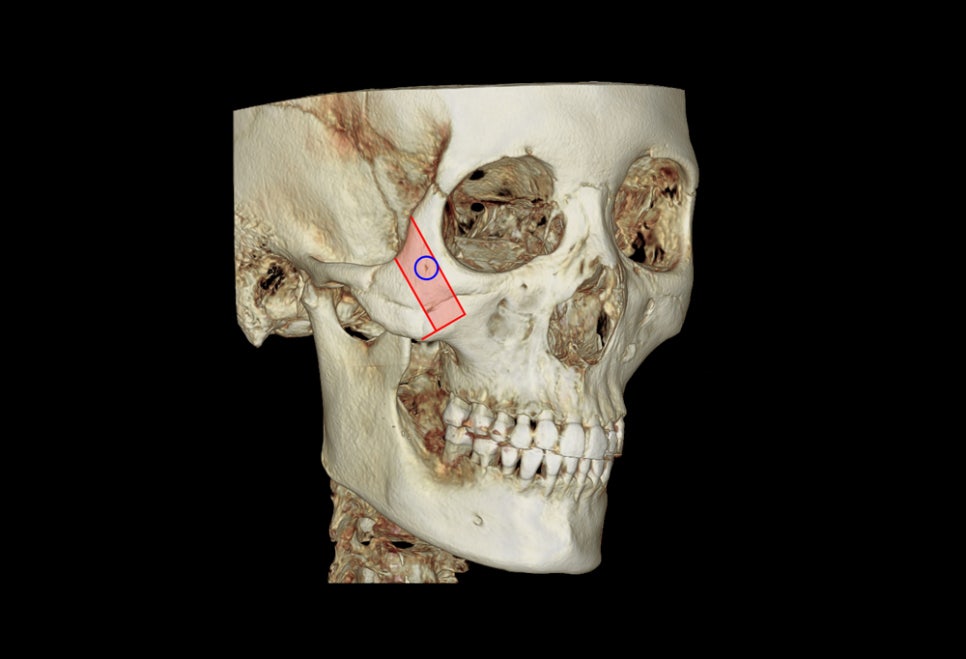
In some cases of L-shaped osteotomy, I saw cases where nearly 1 cm was resected all the way to the red area.
The blue circle, which I also mentioned in a previous column,
is the Zygomatico temporal nerve, which is responsible for sensation around the eye area, and there were cases where even that nerve was cut.
Of course, because this is a surgery in which the bone is cut close to the orbital bone, the width of the cheekbones can be reduced a lot in patients whose cheekbones look broad around the eyes.
However, side effects such as reduced sensation can occur, and the more bone is removed, the shorter the distance becomes for the back part of the cheekbone to reattach, so cases of nonunion occurred frequently.
When nonunion occurs, cheek sagging naturally develops, and if a large amount of cheekbone is removed, the sinus becomes more exposed, increasing the rate of sinusitis.
Many side effects of cheekbone surgery arise from this.
Another major issue is that the actual reduction in the 45-degree cheekbone area is not that large.
Therefore, these days, it seems that the amount of cheekbone removal is reduced and cheek rotation surgery that pushes the bone backward is performed more often.
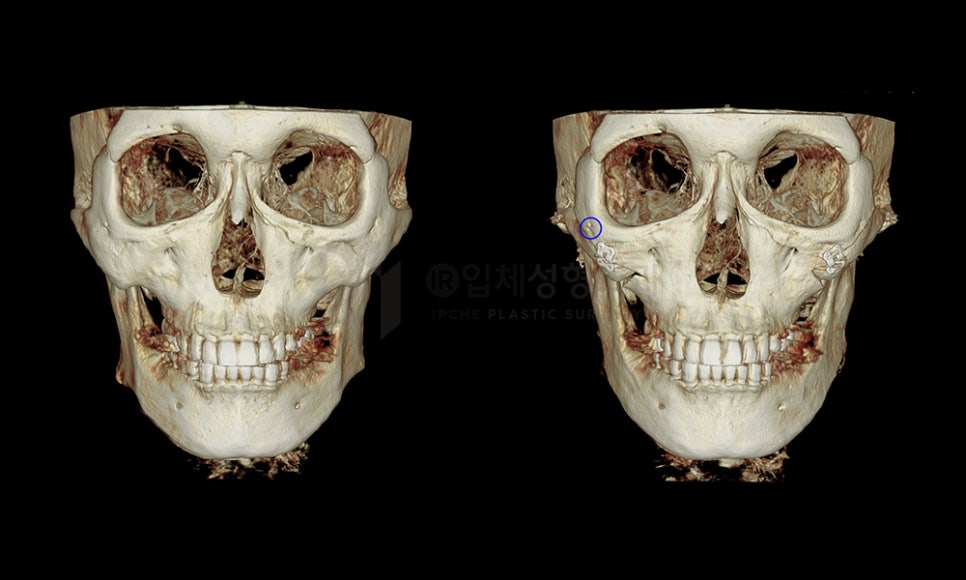
Before-and-after photos of a patient who underwent cheekbone reduction surgery while preserving the Zygomatico temporal nerve
Square Jaw Surgery
The most serious side effect of square jaw surgery caused by excessive bone removal seems to be nerve damage.
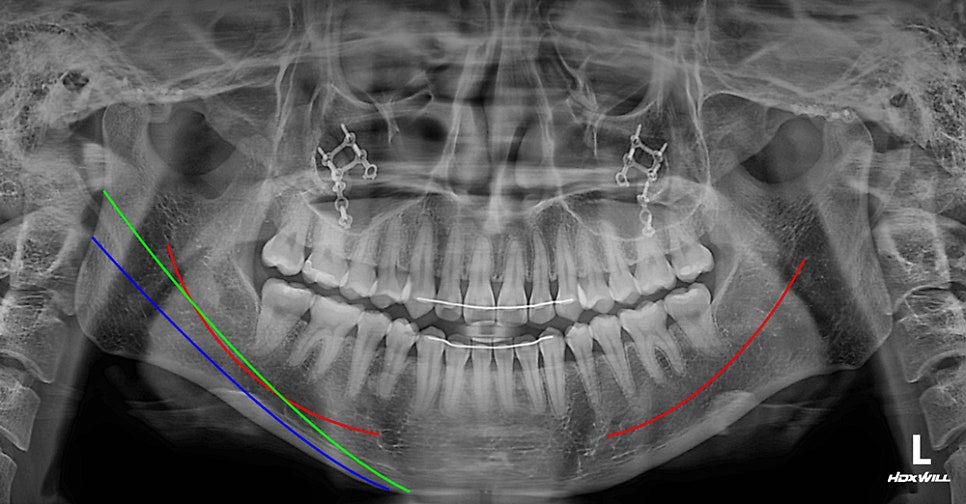
Red line (inferior alveolar nerve), blue line (appropriate resection), green line (excessive resection)
On the panoramic image, the red line shows the path of the inferior alveolar nerve.
In practice, if the best approach is to cut along the blue line, leaving a margin of 3–4 mm below the nerve line, there were also cases where surgeons cut as far as the green line in order to remove as much of the square jaw bone as possible.
If the nerve is cut when the bone is being removed, this causes nerve damage that cannot be reversed forever.
The inferior alveolar nerve is a sensory nerve, so if it is severed, sensation in the lower jaw area is completely lost.
If food spills out or saliva drips, you would not feel anything at all. Motor problems can also occur, and the shape of the mouth may become abnormal.
Some people may say, “It’s fine, please cut as much as possible,” but it would be good to know that this can lead to truly terrible consequences.
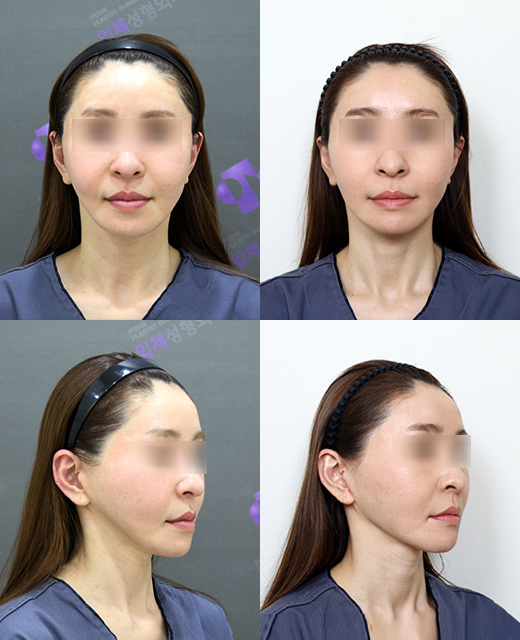
This patient underwent fat grafting in the square jaw area to improve the so-called “goat chin” and chin indentations caused by excessive square jaw resection.
It is not noticeable from the front at all, but from the side, if too much jawbone is removed, the face can look longer and become unnatural.
Sometimes, if too much is removed, the bone can even fracture, so it is always best to be careful and cut safely.
Chin Surgery
If excessive resection is performed during chin surgery, nerve damage can occur, just like in square jaw surgery.
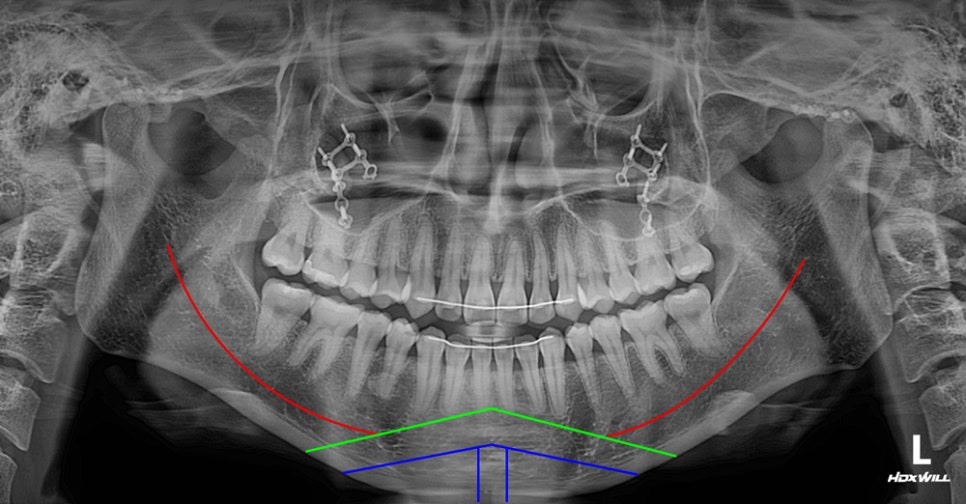
Red line (inferior alveolar nerve), blue line (appropriate resection), green line (excessive resection)
The red line is the path of the inferior alveolar nerve.
A typical T-shaped osteotomy should be performed below the nerve line, as shown by the blue line.
If the osteotomy line is raised because you want to reduce the chin too much, nerve damage like the one mentioned earlier can occur.
Also, if too much bone is removed with a T-shaped osteotomy and too much of the middle bone is resected, the remaining bone may be too small and get resorbed and disappear.
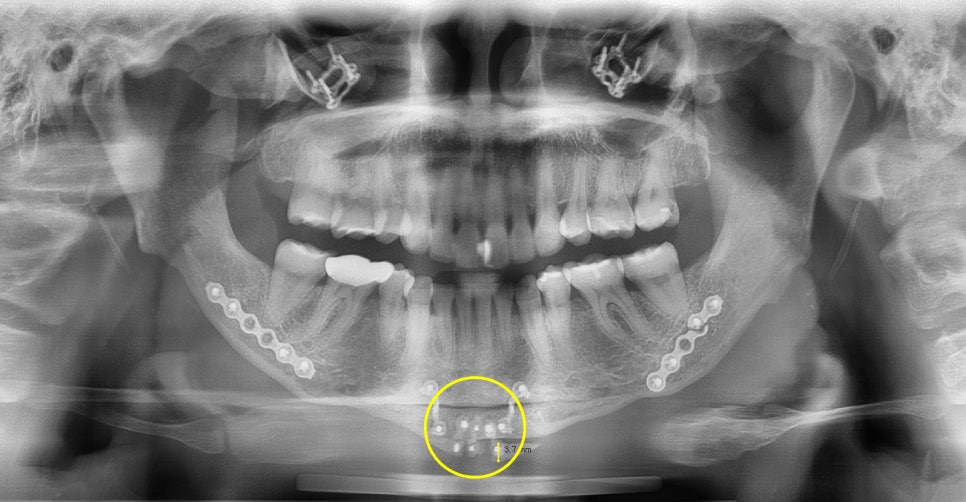
This photo shows a panoramic image of a patient who had surgery one year ago.
At the time of surgery, there would have been bone remaining below the T-shaped osteotomy, but perhaps because unnecessary dissection was performed, the bone fragment was too small and may have been resorbed.
At present, there are also areas where only the fixation pin can be seen by itself.
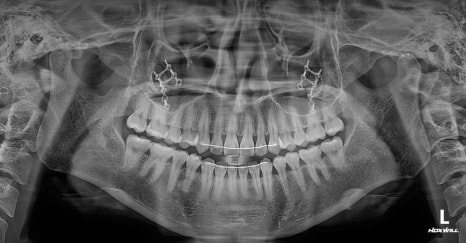
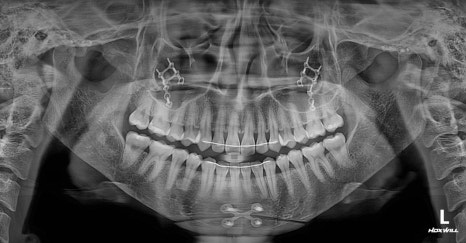
Before-and-after CT scans of a patient who underwent square jaw surgery and chin surgery while preserving the inferior alveolar nerve
I think surgery may sometimes require bold bone removal in order to achieve good results.
However, if excessive resection leads to fatal side effects rather than good results, I think that is a bigger problem.
Today, we looked at the side effects of contouring surgery caused by excessive resection.
Of course, I understand the feelings of patients who want their faces to be smaller by cutting as much as possible, but if you think that safer surgery with fewer side effects may be better in the long run, it may be wise to reduce a little of that desire and approach contouring surgery with more caution.
Thank you.