Hello.
I am plastic surgeon Huh Jae-won, who studies surgeries that make people look younger and help them age in reverse.
I have written about forehead lifts several times before, but many people still ask questions about the “fixation method.”
It seems this has become an important topic of interest for patients as well.
What I always emphasize is this:
In a forehead lift, the biggest factor determining the result is the “dissection range,” that is, the extent of the surgery.
The fixation method, of course, cannot be ignored, but its overall impact on the final result is relatively small.
That said, it is true that the position of the fixation points and the pulling strength can be used to fine-tune the shape of the eyebrows.
A realistic approach to the amount of pulling
Recently, through YouTube, I received questions such as “How many mm can the eyebrows be raised, or can each area be adjusted in millimeter units?”

To begin with the conclusion, a forehead lift is not a precise surgery in 1 mm increments like double-eyelid surgery.
Of course, it may sound nice to answer, “Yes, it is possible,” but if you understand the structure and principles of the surgery, you will naturally see that it is not that kind of procedure.
That does not mean there is no target at all.
Before surgery, I always calculate and set a target for how much lift to achieve.
However, it is not a surgery that can be adjusted quantitatively by saying “4 mm or 5 mm.”
In my experience, even if the lift is sufficient immediately after surgery, on average about 3 mm of the skin returns to its original position over time.
If the skin is thick and firm, it returns more; on the other hand, if the skin is soft and the sagging is severe, it returns less.
In other words, because the amount of recovery varies depending on skin characteristics, predicting it in 2 mm or 4 mm units is close to impossible.
For example, let’s assume a patient says, “My glabella is pressed down, so please lift it about 5 mm, and lift the outer corners of the eyes slightly more, about 6 mm.”
In that case, taking the average amount of regression (about 3 mm) into account, during surgery we would need to lift it about 8 to 9 mm to achieve the desired final result.
This is not a surgery done by intuition, but a calculated approach based on systematic target setting.
Comparison of fixation methods: Endotine/FixTine vs. bone tunneling
Now, let’s return to the main point and look at the fixation methods themselves.
The representative methods are Endotine/FixTine devices and the bone tunneling method.
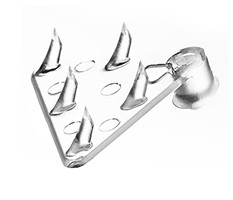
Endotine
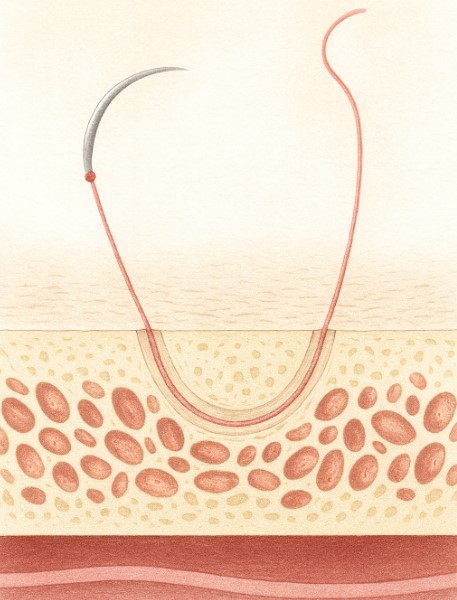
Bone tunneling
① Number of fixation points
An Endotine or FixTine device has about five fixation points per unit.
So if two are used, there are a total of 10 fixation points.
By contrast, in bone tunneling, one strand of suture is passed through one tunnel, so each one creates one fixation point.
Even if three sites are performed, only three fixation points are made.
In other words, in terms of the number of fixation points alone, the Endotine/FixTine method provides stronger mechanical fixation.
However, it is not necessarily true that 10 are required.
Bone tunneling alone can also produce sufficiently stable results.
For example, if a passing score on an exam is 50 points, both 60 and 80 points are passing scores, but 80 points is still somewhat better.
② Ease of adjustment during surgery
Another advantage of the Endotine/FixTine method is that fine adjustments can be made during surgery.
Because this device fixes tissue in a structure similar to hanging it on a hanger, if the surgeon feels “I want to lift it a little more” or “Let’s lift it a little less,” it can be adjusted relatively easily.
On the other hand, bone tunneling is secured by tying with sutures, so once it is tied, it is not easy to revise.
If it is pulled less or more than expected, there is the inconvenience of cutting the existing suture and tunneling again.
In other words, it comes with the surgical tension of having to finish accurately in one attempt.
③ Cost and perceived effect
Both Endotine and FixTine are expensive materials.
Imported Endotine is especially costly, and even domestically made FixTine can add material costs of several hundred thousand won for just one pair.
Therefore, the surgery cost differs depending on which of the two devices is selected.
However, in my personal opinion, the difference in effect relative to price is not felt to be very large.
Rather, the drawbacks unique to Endotine/FixTine, such as foreign-body sensation or nerve irritation symptoms, may cause discomfort.
In conclusion,
“Strictly speaking, the Endotine/FixTine method has a slight surgical advantage, but bone tunneling alone can still produce sufficiently good results.”
That is a fair summary.
Some patients come in with preconceived notions or concerns about a particular fixation method, but if the surgical principles are understood correctly, either option can be chosen appropriately. I always explain that both methods can be proposed comprehensively, taking into account the patient’s skin condition, thickness, and degree of sagging.
Today, I talked about the differences in fixation methods for forehead lift and forehead reduction surgery: bone tunneling, Endotine, and FixTine.
If you have any further questions, please leave them in the comments and I will answer sincerely.
Thank you.