Hello.
I am plastic surgeon Heo Jae-won, who studies surgeries that make people look younger.
These days, I have been steadily reading papers related to aesthetic plastic surgery through various research tools.
In the process, I noticed topics that patients often ask about.
One of them is the “buccal fat pad (BFP),” the cheek fat below the cheekbones.
Today, I would like to talk about how this buccal fat pad is related to facial aging, and how surgery that partially reduces it can lead to a more youthful effect, based on recent papers.
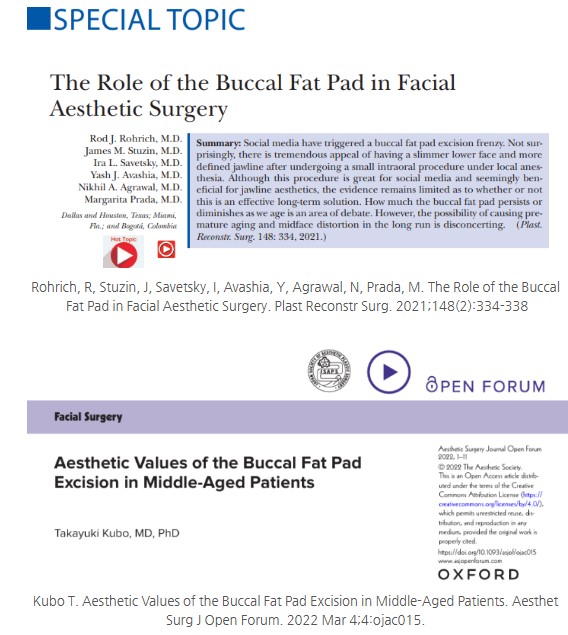
Rohrich RJ et al., The Role of the Buccal Fat Pad in Facial Aesthetic Surgery, Plast Reconstr Surg. 2021;148(2):334–338.
Kubo T, Aesthetic Values of the Buccal Fat Pad Excision in Middle-Aged Patients, Aesthet Surg J Open Forum. 2022;4:ojac015.
What is buccal fat?
Buccal fat is a fat layer located deep between the chewing muscles and facial expression muscles.
When we are young, this fat is plump and gives a cute, youthful impression.
It is what people often call “baby fat.”
But as we age, the story changes.
This fat gradually sags downward, placing weight on the area around the mouth and blurring the jawline.
In the end, it can create marionette lines that extend below the nasolabial folds and cause the corners of the mouth to droop.
The key issue is not simply the amount of fat, but the change in its position.
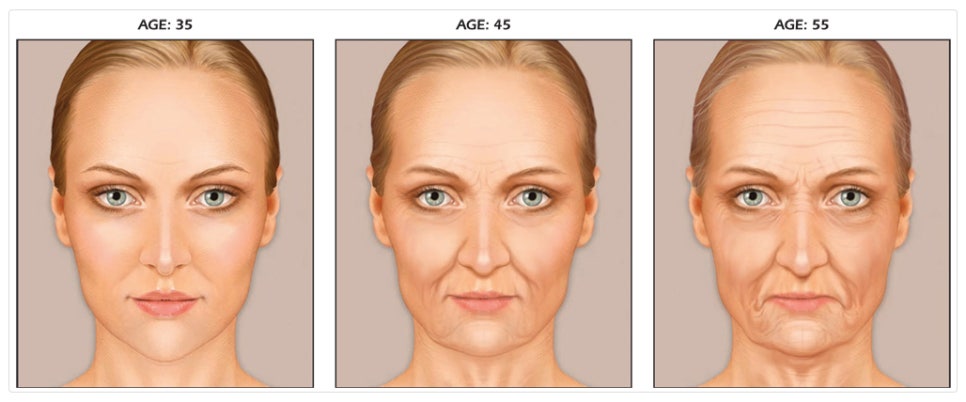
How the face’s center of gravity changes with age
From the 50s onward, the cheek fat below the cheekbones begins to descend, making the area around the mouth feel heavier and the jawline look less defined.
That is why many people say things like:
“My cheeks keep sagging,” “The area around my mouth looks heavy,” and “My jawline seems to have lost its shape.”
This is not simply because there is too much fat, but because the fat has lost its position and started to sag.
Even in people in their 20s and 30s, if this buccal fat pad is naturally abundant, the cheeks may look too full and the face may appear larger.
In particular, after contouring surgery that reduces the cheekbones or lower jaw bone, this buccal fat pad can sometimes appear bulging.
In such cases, the volume is reduced through a small incision inside the mouth.
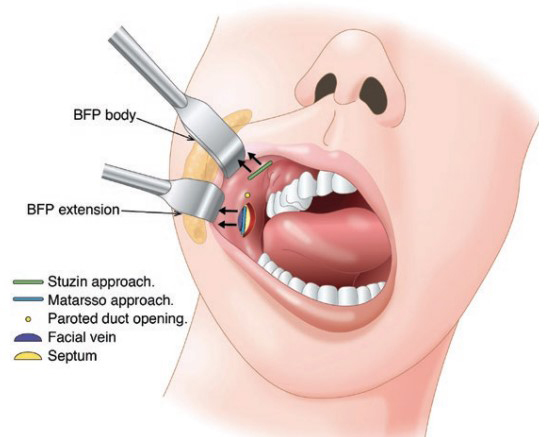
The surgical effect seen in research
In Kubo’s 2022 study, buccal fat removal was performed on 133 patients.
After surgery:
-
The volume of the lower face decreased,
-
The jawline became more defined, and
-
A slightly lifted appearance around the mouth was observed.
What is interesting is that the average amount removed was only 1.6 g.
This means that results depend more on where and how delicately the area is treated than on how much is removed.
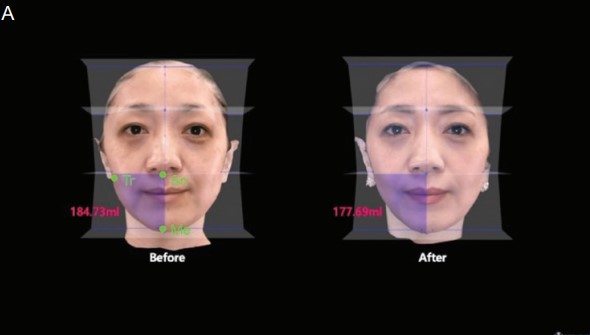
What matters is not the amount, but the location
Buccal fat surgery is not a procedure that simply removes fat to make the face slimmer. Extra caution is especially needed in middle-aged patients.
That is because an older face is not simply one with more fat, but one that has become heavy from sagging.
So during surgery:
-
Removal should be conservative, focusing on the lower lobe,
-
The upper lobe must be preserved,
-
And the incision line should be designed in a direction that makes access to the lower lobe easier.
If these principles are not followed, the cheeks may become hollow instead, creating a tired appearance or, in severe cases, asymmetry.
It is more stable when combined with lifting
If skin elasticity has decreased significantly, simply addressing the buccal fat pad will not solve the problem.
In such cases, combining it with a facelift or neck lift can help balance the entire face and achieve a much more natural result.
It is better to understand this not as a “fat-reduction surgery,” but as a process of correcting sagging structures.
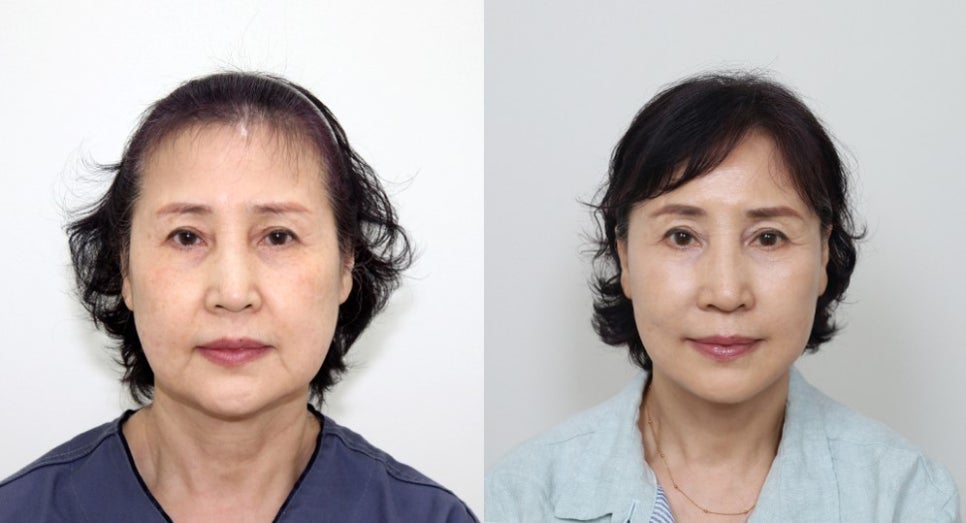
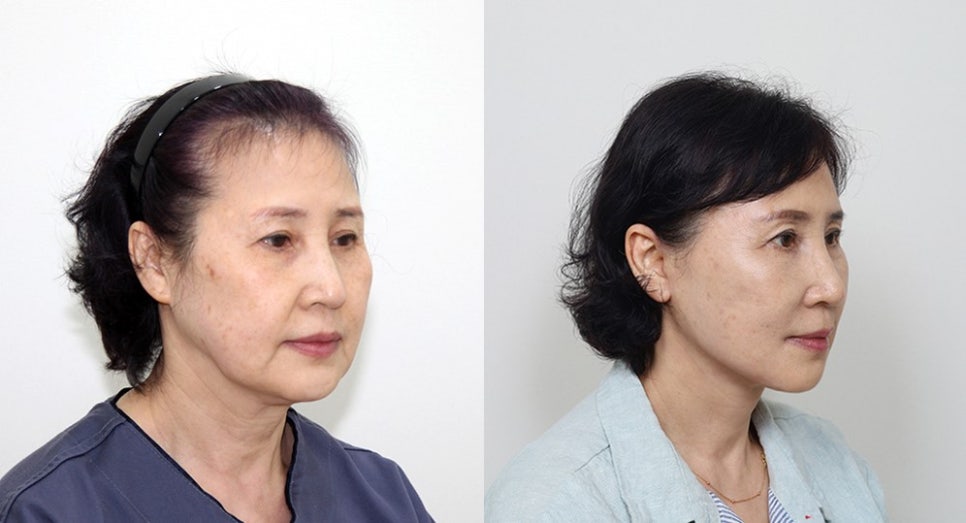
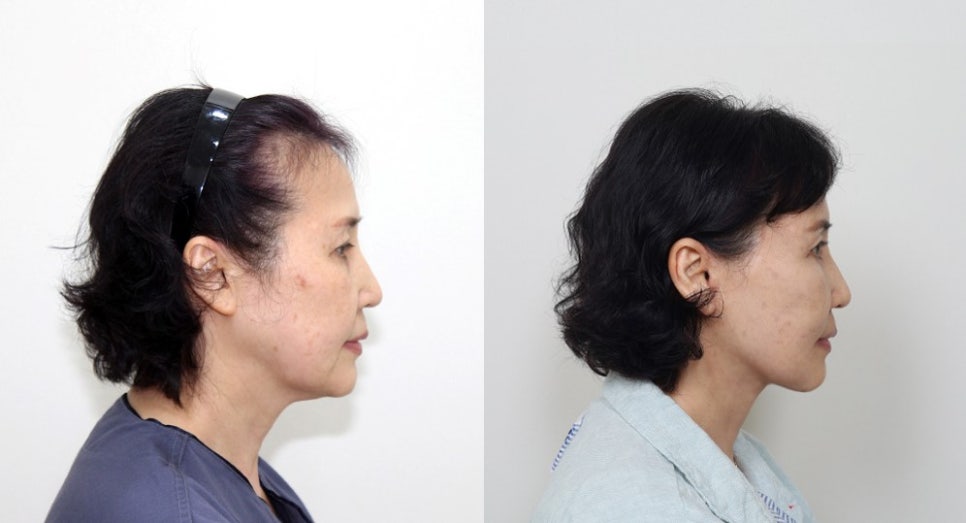
A real surgical patient who underwent a facelift and neck lift together.
Buccal fat removal is a surgery that is not visible from the outside, but one that resets the “center of gravity” deep within the face.
When performed appropriately, it makes the area around the mouth and jawline feel lighter, and the overall impression becomes much brighter.
However, it is not a procedure that everyone needs.
Anatomical understanding, experience, and a conservative approach must all be in place in order to expect a natural and lasting result.
I believe this surgery is not simply a procedure to remove cheek fat, but a process of “rebalancing the face.”
If you have any further questions, please leave them in the comments or send me a message.
Even if it takes a little time, I will be sure to reply.
Thank you.