Hello.
I’m plastic surgeon Heo Jae-won, and I study surgeries that make people look younger and more refreshed.
Recently, inquiries about under-eye fat, hollowness, and sagging have been steadily increasing.
In the late 30s, people first begin to notice deeper under-eye wrinkles or grooves, and they start to experience issues such as makeup not sitting well or settling into wrinkles.
In reality, however, many people postpone care because of busy schedules and childcare, so the age at which they actually visit the clinic is often in their 40s or 50s. They usually come in when they start thinking, “I can’t keep going like this anymore.”
Today, I’d like to explain how I combine generational lower blepharoplasty perspectives to create a surgical plan through the case of a male patient in his early 50s.
A Man in His Early 50s Showing Moderate Sagging Similar to His Late 40s
The patient I’m introducing today is in his early 50s, but his overall impression is relatively youthful, so the actual degree of sagging is closer to that of someone in their late 40s.
Previously, I explained the generational approach to lower blepharoplasty using cases of patients in their 60s and 70s.
The principles of lower blepharoplasty are the same, but the younger the age group, the lower the level of difficulty tends to be.
If this four-stage classification is your first time seeing it, referring to the earlier post will help you understand it more easily.
First-Generation Perspective: The Problem of Protruding Fat (Orbital Fat)
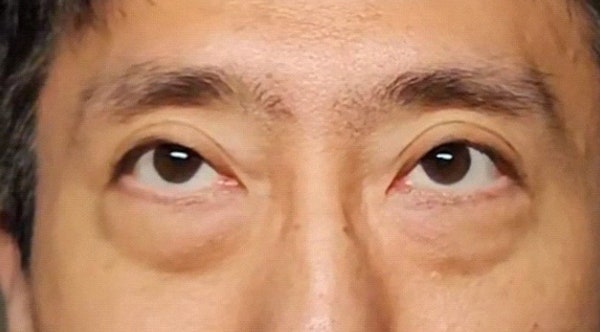
This patient had clearly visible forward-protruding orbital fat.
However, in people in their 40s and 50s, the degree of protrusion is milder than in those in their 60s and 70s, so there is no need to remove excessive amounts of fat.
★ First-generation surgical plan
Second-Generation Perspective: Hollowness of the Tear Trough
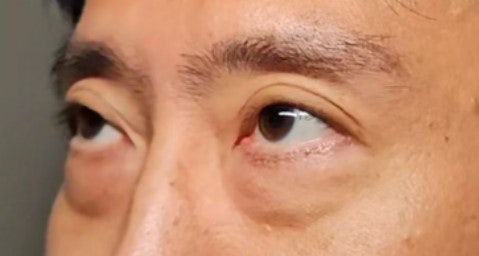
This patient had a clearly sunken tear trough directly below the protruding fat.
Therefore, simply removing the fat would make the lower hollowing stand out even more, so repositioning is essential.
★ Second-generation surgical plan
Third-Generation Perspective: Evaluation of Orbicularis Oculi Muscle Function and Asymmetry
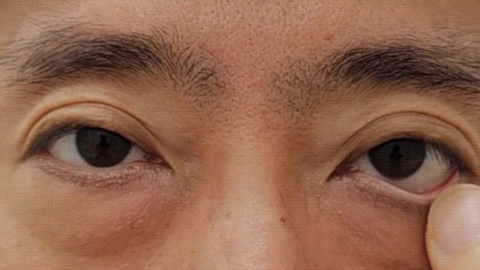
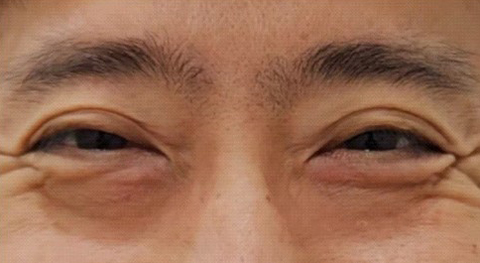
In people in their 40s and 50s, orbicularis oculi muscle elasticity is relatively good because facial muscle activity is still active.
This patient also did not show a degree of looseness that required surgical fixation on the elasticity test.
However, asymmetry in the under-eye volume when smiling was noticeable, and taking this into account during surgery makes the result more natural.
★ Third-generation surgical plan
Fourth-Generation Perspective: Involvement of the Midface Structure (Ligaments and Cheek Sagging)
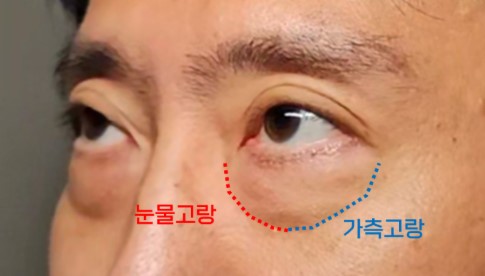
This patient did not have severe Indian lines, but the tear trough and lateral groove were relatively distinct.
This is a form that appears especially often in men with stronger ligament structures.
The process of opening these ligament-related grooves and lifting the upper cheek is the midface lift (SOOF·DNLF lift).
If this is not addressed, shadows in the groove area may remain even after under-eye surgery, reducing satisfaction.
★ Fourth-generation surgical plan
- Improve the overall zygomatic–nasolabial–upper cheek line through midface lifting (SOOF + DNLF)
Personal Technique +α: Refining the Details Based on the Fourth-Generation Approach
Based on the basic structure of the four stages above, I added the following techniques to improve the completeness of the surgery.
★ Final surgical plan summary
-
Remove only the necessary amount of fat (1st generation)
-
Precisely reposition the remaining fat (2nd generation)
-
Consider balance in under-eye volume + orbicularis suspension (3rd generation)
-
Midface lifting (SOOF + DNLF) (4th generation)
-
+α (personal technique refinements)
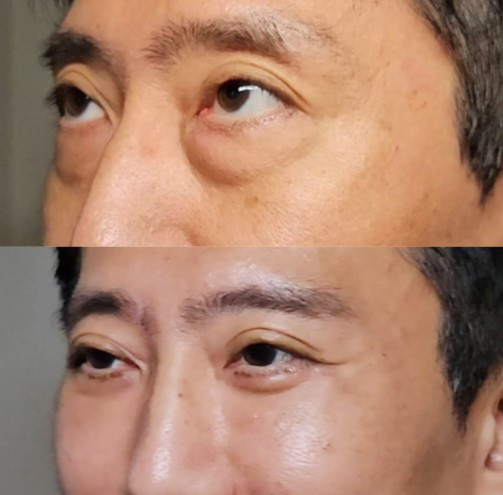
Before surgery / 2 months after surgery
This case was an example of how the generational concepts of lower blepharoplasty are combined and applied in actual clinical practice through a male patient in his 50s.
Since people in their 40s and 50s are entering the stage where midface aging begins in earnest, the key is not simple fat removal but fat repositioning + midface lift (SOOF lift).
If you’re curious about which stage you fall into, please leave a comment and I’ll check and reply.
Thank you for reading.