Hello.
I’m Huh Jae-won, a board-certified plastic surgeon performing rejuvenation surgery at Iple Plastic Surgery.

The recent popularity of Black and White Chef Season 2 has been enormous.
Personally, I’m not someone who usually enjoys cooking programs, but while watching a few episodes by chance, I noticed an interesting structural similarity.
The contrast between “popular food” and “fine dining” shown in this program unexpectedly offered many insights into understanding plastic surgery care as well.
Food that satisfies 100 people, and food made for one person
In the team missions on the show, 100 members of the general public actually taste the food and vote one person, one vote.
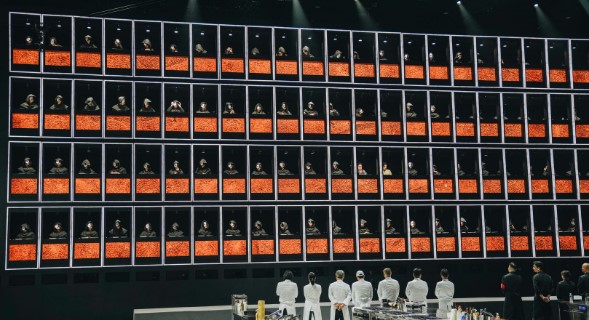
This is a completely different game from a mission judged by just a few judges.
At this stage, a generally solid choice is far more advantageous than a dish that precisely targets a specific taste.
One thing becomes clear here.
The difference between popular food and fine dining is not about which tastes better, but about how the goal is set.
The goal of popular food is clear. Cooking time should be short, it should not cause strong rejection from anyone, and turnover should be high.
On the other hand, fine dining is different.
The chef serves only a limited number of people each day with the best menu they can present that day.
They personally select the ingredients, cook them in the way that best brings out those ingredients, explain the meaning and flow of each dish, and even design the order in which the dishes should be eaten so that the full experience is complete. In other words, fine dining is not food made to sell in large quantities, but a structure that creates an experience with maximum completion.
The problem is that this structure is very unfavorable from a business perspective.
Fine dining chefs often say the same thing in interviews.
“Fine dining does not structurally make money.” “The ingredient cost is too high.” “Among chefs, fine dining pays the lowest salary.”
Here, ingredient cost does not simply mean the price of food ingredients.
-
Time spent selecting ingredients
-
Time required for cooking
-
The skill needed to maintain quality above a certain level
All of these are costs.
There is a clear limit to how many guests can be served in a day, and the ways to increase revenue are very limited.
In other words, fine dining was not designed from the start with profit maximization as its goal.
Plastic surgery has the same structure.
At this point, I naturally thought of plastic surgery.
Plastic surgery also clearly has two different structures.
-
A structure that performs surgery for 5 people a day, giving each a 60-point operation
-
A structure that performs surgery for 1 person a day, giving that person a 90-point operation
To put it a little more numerically:
- Reduce the time per person, charge 400 each for 5 people, and produce results worth 60 points on average.
- Charge 800 for 1 person and produce a 90-point result.
If we look only at revenue, the former is likely to be more than twice as efficient.
Considering hospital operations, the doctor’s labor time, and risk management, this is by no means an unreasonable choice.
In facelift surgery, the “ingredient cost” of fine dining is time.
Just as ingredient cost is the key expense in fine dining, the biggest cost in facelift surgery is time.
Among facial surgeries, facelift surgery is one of the operations that covers the widest area.
There are many surgical tasks that must be done to improve the result even slightly.
The important point here is that the difference between the time needed to make a 60-point result and the time needed to make a 90-point result is not simply 1.5 times; in practice, it feels closer to several times.
Every detail increases surgery time and concentration exponentially, and that time becomes the “ingredient cost.”
Baek Jong-won and Ahn Sung-jae, and a realistic choice
While watching Black and White Chef, two symbolic figures came to mind.
- Baek Jong-won: the symbol of popular food
- Ahn Sung-jae: the symbol of fine dining
Realistically speaking, Baek Jong-won is likely to be overwhelmingly larger in terms of assets and business success.
Then the question is this.
What path would people actually want to choose?
Fine dining may look impressive, but once people realize the reality of low profitability, high ingredient cost, and long working hours, most will choose the path of popular food. From a business standpoint alone, fine dining is by no means a rational choice.
However, there is a decisive difference in plastic surgery.
That said, surgical procedures in plastic surgery are fundamentally different from food in one key way.
Food can be changed. If you don’t like today’s choice, you can go to a different restaurant tomorrow. The cost of failure ends with one meal.
But surgery is different.
The surgical result remains on the face that the patient sees 24 hours a day, 365 days a year.
They experience the result of an only-okay choice again and again every time they look in the mirror or meet other people.
For this reason, especially in facelift surgery, it is difficult to avoid an approach that is close to fine dining.
This article is not meant to be promotional content saying, “I do fine dining.”
Facelift surgery is not an operation that is efficient or highly profitable, but I wanted to explain that its nature makes it a field that has no choice but to work that way.
Of course, there are certainly procedures where a faster, more efficient approach produces better results.
Like a chef who studies cooking, I plan to continue thinking about and studying facelift surgery.
Today, I organized my thoughts from that process.
Thank you for reading.