Hello.
I am Huh Jae-won, a board-certified plastic surgeon who studies surgeries that make people look younger.
When I consult with facelift patients, there is one question I surprisingly hear quite often.
“Doctor, is a drain bag really necessary?” “I heard some hospitals don’t use a drain bag.”
Today, I’d like to talk about this question calmly, with a focus on the points that really need to be addressed.
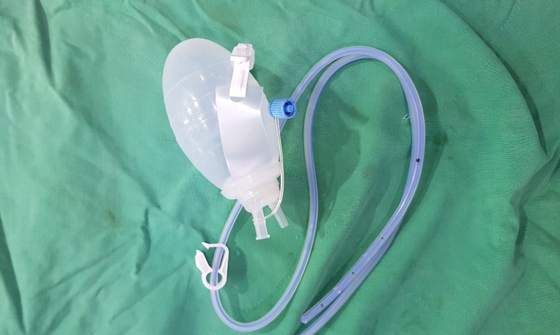
Drain bag
The misunderstanding created by saying “we don’t use a drain bag”
The phrase “we don’t use a drain bag” can sound very positive to patients.
It can make the surgery seem so clean that there is almost no bleeding.
But from a doctor’s perspective, this expression can create a misunderstanding that is a little different from the actual recovery process.
Let me give you a simple example.
When you fall and lightly scrape your skin, it bleeds at first. Then the bleeding stops quickly.
But after that, many of you have probably experienced clear fluid continuing to seep from the wound for a few days.
Because of this fluid, the gauze gets wet and the dressing has to be changed repeatedly.
Facelift surgery is not a “small wound”
Facelift surgery is not a procedure that only deals with the skin.
It is a fairly large-scale surgery that involves wide-area skin dissection while also working on the deeper tissues and fascia.
So no matter how well bleeding is controlled, postoperative exudate (clear fluid) from the tissues during the first 2–3 days cannot be avoided.
This is not a matter of whether the surgery went well or poorly; it is closer to a normal bodily response.
So what happens if this fluid cannot leave the body?
In most cases, it pools between the tissues, and that becomes swelling.
If the amount increases, it can also lead to a seroma, where fluid collects in a pocket-like space.
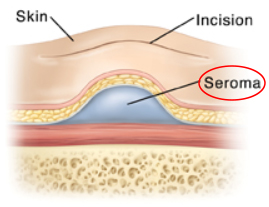
Seroma
The particularly important first 3 days after surgery
The first 3 days after facelift surgery are a very important period in the recovery process.
During this time, the deeper tissues, fascia, and skin need to make firm contact with one another and adhere stably for good results and faster recovery.
But if fluid is present in between, the tissues cannot properly adhere.
In such cases, you may need to wait for natural absorption, or repeatedly drain the fluid with a syringe if necessary.
To prevent this situation, a drain bag or drainage tube is used for about 1–2 days after surgery.
It is not fair to say there is no discomfort at all, but during that period it sufficiently removes the fluid produced inside the body.
As a result, swelling is reduced, the chance of seroma decreases, and recovery may actually become faster.
Some people connect this process to the surgeon’s skill, but I do not think that is the right way to look at it.
Rather, it is closer to the area of recovery planning: anticipating the postoperative course and considering possible problems in advance.
Because doctors are not gods, it is better to prepare for situations that might happen rather than assume that “nothing will happen.”
Different hospitals may use different terms such as “drain bag,” “drainage tube,” or “drain.” But the essence is the same.
It is a device for draining fluid produced after surgery to the outside of the body. The only difference is whether it has a collection bag attached.
Personally, I think the type with a bag attached, which makes it easier to check and manage the output, is functionally more stable.
What really matters in a facelift
What matters in a facelift is not the statement “there is no bleeding.”
What matters much more is how the recovery process after surgery is prepared and managed.
Even with the same surgery, the patient’s experience can differ greatly depending on how recovery is designed.
When you receive a consultation, I recommend that you be sure to check this point as well.
Thank you.