Hello, this is Dr. Jo Hyun-woo of 입체성형외과.
When people come in for consultations about square jaw surgery, they often have two main concerns.
Some want to get rid of a square jaw that looks angular from the side, while others are worried about a jaw that looks wide from the front.
Of course, many people have both concerns at the same time.
Today, I’d like to talk about how square jaw surgery should be approached in order to create the face you want.
First, the square jaw I’ll talk about is a jaw that looks angular from the side.
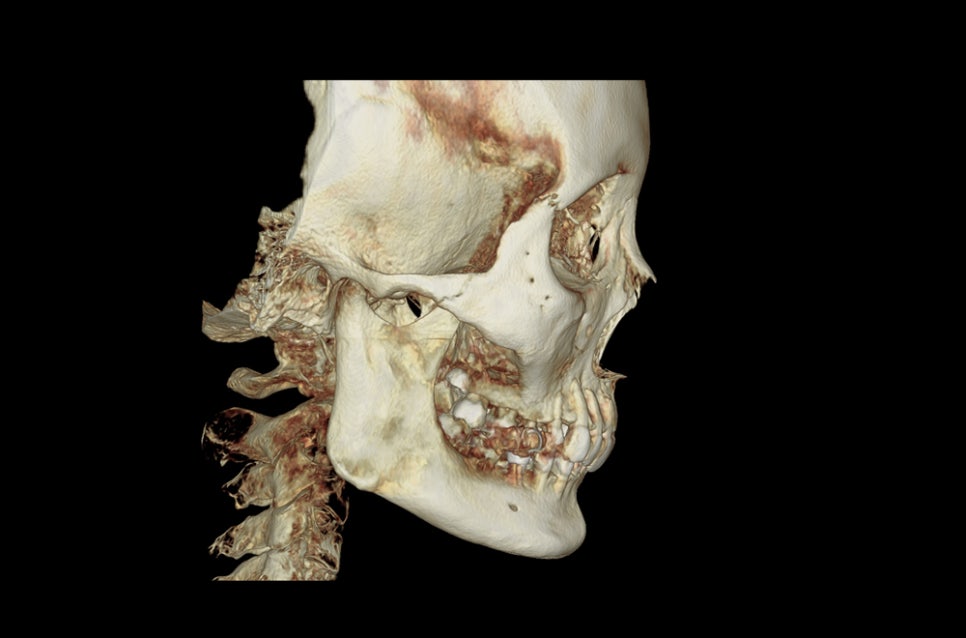
CT image of a jaw that looks angular from the side
As you can see in this image, this patient’s square jaw angle is very prominent from the side.
As I mentioned before while reviewing related papers, the ideal angle of a square jaw is generally known to be around 120 to 130 degrees. In cases like this, simply refining an excessively developed square jaw angle to an appropriate angle can make the jawline seen from the side look much more natural and ideal.
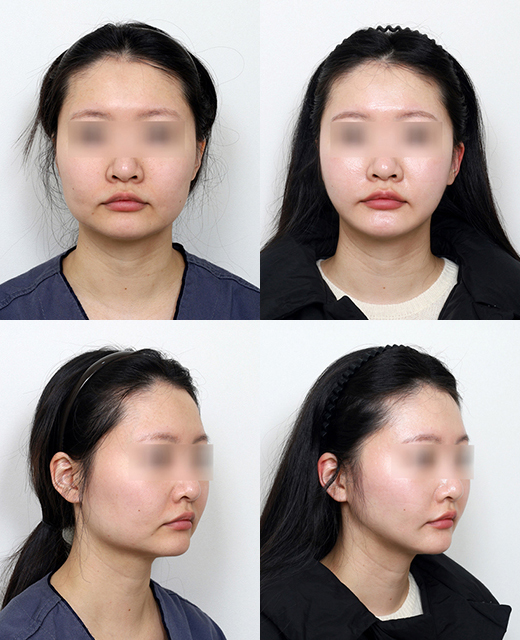
In cases where the jaw looks angular from the side: square jaw surgery
In fact, this kind of surgery can be considered the most basic method of square jaw surgery.
Because adjusting the jaw angle appropriately alone often leads to a major improvement in the side profile, it is also a procedure that can deliver dramatic changes and high satisfaction.
When I first started performing square jaw surgery, there were many patients with a significantly developed side angle like this.
However, when I look at people coming in for consultations these days, many do not have a highly prominent square jaw angle. Instead, they often want to maintain a natural side angle to some extent while making their face look slimmer from the front. This is where the concepts of a curled jaw and a protruding jaw come in.
I’ll show you CT scans of the two types.
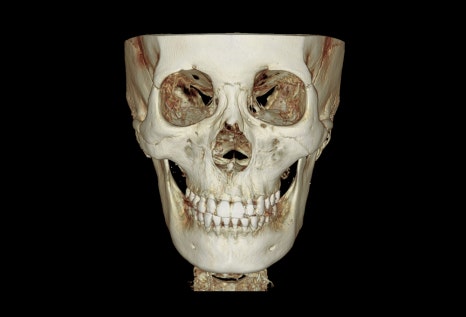
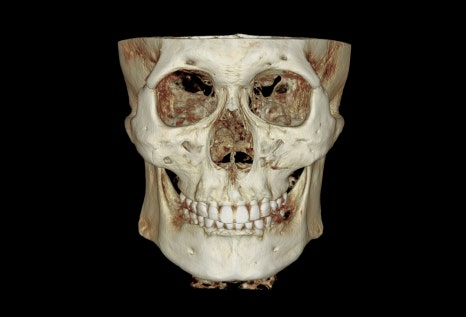
(left) curled jaw, (right) protruding jaw
As you can see, when you check the CT from the front, the shape of the square jaw angle appears differently from patient to patient.
Some people have a jaw angle that curls inward, while others have a shape that protrudes significantly outward.
For example, in the case of a protruding square jaw, cutting the jaw angle can produce a dramatic effect even from the front.
Simply removing the jaw angle can make the face look much slimmer from the front as well.
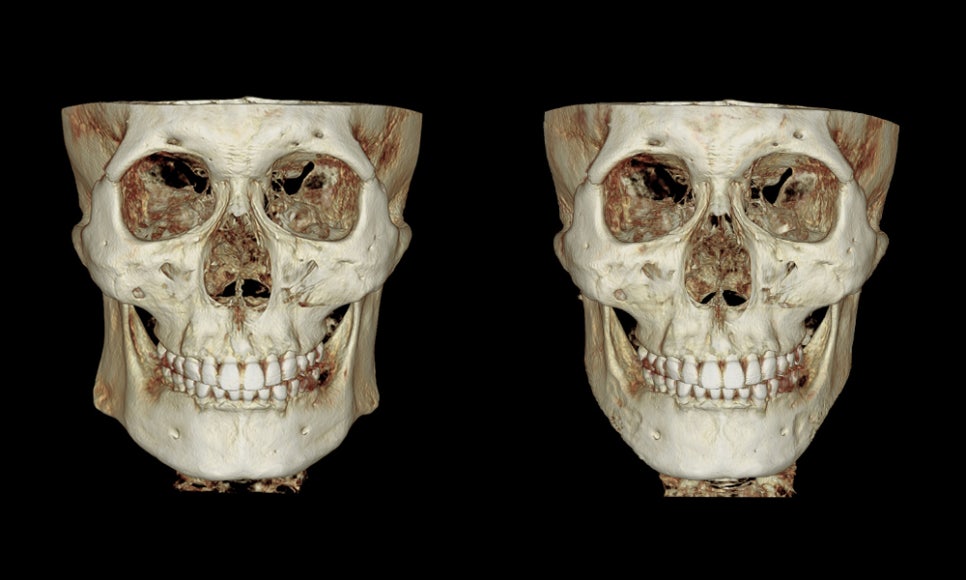
In cases of a protruding jaw, square jaw surgery can produce a dramatic frontal effect
However, as I mentioned earlier, many of the people who come in for consultations these days do not have a heavily developed square jaw angle.
Even if the jaw protrudes outward, there are cases where there is not enough bone that can be removed.
In such cases, the procedures used to improve the frontal effect include cortical bone contouring, masseter muscle resection, and liposuction.
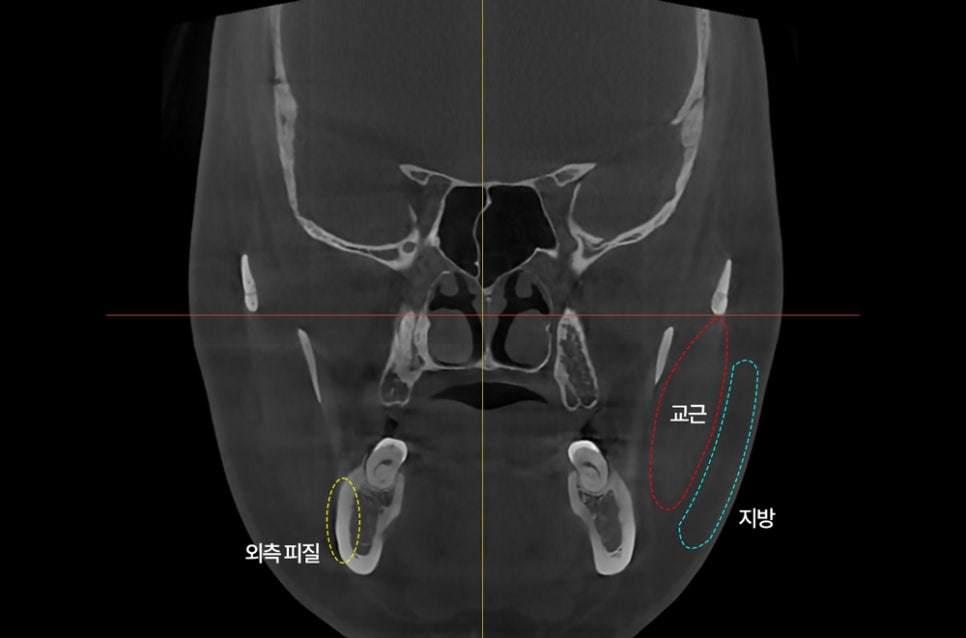
This CT is an image called a “coronal view” of the facial bones.
Simply put, you can think of it as a cross-sectional image of the face cut vertically from the front.
In this image, you can see the outer cortex of the jawbone and the muscles, and the fatty layer at the very outside.
I’ll also show you this patient’s 3D imaging photos.
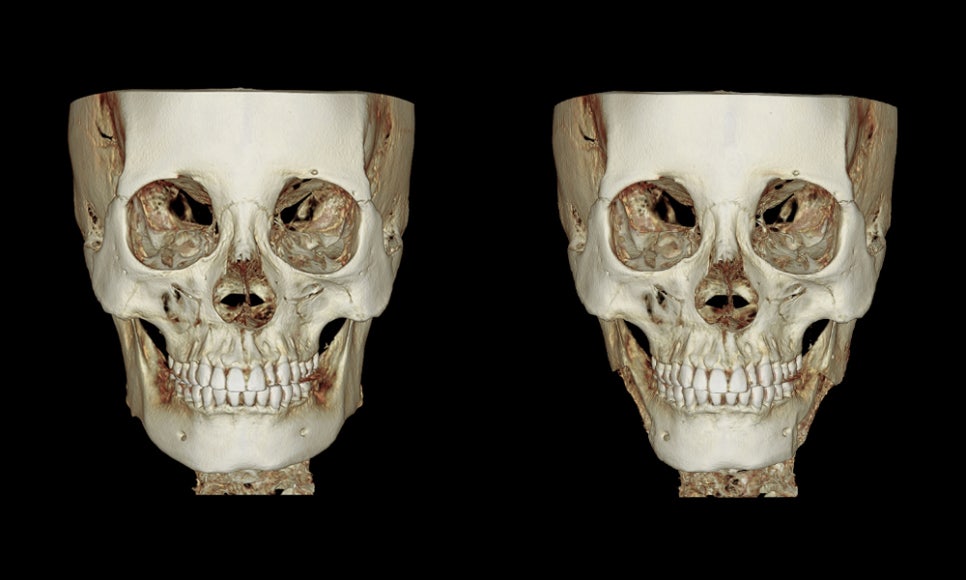
In cases where the jaw looks wide from the front: square jaw surgery, cortical bone contouring, masseter muscle resection
The square jaw shows a slightly protruding outward shape.
For the frontal effect, one option is to thin the outer cortical bone visible in the coronal view I explained earlier by performing osteotomy.
Another option is to perform masseter muscle resection together, removing part of the masseter muscle that surrounds the outside of the jawbone.
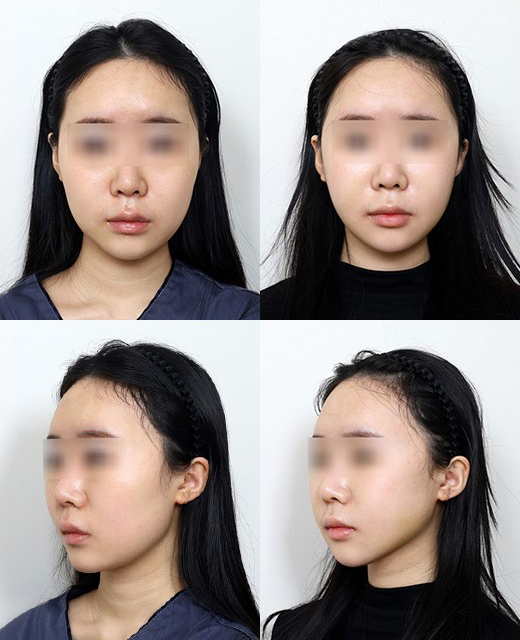
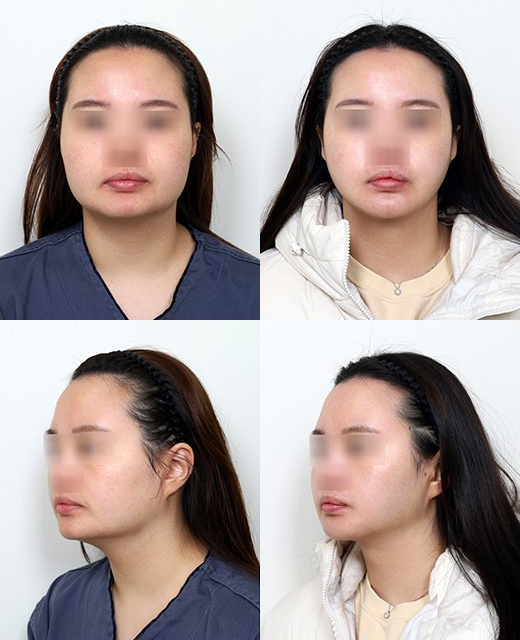
A patient who underwent zygoma reduction surgery, square jaw surgery, and cheek liposuction
The next option to consider is cheek liposuction.
To improve the facial contour from the front, it is helpful to approach the problem in a combined way by considering not only the bone, but also multiple factors such as bone, muscle, and fat.
As I mentioned earlier, if the jaw protrudes outward and the side square jaw angle is developed to around 90 degrees, then simply removing the jaw angle alone can produce a dramatic effect.
On the other hand, if the jaw is curled inward, square jaw surgery can reduce the side angle and create a softer jawline, but there may not be a major change in the width of the face seen from the front.
Therefore, when planning square jaw surgery, it is very important to carefully observe your own jawbone structure and then decide on the surgical method that is most suitable for you.
If you proceed with surgery simply thinking, “I have a square jaw, so if I cut the bone, my face will become slimmer,” the likelihood of being dissatisfied with the postoperative result is high.
In fact, the shape of the bone, the thickness of the masseter muscle, and the amount of fat are difficult to judge accurately just by looking from the outside.
So for those who want to reduce the side angle and create a slimmer face from the front, I think it can lead to a more satisfying surgery if the facial structure is analyzed accurately through a CT scan and a customized surgical plan is made.
Thank you.