Hello.
I’m Huh Jae-won, a board-certified plastic surgeon at 3D Plastic Surgery, where I perform rejuvenation surgery.
As the number of foreign patients has gradually increased recently, I’ve been noticing a difference that I didn’t pay much attention to before.
Even when the same incision is made, the dissection is performed in the same direction, and the closure is done in the same way, scars are often much less noticeable in White patients.
It’s not just that they are less visible; quite a few patients even say, “It barely bothers me.”
On the other hand, in Asian patients, even very small incision lines often remain noticeable for a long time.
I wondered whether this was simply an individual difference, and a paper I recently read happened to explain this experience quite well, so I’d like to introduce it.
Facial scars should be thought of in two ways.
When talking about scars after facial surgery, two factors actually act at the same time.
One is how visible the scar actually is, and the other is how much it bothers the patient.
These two do not always match. Even with the same scar, one person may barely notice it, while another may keep finding it bothersome.
This study analyzed exactly this difference by comparing it between racial groups.
A study comparing scar perception between White and Asian patients
A total of 147 facial surgery patients were included, and scar perception was compared between White and Asian patients.
The results showed a relatively consistent pattern.
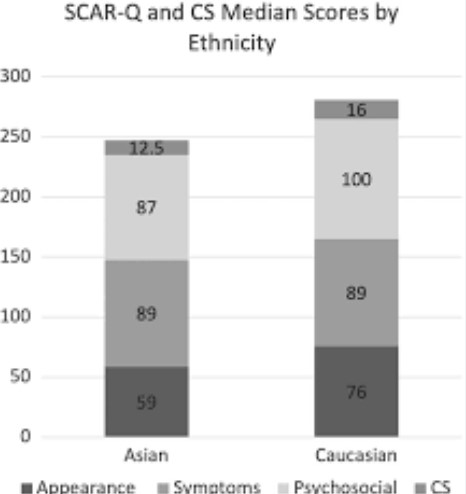
White patients, compared with Asian patients,
scored higher in all areas.
The most noticeable difference was in the appearance satisfaction category.
In other words, even after the same surgical outcome, Asian patients tended to be more sensitive to scars.
Another interesting point was this.
Symptoms such as tightness, discomfort, and sensory changes that appear over time after surgery improved at a similar rate in both groups.
In the end, the difference was not so much the discomfort of the scar itself, but how the scar looked and how it was perceived.
This also matches what I feel in actual clinical practice.
Personally, I found these results quite relatable.
In clinical practice, White patients often have little to no residual hyperpigmentation, the redness fades quickly, scars rarely spread, and incision lines often become less noticeable at a faster rate.
In short, objectively, the scars are often less visible.
And this naturally leads to differences in subjective satisfaction.
There is one more issue to think about here.
As I have mentioned several times in previous posts, many of the basic concepts and approaches used in current facelift surgery were established in the United States and Europe.
In other words, this is a surgical method that developed based on patient groups with skin characteristics in which scars are relatively less noticeable.
Put differently, factors such as the 기준 for incision length, the choice of incision location, the way skin tension is distributed, hairline access strategies, and retrotragal incision design were not originally created with Asian patients as the standard.
These differences can also affect satisfaction with clinical outcomes.
In Asian patients, the surgical design needs to be different.
In Asian patients, scars tend to be more visible, and expectations regarding scars are often higher.
Therefore, simply applying the same technique in the same way does not always produce sufficient results.
The incision location must be chosen more carefully, the incision length should be minimized as much as possible, hairline distortion should be minimized, skin tension should be distributed more meticulously, and the closure strategy also needs to be designed more precisely.
In other words, facelift surgery is not a single standardized method, but a procedure that should be adjusted while taking into account the patient’s skin characteristics and cultural expectations.
This study does not simply show that Asian patients are more sensitive to scars.
Rather, its more important meaning is that because current facelift techniques have developed mainly around Western patients, we need surgical designs that are better suited to Asian patients, who place greater importance on scars.
When I have recently been treating foreign patients, this paper felt like it was explaining a difference I had vaguely sensed in a relatively clear way, and personally, it was an interesting study that made me reconsider the incision design in facelift surgery.
I hope today’s post was helpful in some small way.
If you have any questions, please feel free to leave a comment anytime.
Thank you.