Hello.
I am plastic surgeon Heo Jae-won, and I perform rejuvenation surgery at 입체성형외과.
Recently, while consulting on facelifts, one clear change has become apparent.
It has become harder to find a face that has not undergone any procedures before surgery.
In particular,
-
Thread lifting
-
Collagen boosters (Juvgel Volume, Radiesse, Sculptra)
-
Energy-based lifting such as Ulthera and Thermage
Most people have experienced at least one of these three.
Among them, there have recently been more cases in which tissue dissection during facelift surgery feels more difficult after a collagen booster.
Just in time, a recent paper that directly attempted to answer this question was published, so I would like to introduce it.
This study surveyed 63 doctors who perform facelift surgery about how facelift surgery actually changes in patients with a history of collagen booster procedures.
Collagen boosters can delay the timing of surgery.
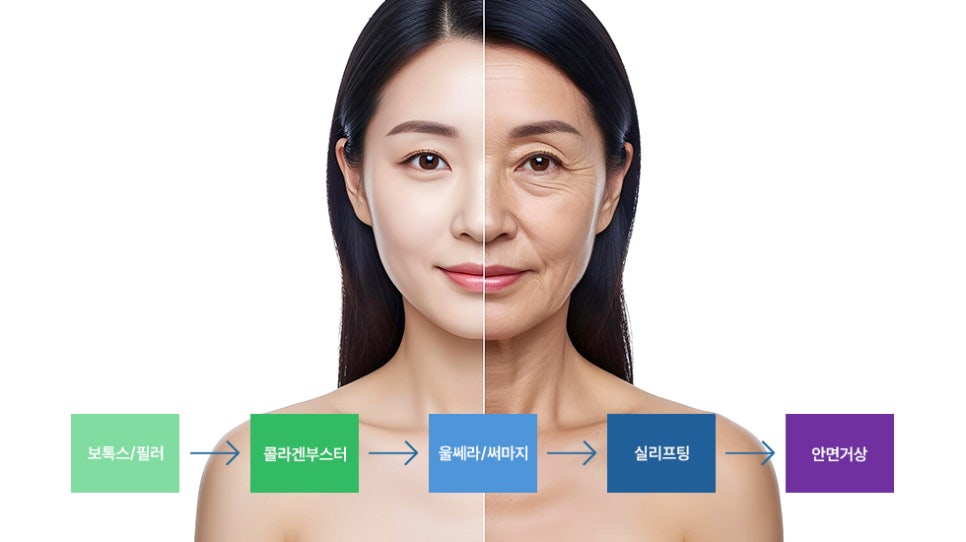
At present, treatments for facial aging follow one treatment flow, from Botox, fillers, and collagen boosters to energy-based lifting, thread lifting, and finally facelift surgery.
A collagen booster is not simply a volume-replenishing procedure; it is a treatment that induces collagen production in the skin and changes in tissue density.
In this study as well, about 59% of physicians answered that it has the effect of delaying the timing of facelift surgery. But the important question begins here.
Does delaying the timing of surgery mean that the surgery becomes easier?
There are also cases where the surgical strategy actually changes.
About 44% of physicians said they were affected by whether the facelift surgical strategy changed after a collagen booster.
In addition, about 50% responded that the surgery time became longer.
In other words, it does not become more difficult in every case, but there are changes that cannot be ignored.
The most frequently reported change was “difficulty in dissection.”
The most striking result in this study is the following.
The most commonly reported problem in facelift surgery after a collagen booster was difficulty in tissue dissection (91.8%).
Next were skin surface irregularity, prolonged inflammatory response, changes in nerve function, hematoma, and skin necrosis.
In other words, the change that appeared before complications themselves was a change in the tissue layers.
Deep plane is also affected.
For subcutaneous dissection, most cases were described as manageable difficulty, but in about 10% of cases, a change in dissection strategy was required.
For deep plane dissection, about 28% said they experienced enough difficulty to affect the surgical strategy. This means that tissue changes may not be limited to the superficial layer.
Which procedure was performed is also an important variable.
Ninety-seven percent of respondents said that the level of surgical difficulty can vary depending on the type of procedure.
In particular, thread lifting and CaHA were often identified during surgery, while PLLA was found less frequently.
In other words, a history of previous procedures is not just reference information; it is a factor that affects actual surgical planning.
However, there is another, more important message in this paper.
The key point of this study is not simply the conclusion that "surgery may become more difficult."
The discussion continues with what is a more important variable than collagen boosters, and why the time interval between a procedure and surgery matters.
I will organize that part in the next post.
If you have any questions, please leave a comment anytime.
Thank you.