Hello.
I am Huh Jae-won, a board-certified plastic surgeon who studies surgeries that make people look younger.
In the previous post, I introduced a study finding that 91.8% of respondents reported increased difficulty in tissue dissection during facelift surgery in patients who had experienced collagen booster procedures. However, the core message of this paper does not simply stop at the conclusion that “collagen boosters make surgery more difficult.”
Rather, the more important question is this:
What is the real cause of increased surgical difficulty?
There is another factor that matters more than the collagen booster itself.
Interestingly, many facelift surgeons who participated in the survey did not interpret changes in surgical difficulty as being solely due to the collagen booster procedure itself.
Instead, they pointed out that the following factors may have a greater impact.
-
The type of product used
-
The anatomical layer into which it was injected
-
How the agent spread and how evenly it was distributed
-
The amount of time that had passed since the procedure
In other words, what matters is not whether there was a procedure history, but how the procedure was performed.
Injection depth is especially an important variable.
Collagen boosters are basically treatments designed to stimulate fibroblasts in the subdermal plane, just beneath the skin.
When they act in this layer, relatively uniform collagen formation can occur, and a natural tissue-improving effect can be expected.
However, in actual clinical practice, they are not infrequently injected into deeper layers than recommended.
Recently, there have also been increasing cases of use in deeper planes for volume enhancement, such as Juvelook Volume.
The paper also mentions that such deep-layer injections may affect the later facelift surgery process.
In such cases, tissue changes are more likely to appear not in a uniform way, but in forms such as the following.
-
Localized fibrosis
-
Uneven tissue density
-
Nodule formation
And these changes can, in actual surgery, first lead to increased dissection difficulty.
The time interval between the procedure and surgery is also an important variable.
Another point worth noting is the time that has passed since the procedure.
The paper also investigated how much time should ideally pass after a collagen booster before performing facelift surgery.
Although no clear standard was presented, a certain trend was confirmed.
In particular, when surgery was performed within 6 months after the procedure, a higher proportion of respondents felt that the surgery had become more difficult.
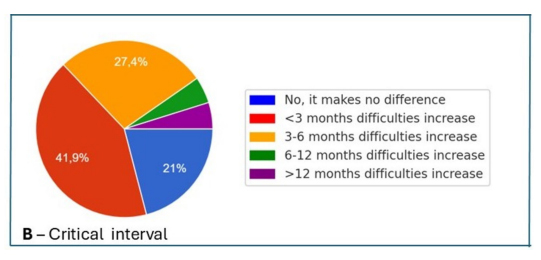
This means that during the period when collagen formation and inflammatory responses in the tissue are still progressing, the dissection process may become more challenging.
Therefore, if the need for facelift surgery is already clear, some also suggested that it may be more reasonable to prioritize surgery rather than first performing a collagen booster.
In actual clinical practice, multiple procedures are often performed together.
In reality, it is much more common for various procedures to be performed together rather than a collagen booster alone.
Typical examples include
-
Fillers
-
Laser-based lifting
-
Thread lifting
which are often performed simultaneously or sequentially.
Therefore, it is not easy to clearly distinguish whether the tissue changes observed during surgery are due to one specific procedure or the cumulative effects of multiple treatments.
In fact, some of the doctors who participated in the survey also suggested that substances such as hyaluronic acid fillers or PMMA may have a greater effect on surgical outcomes.
So, should collagen boosters be avoided?
Not necessarily.
As the paper clearly emphasizes, collagen boosters help improve skin elasticity and are an effective treatment for delaying the timing of facelift surgery.
The issue is not the procedure itself, but how it is positioned in relation to surgery. In particular, if facelift surgery may be needed within the next 1 to 2 years, the treatment sequence should be decided carefully.
In the end, what matters is the order of treatment.
The paper suggests that if the indication for facelift surgery is already clear, it may be more reasonable to prioritize surgery rather than first performing a collagen booster, and then use collagen boosters later as a form of maintenance treatment.
Of course, in actual practice, the number of patients who undergo facelift surgery for the first time without any prior procedure history is steadily decreasing.
Therefore, it seems that planning surgery with these tissue changes in mind will become even more important going forward.
In summary, the following points stand out.
Collagen boosters may help delay the timing of facelift surgery.
However, once the time comes when surgery is needed, they may affect the difficulty of tissue dissection, and the extent of that effect can vary greatly depending on factors such as
Having a thorough understanding of these factors and planning treatment accordingly can be an important help in predicting surgical outcomes.
If you have any questions, please feel free to leave a comment anytime.
Thank you.