Hello.
I am plastic surgeon Heo Jae-won, who studies facelifts and youthful-looking surgery.
While reviewing recently published papers related to facelifts, I came across one very interesting trend.
These days, one thing has clearly changed when I see patients in consultation.
A significant number of people coming in for facelift or midface lifting consultations are either currently using or have used GLP-1 medications such as
In practical terms, it feels like about one in five patients has a related history. In fact, this phenomenon has already begun to be analyzed as a trend in the United States.
The paper I will introduce today also covers exactly that topic.
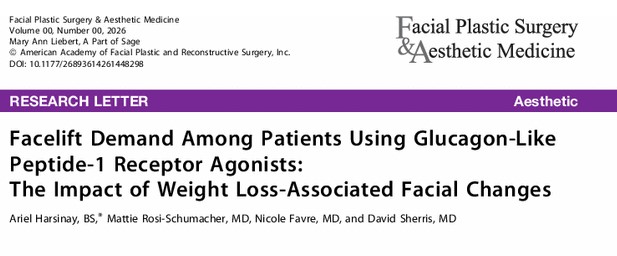
Facelift Demand Among Patients Using Glucagon-Like Peptide-1 Receptor Agonists: The Impact of Weight Loss-Associated Facial Changes
Facial Plastic Surgery & Aesthetic Medicine, 2026
Why are GLP-1 medications linked to facelifts?
This connects to the relationship between skin and volume that I have explained repeatedly in earlier posts.
The skin of our face stretches and adapts to match the size of the fat and soft tissue underneath.
In other words, when facial fat increases, the surface area of the skin also expands to cover that volume.
The problem comes after that.
When body weight drops rapidly, the internal volume decreases, but the already stretched skin and soft tissue cannot keep up with that speed.
In the end, the outer tissue is left behind like a balloon losing air, and sagging occurs.
Recently, these facial changes have also been called “Ozempic face.”

Scott Disick
Ozempic face refers to the phenomenon in which rapid weight loss from GLP-1 medications (such as Ozempic and Wegovy) reduces facial fat, making the cheeks look hollow and wrinkles and sagging more noticeable. In other words, it is a widely used expression meaning, “The weight is gone, but the face looks older.”
The changes that commonly appear in real life are:
-
Deepening nasolabial folds
-
Sagging along the mouth line (jowl)
-
A collapsing jawline
-
Hollow cheeks
-
Downward descent of the deep cheek fat
-
Reduced neck elasticity
-
Midface sagging
This is why some people say they successfully lost weight, but their face instead looks tired and older.
What did this study analyze?
Researchers at the University at Buffalo in the United States retrospectively reviewed patients who underwent facelift surgery from 2005 to 2024.
A total of 10,300 patients were analyzed, and 147 of them were reportedly using GLP-1 medications before surgery.
What is interesting is that the proportion of patients using GLP-1 medications, which was almost nonexistent at first, increased sharply over the past few years.
In fact, semaglutide medications were originally developed first for the treatment of diabetes.
However, after the FDA approved Wegovy for obesity treatment in 2021, the number of patients using it for weight loss began to rise explosively.
And the paper explains that, starting from that point, the proportion of GLP-1 users among facelift patients also increased steeply.
Why does the face look older even though the weight is gone?
This is something many people are surprisingly curious about. “Shouldn’t losing weight make you look younger?”
Of course, appropriate weight loss is good for your health and can improve your overall appearance.
But the face works a little differently. In particular, after the 30s and 40s, the elastic fibers in the skin begin to decrease.
Put simply, the skin’s “spring-like” ability to tighten again becomes weaker.
When we are young, even if we lose weight, the skin can shrink back naturally to some extent. But when elasticity has declined, the skin cannot keep up with a sudden decrease in volume.
That is why sagging and hollowing appear at the same time in the areas where fat has been lost.
Why facelift surgery is changing recently
In the past, a facelift was seen mainly as simply “pulling the face upward.”
But recently, the approach has become more complex.
What matters now is not just lifting, but
-
how to view the volume that has been lost
-
how to correct hollowing and sagging at the same time
-
how to reposition facial structures that have changed after weight loss
In other words, modern facelift surgery is becoming less like a procedure that simply pulls the skin tighter and more like a process of restoring overall balance to match the reduced internal facial structure.
I believe GLP-1 medications such as Wegovy and Mounjaro are a very meaningful development in the field of obesity treatment.
That said, as the degree of weight loss becomes greater, the facial changes that appear are also likely to become an increasingly important issue.
In fact, this trend is being observed more and more often in recent facelift patients as well.
I think the concept of “weight loss-associated facial aging” will likely become an important topic in the facelift field in the future.
I hope today’s post was helpful.
Thank you.