Hello.
I’m Huh Jae-won, a board-certified plastic surgeon at 3D Plastic Surgery, where I treat facial rejuvenation surgery.
When I see patients coming in for a facelift consultation, most are not only worried about sagging cheeks.
In many cases, they are also very concerned about a double chin, sagging under the chin, and a collapsed neck line.
So today, I’d like to talk in a simpler way about why the details of the double chin area are important in facelift surgery.
In fact, facelift surgery varies quite a bit from hospital to hospital and from surgeon to surgeon.
The extent of the incision differs, how far the dissection is done differs, and the layer that is corrected and how much of it is addressed also vary.
But in the end, the core principle is the same.
What is not touched does not change.
For example, a method that makes a small incision only in the scalp area and pulls the skin tight may make the face look better at first.
However, as time passes, the skin’s elasticity can cause it to sag again to some extent.
That is because the area where the actual sagging occurred was not sufficiently addressed.
This principle applies similarly to the double chin area.
Many of those considering a face-and-neck lift do not only have sagging cheeks,
-
but also a lot of fat under the chin,
-
a collapsed neck line, or
-
a blurred jawline boundary.
That is why, when these areas are refined together during a facelift, the overall impression becomes much cleaner and younger.
But there is one important point here.
The double chin area is, surprisingly, quite far from the ear incision line.
In other words, simply making incisions in front of and behind the ear does not automatically improve the area under the chin.
In many cases, additional refinement under the chin is needed using a long liposuction instrument or various surgical tools.
In the end, the degree to which these details are taken care of creates a difference in the postoperative look and the level of completion.
Of course, that also makes the surgery take longer.
I once said that the “cost” in plastic surgery is closer to surgical time than to the ingredient cost in a restaurant.
In the end, good results often require both time and care.
Of course, there are clear limits compared with platysmaplasty, which directly makes an incision under the chin and tightens the muscles there.
However, if the sagging is not very severe, then simply refining the under-chin area a little during a facelift can often produce a much more natural and satisfying change without a separate scar under the chin.
This patient also came in for a one-year follow-up after a face-and-neck lift,
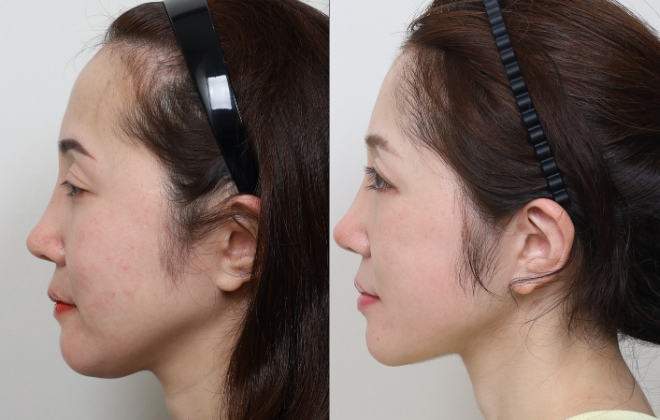
Even without a separate platysmaplasty under the chin, the jawline and side profile became more refined, and the overall impression looks much younger and softer.
Also, as time passed, the scar faded to the point of being barely noticeable.
When I look back at patients’ progress over time, I end up thinking that the results are ultimately made by small differences in detail.
And I believe that a good surgery still shows over time.
If you have any questions, please feel free to leave them anytime.
I’ll explain slowly and in detail.
Thank you.