Hello, I am Dr. Hyunwoo Jo, director of 3D Plastic Surgery Clinic.
One of the questions patients often ask is, “Will Indian wrinkles develop after cheekbone surgery?”
Many patients also ask, “I heard that shaving causes Indian wrinkles. Is that true?”
Today, I will explain these questions in detail.
What Are Indian Wrinkles?
Indian wrinkles are named because they are said to resemble the stripes traditionally painted on the faces of Native Americans.
They generally refer to diagonal wrinkles that extend from beneath the eyes toward the cheekbones.
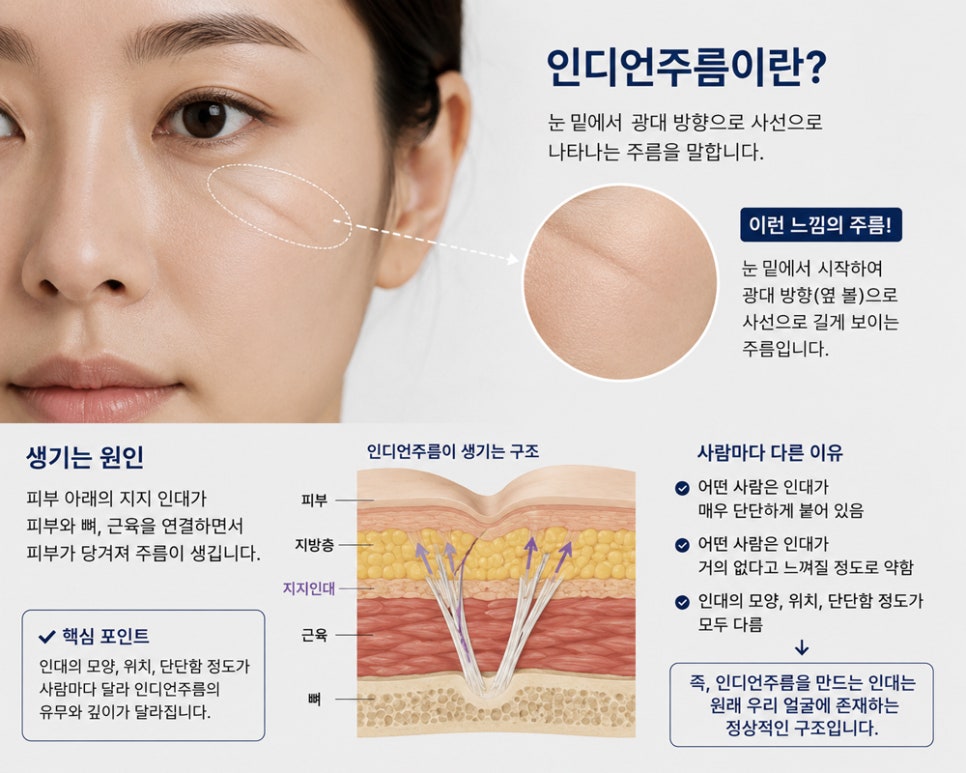
They look like this.
Indian wrinkles are caused by the supporting ligaments beneath the skin.
Because ligaments connect the skin to the bones and muscles, wrinkles can form along them.
However, in some people, these ligaments are attached very firmly, while in others, they may be so weak that they are barely noticeable.
Just as every person’s facial features are different, the shape, location, and strength of these ligaments also vary from person to person.
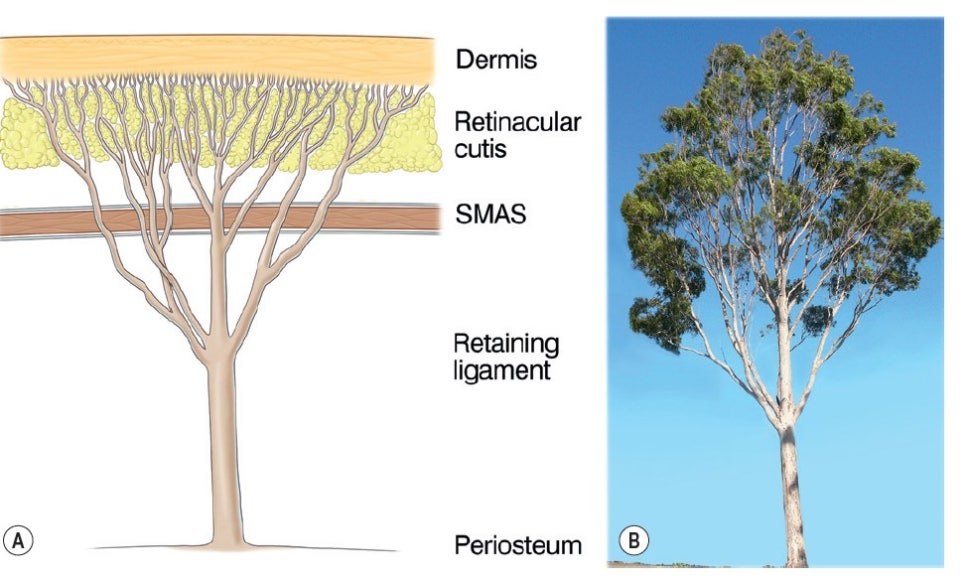
These ligaments, which connect firmly from the bone to the skin, help prevent the skin tissue from sagging.
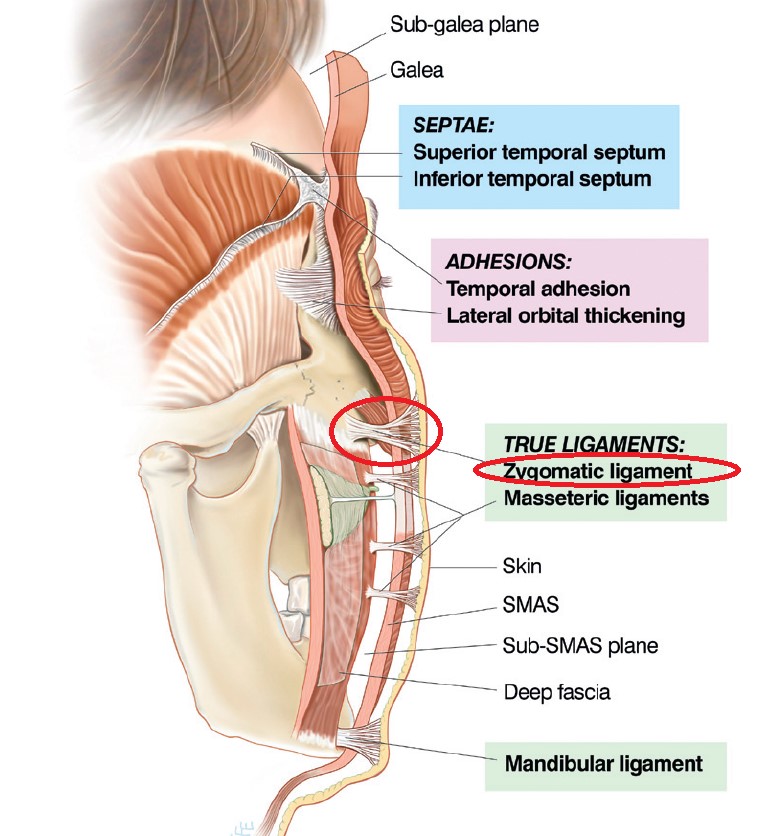
As we age, the skin gradually begins to sag, and the fat that originally provided fullness also decreases.
As a result, the ligaments that were holding the skin in place become relatively more prominent, making Indian wrinkles more noticeable.
Then why do people say that Indian wrinkles developed after cheekbone surgery?
In my opinion, you can understand it as follows: just as Indian wrinkles become more prominent when the volume of fat decreases, reducing the volume of the cheekbones can also make Indian wrinkles appear more pronounced.
There is a common misconception here.
Some people believe that “3D cheekbone surgery performed through an intraoral incision is fine, but shaving causes Indian wrinkles.” However, this is not accurate.
Because both procedures reduce the volume of the cheekbones, both may, in principle, make Indian wrinkles appear more prominent.
As mentioned earlier, the strength and shape of these ligaments vary from person to person.
In some people, the ligaments are strongly developed, making the wrinkles clearly visible, while in others, they are weak and barely noticeable.
Therefore, it is not true that a specific surgery will inevitably cause Indian wrinkles.
By the same principle, liposuction in the area of the Indian wrinkles can also reduce volume and, instead, make the wrinkles appear more prominent.
Then how can existing Indian wrinkles be addressed?
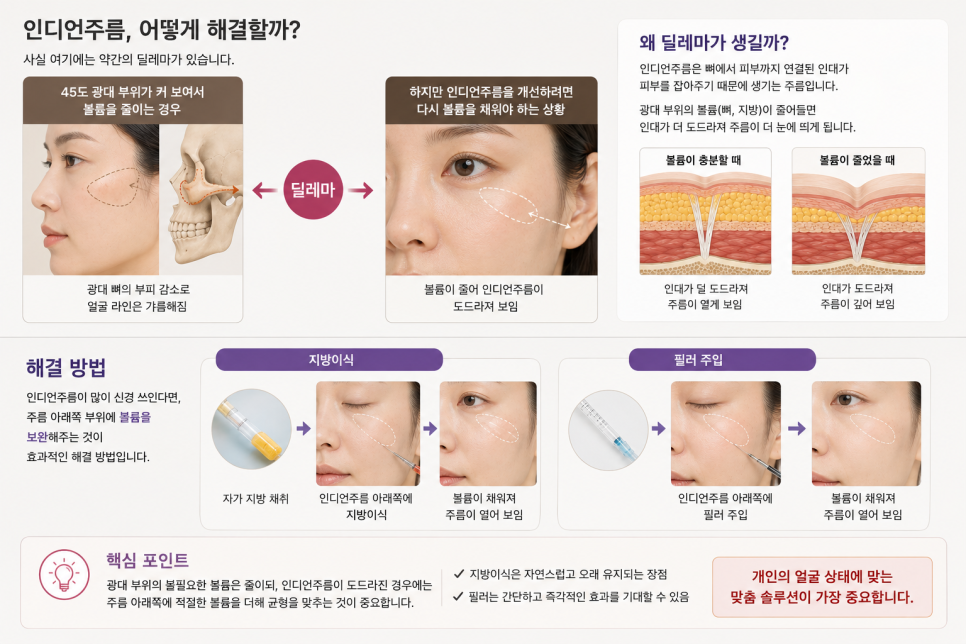
There is somewhat of a dilemma here. The volume of the 45-degree cheekbone area was reduced because it appeared large, but improving Indian wrinkles may require filling that same area with volume again.
If Indian wrinkles are causing significant concern, there are ways to address them.
Usually, supplementing volume in the area below the wrinkles with fat grafting or fillers can help make Indian wrinkles appear noticeably less pronounced.
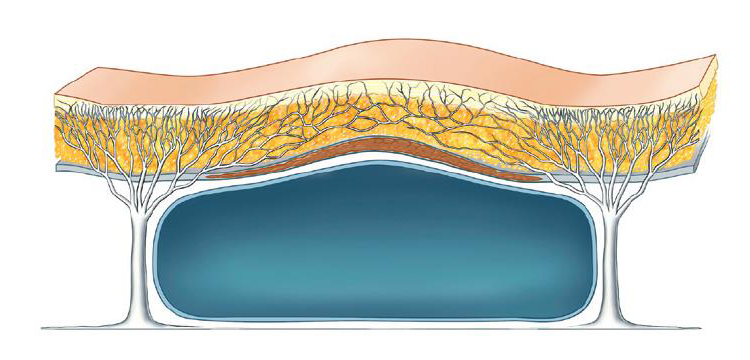
As shown in this illustration, filling the area with a material can make Indian wrinkles appear lighter.
Another option is vertical thread lifting.
Using short threads to pull the skin upward in a vertical direction can make Indian wrinkles appear less noticeable. However, I believe that thread lifting alone is somewhat limited in its effectiveness for improving Indian wrinkles.
Finally, there is a surgical option. This involves directly releasing the firmly established ligaments.
In some patients, the ligaments that create Indian wrinkles are connected very tightly and are extremely short and strong.
In such cases, even if filler is injected, it may not enter the desired location and may spread into the surrounding area, potentially making the Indian wrinkles appear even more prominent.
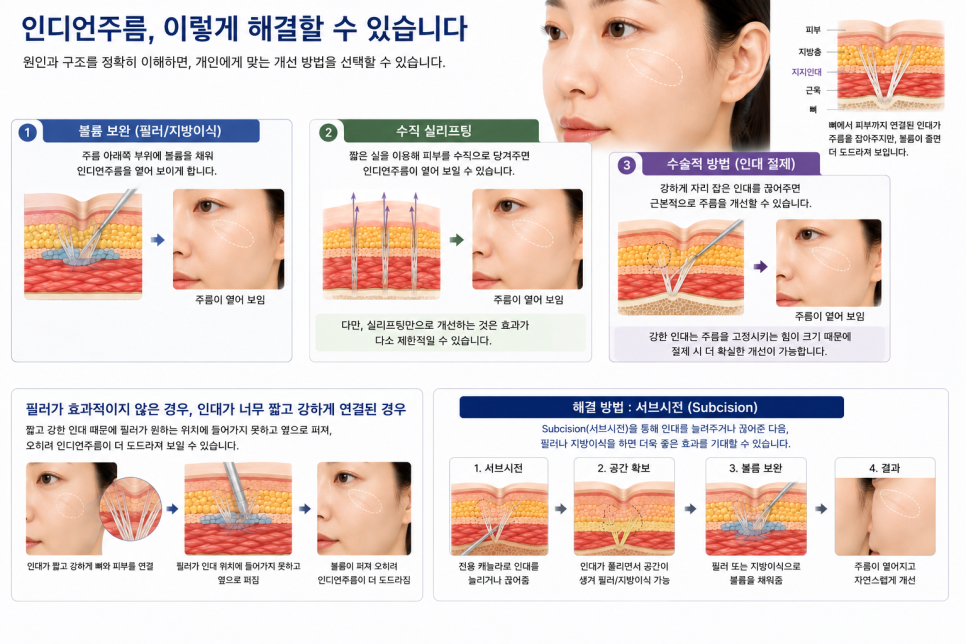
In these cases, the strongly connected ligaments can be stretched or partially released through a surgical technique called ‘Subcision.’ Combining this with filler or fat grafting may produce somewhat better results.
Today, we discussed the claim that “cheekbone surgery causes Indian wrinkles.”
Many people commonly believe that shaving causes Indian wrinkles, while osteotomy surgery does not.
In fact, it is more accurate to say that the outcome can vary depending on the patient’s skin condition, ligament structure, changes in volume, and other factors, rather than on the surgical method itself.
Indian wrinkles may become more prominent in some people, while others may experience little to no change.
Therefore, checking in advance how developed your own Indian bands are may help provide some degree of predictability before surgery.
Even if Indian wrinkles do develop, there are sufficient ways to improve them, so you do not need to worry too much.
Thank you.