Hello. I’m Dr. Jo Hyun-woo of 입체성형외과.
There is a question I hear quite often during facial contouring consultations:
“Doctor, can facial contouring surgery make my teeth stop fitting together properly?”
“I saw a review saying that the lips became misaligned. Is that okay?”
If you search online, it is not difficult to find reviews saying, “It feels like my teeth don’t fit together after surgery,” “I can only chew on one side,” or “It feels like my jaw is crooked.” However, before taking these reviews at face value, there is one important point to understand first.
The feeling that a patient’s “bite is off” and an actual change in the bite are completely different things.
Today, I will explain in detail whether facial contouring surgery can cause problems with the teeth or bite.
Does facial contouring surgery change the bite?
To give you the conclusion first, facial contouring surgery is not a procedure that changes the bite.
Facial contouring surgery is performed to improve the outer contours of the face. Typical procedures include malar reduction, square jaw surgery, and chin surgery.
In contrast, the bite is determined by the positional relationship between the upper and lower jaws. Procedures that change this relationship belong to the field of orthognathic surgery, not facial contouring surgery.
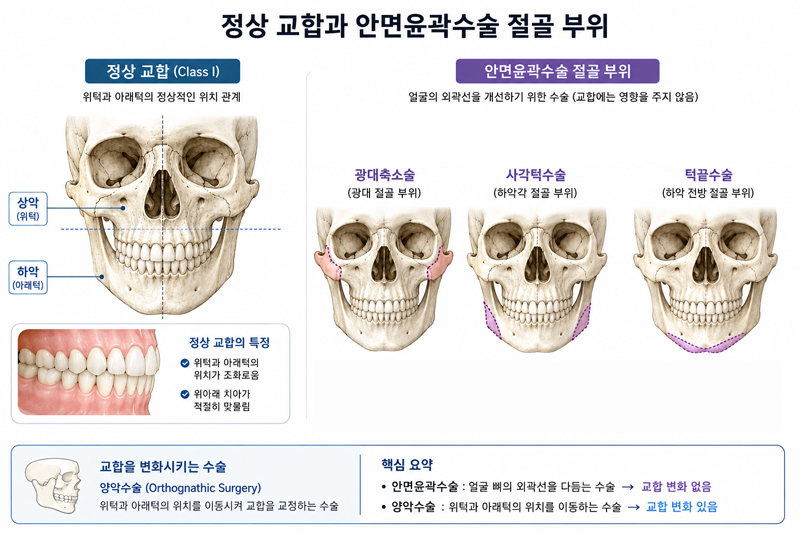
Illustration showing a normal bite and the areas where the bones are cut during facial contouring surgery
Facial contouring surgery changes the contours of the face; it is not a procedure that changes the way the teeth come together.
In fact, it is extremely rare for the bite to change significantly as a result of properly performed facial contouring surgery alone.
Then why can it feel like the teeth no longer fit together?
Some patients who visit us after surgery say, “I don’t think my teeth fit together the way they used to.”
However, in most cases, there is no particular problem with the actual bite.
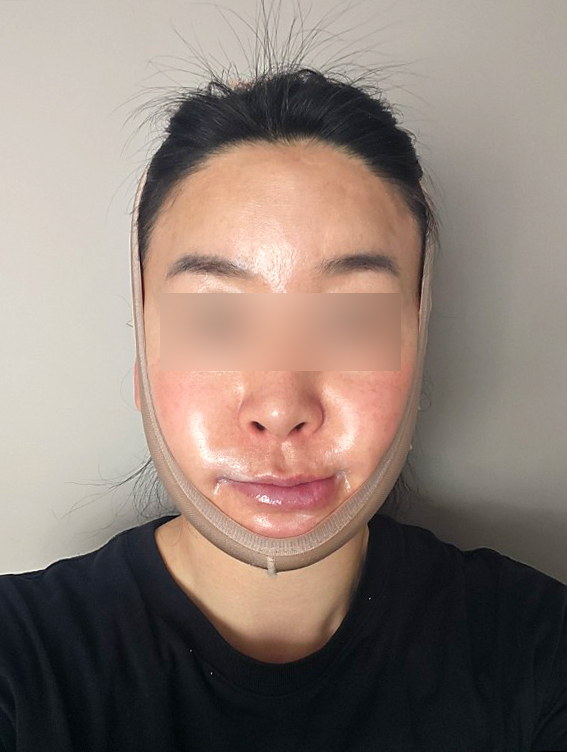
Swelling after facial contouring surgery
The most common cause is swelling. After facial contouring surgery, significant swelling occurs not only in the bones but also in the muscles and soft tissues.
In particular, patients who have undergone square jaw surgery or chin surgery often experience firm swelling around the jaw.
This swelling can cause the jaw to move along a slightly different path than it normally would when closing, making the patient feel as though the bite has changed.
In reality, the position of the teeth has not changed; the swelling is preventing the jaw from moving normally.
This is also one of the points I explain most frequently while monitoring patients’ recovery after surgery.
Does significantly reducing the square jaw weaken chewing function?
This is a question often asked by patients who want to make their faces as small as possible.
The masseter, a chewing muscle, is attached to the square jaw area. This muscle is responsible for chewing food.
Therefore, patients worry, “If a significant amount of jawbone is removed, won’t my chewing strength also become weaker?”
However, in general, square jaw surgery performed within an appropriate range does not significantly affect the chewing function needed for daily life.
Of course, immediately after surgery, chewing may feel awkward because the muscles are tense and still recovering.
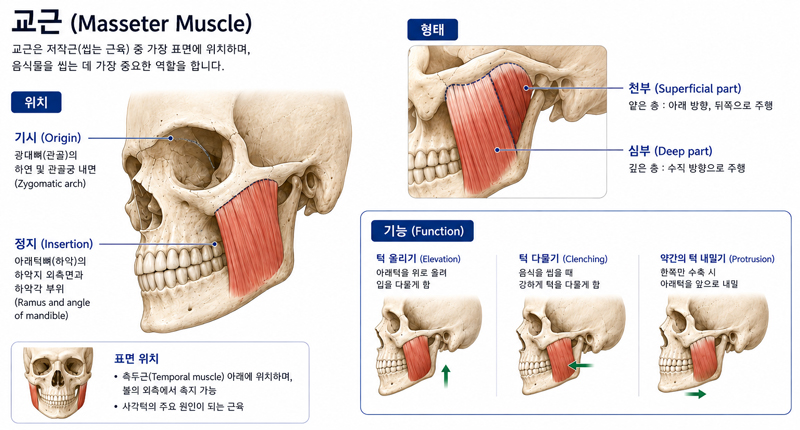
Illustration showing the location and function of the masseter muscle
However, in most cases, this improves naturally over time.
What matters more is not removing as much bone as possible, but considering both the facial shape and function.
I believe that good facial contouring surgery is not about removing a large amount of bone, but about refining the contours appropriately.
Can malar reduction also affect the bite?
Because the cheekbones are not directly related to the structures involved in the way the teeth come together, changes in the bite after properly performed malar reduction are extremely rare in practice.
However, swelling around the cheekbones or restrictions on opening the mouth wide may cause temporary discomfort.
This also generally improves naturally during the recovery process.
What about the online reviews saying that the “bite became misaligned”?
In the consultation room, patients sometimes show me screenshots of such reviews and ask about them.
However, the important point here is that a sensation must be distinguished from a diagnosis.
Just because a patient feels that their bite has become misaligned does not mean that an actual bite abnormality is present.
When checked through postoperative CT scans and follow-up examinations, most cases do not show an actual bite abnormality.
Much more often, these sensations are caused by postoperative swelling, muscle tension, limited mouth opening, reduced sensation, and the recovery process itself.
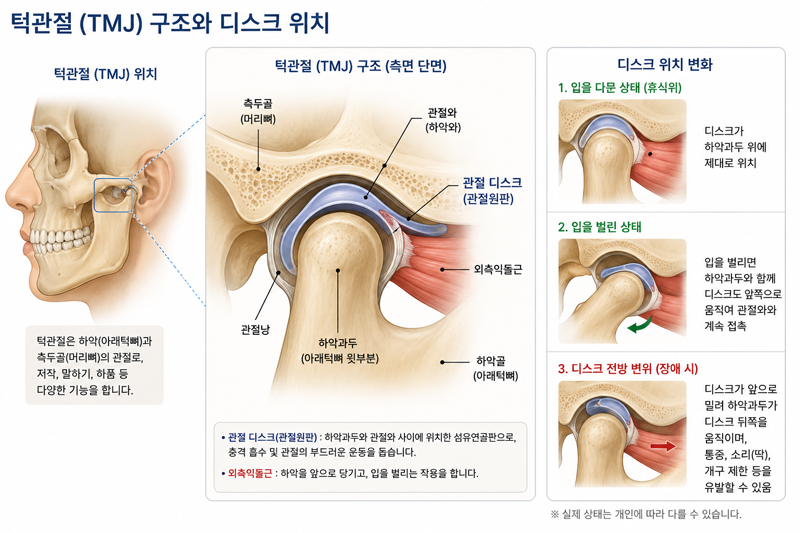
Structure of the temporomandibular joint (TMJ)
Therefore, there is no need to become excessively worried based solely on online reviews. What matters is an accurate diagnosis.
What changes can occur during recovery after facial contouring surgery?
Various changes may occur from immediately after surgery throughout the recovery process.
Swelling is usually at its most severe during the first week after surgery. You may have difficulty opening your mouth and feel that your teeth do not fit together as they normally do.
By about one month after surgery, the major swelling has decreased, and jaw movement also begins to feel more natural.
By around three months after surgery, most patients are able to go about their daily lives without significant discomfort.
At around six months, the tissues generally become stabilized. Of course, individual recovery times vary, but this is the general course.
In most cases, these changes are part of the natural recovery process. However, if you experience severe pain when chewing, difficulty opening your mouth, or persistent temporomandibular joint pain, it is advisable to seek medical attention.
Many people worry that facial contouring surgery may cause problems with their teeth or bite.
Although you may feel that your teeth do not fit together properly after surgery, this is usually a temporary phenomenon that occurs due to swelling and the recovery process.
Most importantly, the surgical plan should be based on an accurate diagnosis and thorough consultation, while considering not only the shape of the face but also its function.
If you are considering surgery, consult thoroughly with an experienced medical professional and find the method that is most suitable for you.
I hope today’s article was helpful to those who have been wondering about facial contouring surgery and the bite.
Thank you.