Hello.
I am Jae-won Heo, a board-certified plastic surgeon at Ipche Plastic Surgery, where I mainly provide facial rejuvenation procedures.
When discussing facelifts, patients often ask about one issue nearly as frequently as they ask about the extent of the surgery.
That issue is whether fat grafting should be performed at the same time.
“Will my face look too gaunt if I only have a facelift?”
“Would it be better to fill in the hollow areas of my cheeks as well?”
“Wouldn’t it be better to have fat grafting done at the same time rather than later?”
The answer to these questions is not the same for every patient.
The reason a face looks older is not simply that the skin has sagged downward.
This is also because the volume that once made the face look soft and three-dimensional gradually decreases along with the sagging tissues.
Therefore, some faces can be adequately improved by lifting the sagging tissues alone, while others require both surgery to reposition the tissues and treatment to restore lost volume.
Aging involves both sagging and volume loss
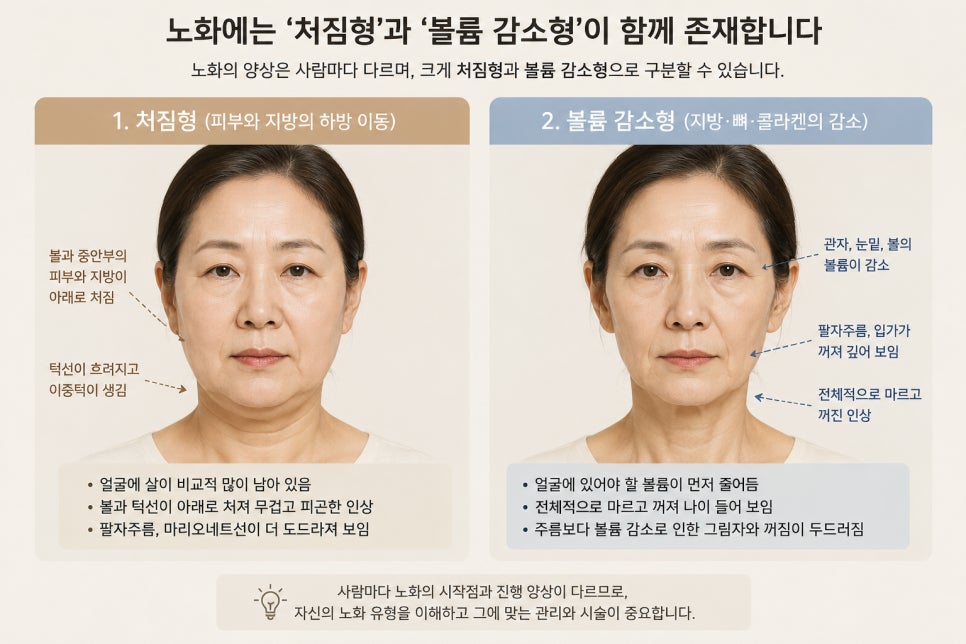
Everyone ages differently.
Some people retain relatively more facial fat while their cheeks and jawline sag downward. Others first lose the volume that should remain in the face, creating an overall gaunt and hollow appearance.
In the latter case, shadows and grooves become more prominent in specific areas.
Examples include Y-shaped hollows in the front cheeks, a sunken appearance beneath the cheekbones, nasolabial folds that have deepened from long-term skin creasing, and depressions below the lines around the mouth. With this type of aging, not every issue can be resolved simply by moving the tissues upward.
Although sagging tissues can be lifted, lost volume cannot be recreated by pulling the tissues alone.
For this reason, a facelift consultation should assess not only the extent of sagging but also which areas of the face have actually experienced volume loss.
When necessary, fat grafting can be a good way to complement the results of a facelift. However, one distinction must be made here.
The fact that an area can receive fat grafting does not necessarily mean that it can always be treated at the same time as a facelift.
The front cheeks, nasolabial folds, and areas around the mouth can be corrected at the same time
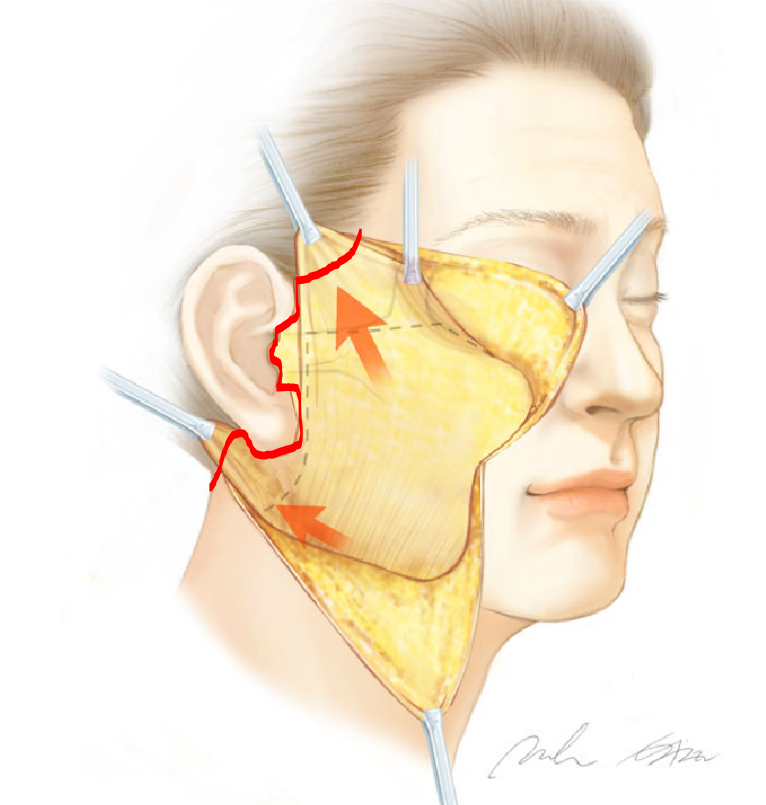
The front cheeks, the area around the nasolabial folds, and the area below the corners of the mouth are areas where fat grafting may be considered alongside a facelift.
In a typical facelift, dissection begins in front of the ears and proceeds toward the cheeks and jawline.
However, the skin and subcutaneous tissue are not completely opened all the way to the central areas of the front cheeks or nasolabial folds.
Therefore, if the area dissected during the facelift does not significantly overlap with the space receiving the fat graft, the deficient volume can be supplemented during the same surgery.
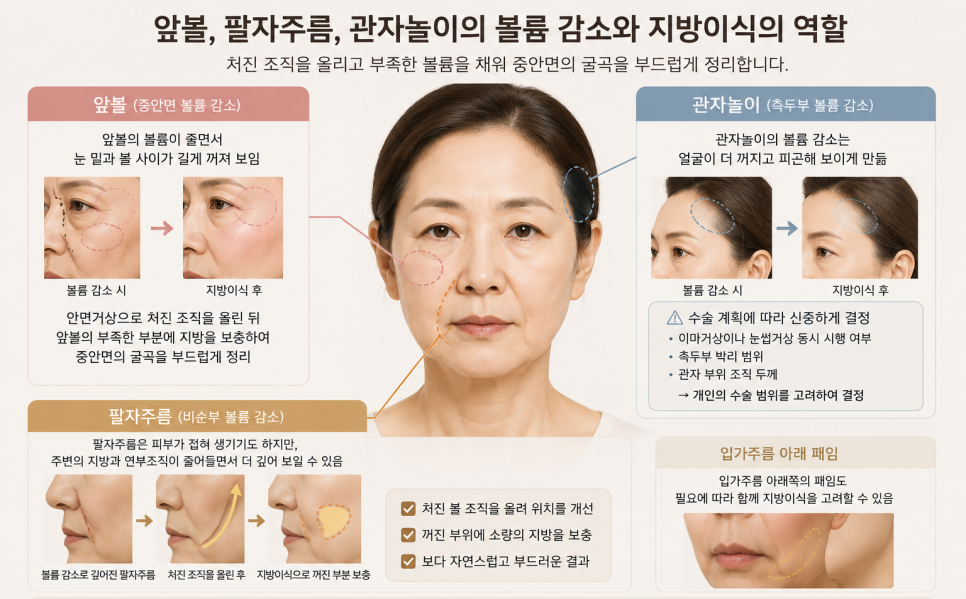
In particular, some people experience loss of volume in the front cheeks, making the area between the lower eyelids and cheeks appear elongated and hollow.
In these cases, lifting the tissues that have descended during the facelift and supplementing the deficient areas of the front cheeks with fat can help smooth the contours of the midface, rather than simply making the face look tighter.
The same applies to the nasolabial folds.
Nasolabial folds may form because the skin creases, but they can also appear deeper as the fat and soft tissue around them decrease.
In such cases, lifting the sagging cheek tissues while adding a small amount of fat to the areas that are actually hollow may lead to a more natural result.
Depending on the circumstances, fat grafting may also be considered for depressions below the lines around the mouth.
A facelift improves sagging around the mouth and along the jawline, but it is not a procedure that corrects all pre-existing volume deficiencies below the mouth.
Therefore, if the remaining hollowing is caused by an actual lack of tissue, supplementing an appropriate amount may be helpful.
Fat grafting to the temples can also be performed at the same time in some cases.
However, the surgical plan for this area may vary depending on whether a forehead lift or brow lift is also being performed, how far the dissection extends in the temporal region, and the thickness of the tissues in the temple area. Therefore, rather than uniformly adding fat to the temples in every patient, the decision should be made based on the individual's surgical scope.
Fat is often not added to the lateral cheeks at the same time as surgery
Unlike the front cheeks, the lateral cheeks are a relatively challenging area for fat grafting at the same time as a facelift.
The lateral cheeks are highly likely to directly overlap with the area dissected during a facelift proceeding from in front of the ears.
If fat is immediately grafted into a space where the skin and subcutaneous tissue have been widely separated, the injected fat may not remain stably in the intended location, making its position and shape difficult to predict.
In addition, swelling, tissue movement, and adhesion are ongoing immediately after surgery, so it is not easy to accurately assess how much volume is actually lacking in the lateral cheeks.
Even in people whose lateral cheeks appeared severely hollow before surgery, the hollowing may improve more than expected after the facelift as the tissues return to their original positions.
For this reason, we do not automatically assume from the outset that additional fat should be added simply because the lateral cheeks appear hollow. It is important to examine how the tissues remaining in the face can be repositioned.
Existing tissues are used before adding new volume
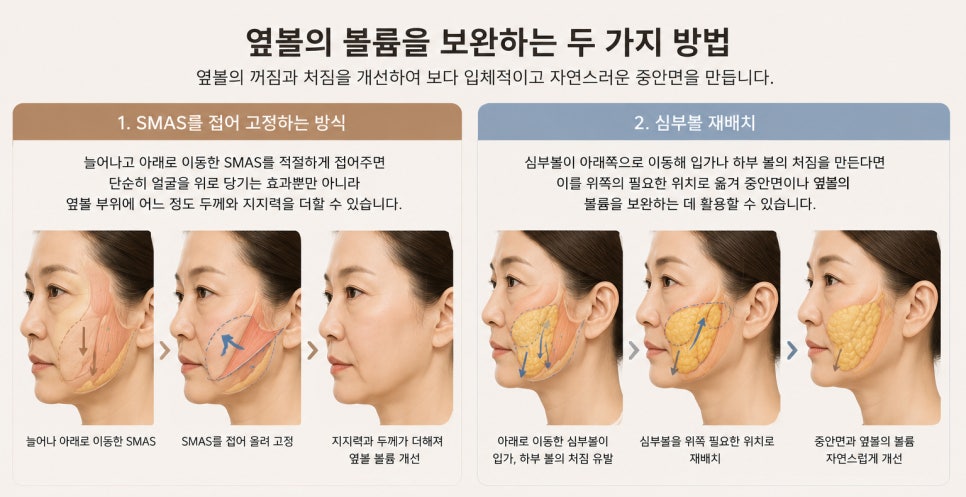
One way to supplement volume in the lateral cheeks is to fold and secure the SMAS.
Appropriately folding the SMAS, which has stretched and moved downward, can provide not only a lifting effect but also a certain amount of thickness and support to the lateral cheek area.
Another option is to consider repositioning the buccal fat pad.
The buccal fat pad is not tissue that must always be removed simply because it is thought to make the face look heavier.
If the buccal fat pad has moved downward and is contributing to sagging around the mouth or lower cheeks, it can be moved upward to a necessary position and used to supplement volume in the midface or lateral cheeks.
After performing the facelift and tissue repositioning in this way, we wait until the surgical results have stabilized.
If noticeable hollowing remains in the lateral cheeks even after approximately six months, when swelling and adhesions have generally subsided sufficiently, additional fat grafting can be performed only in the areas that need it. This approach has the advantage of allowing the deficient amount to be assessed more accurately than adding fat based only on estimates immediately after surgery.
It can also reduce the likelihood of overfilling the lateral cheeks and making the face appear wider or heavier.
A facelift and fat grafting are not the same procedure
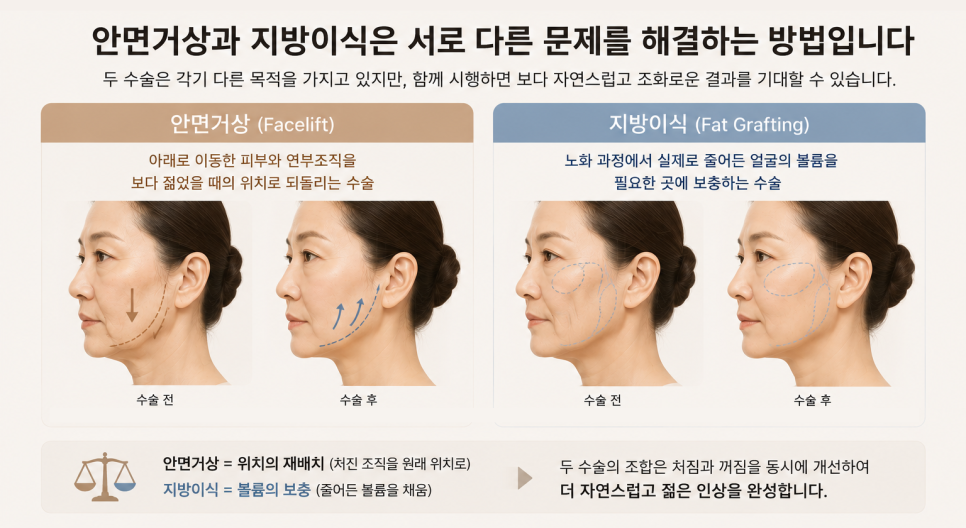
A facelift and fat grafting are methods that address different issues.
A facelift is a procedure that returns skin and soft tissue that have moved downward to positions closer to where they were when the face was younger.
Fat grafting is a procedure that supplements areas where facial volume has actually decreased during the aging process.
Therefore, if excessive fat is added to a face where sagging is the primary concern, the added weight may increase, causing the face to look dull and puffy instead.
Conversely, if a facelift alone is performed on someone with significant facial volume loss, the positions of the jawline and cheeks may improve, while the overall appearance may still look gaunt and tired.
Ultimately, it is important to distinguish whether each area has sagged downward, whether volume has actually decreased in a particular area, whether the deficient volume can be addressed by moving existing tissue, or whether new volume needs to be added.
The purpose of a facelift is not to pull the face tightly until it looks taut. Likewise, the purpose of fat grafting is not to fill every possible hollow in the face.
Downward-shifted tissues should be moved back to where they belong, while volume that has decreased over time should be supplemented only where it is truly needed and only in the necessary amount.
Ultimately, the key to creating a natural-looking face is not pulling more or filling more.
It lies in finding the proper positions for each tissue and the appropriate amount needed for the face.
I hope today's post was helpful as well.
Thank you.