Hello.
I’m Jae-won Heo, a board-certified plastic surgeon at Ipteche Plastic Surgery Clinic, specializing in procedures for a more youthful appearance.
The aspects that need to be prioritized in a facelift vary somewhat depending on the patient’s age.
Today, I’d like to discuss the key considerations for two representative age groups: patients in their 40s and those in their 60s.
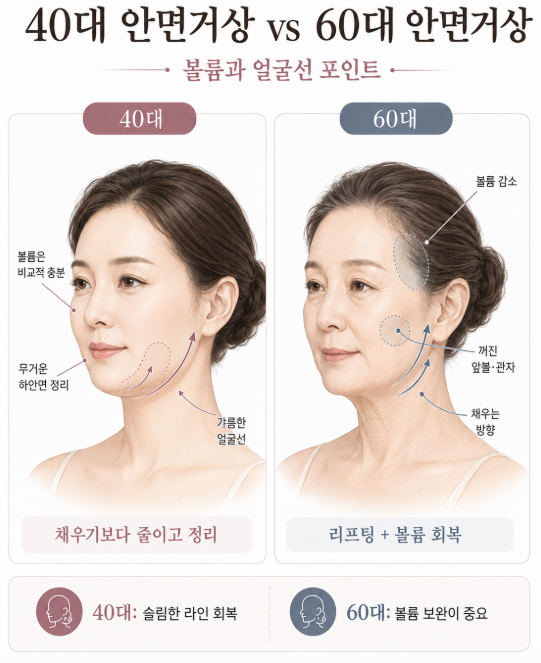
Facelift in Your 40s: Scars, Contours, and a Slimmer Look
One of the most important considerations for a facelift in your 40s is scarring. Many people think that younger skin always heals better, but this is not necessarily the case.
Because younger skin has good healing capacity, its collagen response can also be more active. Depending on the individual, this can make it more likely for scars to remain red for a long time or develop into raised, thickened hypertrophic scars.
People in their 40s are often socially active, and they may frequently tie their hair back or expose their ears.
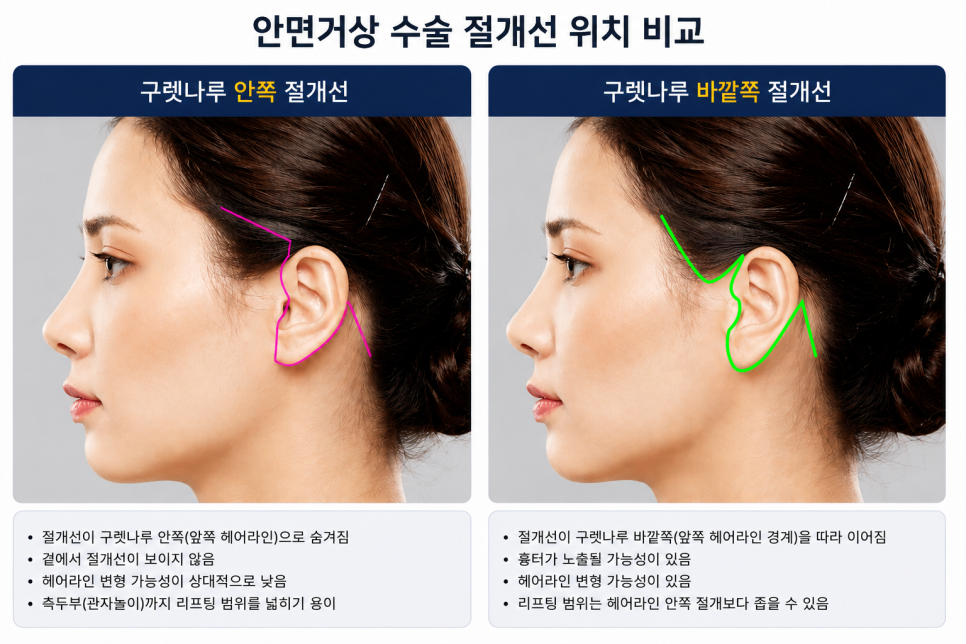
For this reason, the placement of the incision is very important. When possible, the incision is designed to be hidden as much as possible within the scalp and along the natural boundaries around the ear.
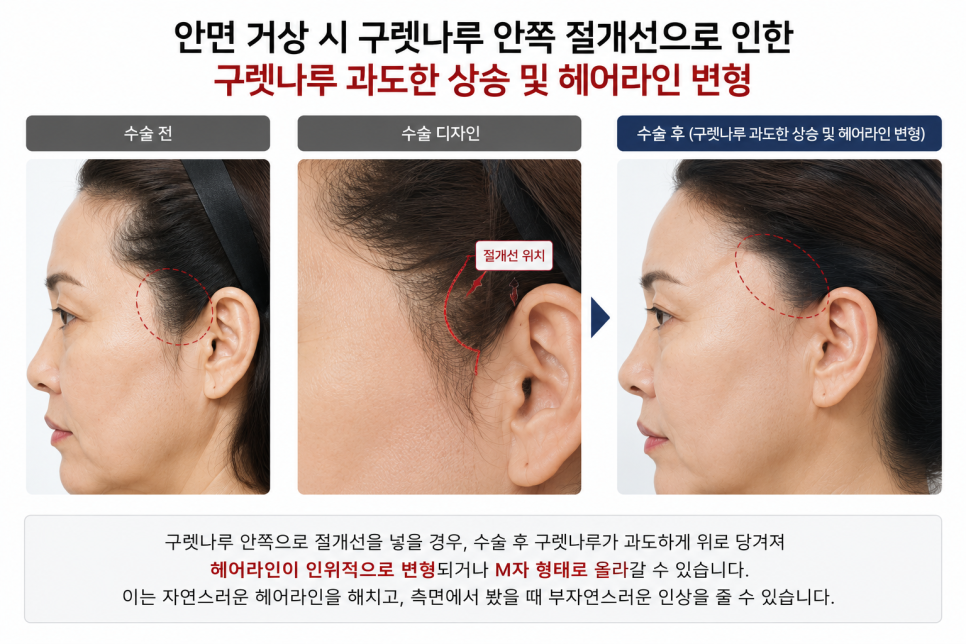
An incision entirely within the scalp is not always the right answer. However, when relatively less skin is removed, it can also reduce the degree to which the sideburns are pulled upward, so I tend to recommend an incision within the scalp. Of course, the incision may vary depending on the amount of excess skin, the position of the sideburns, the hairline, and the degree of neck laxity.
However, in patients in their 40s, making the result look as inconspicuous as possible is generally more important.
Another important point is that people in their 40s often still retain a relatively significant amount of facial volume.
For this reason, a facelift in your 40s is often less about filling a hollowed-out face and more about refining the weight of sagging cheek fat, the deep cheek fat, and the jawline to create a slimmer, more refined appearance. Simply put, a facelift in your 40s is often closer to a “beautifying procedure” than a “rejuvenating procedure.”
Facelift in Your 60s: Sagging, Skin Removal, and Volume Restoration
A facelift in your 60s is different from one in your 40s. At this stage, laxity of the skin itself is usually more pronounced.
The jawline may lose definition, the neck skin may become lax, and marionette lines and sagging beneath the chin may appear together. Therefore, for a facelift in your 60s, it is important to lift the tissues sufficiently and remove an adequate amount of excess skin.
Because there is often more excess skin in your 60s, it may not always be possible to hide the incision entirely within the scalp. The skin needs to be adequately refined, but trying to hide the incision too far inside the scalp can instead pull the hairline upward excessively, creating a more noticeable and less desirable appearance.
In addition, scars tend to form less readily with age, so there are cases in which an incision outside the scalp may actually be recommended. Therefore, in your 60s, when necessary, an incision outside the scalp that follows the hairline may be more appropriate. Even in this case, it is important to follow the most natural boundary possible and reduce tension on the sutures so that the scar is less visible.
Another aspect that cannot be overlooked in a facelift in your 60s is volume restoration.
As we age, the face does not merely sag. Volume also decreases in the front cheeks, temples, under-eye area, and around the cheekbones. As a result, lifting alone may improve the contours while making the face look thin and harsher. In such cases, a process that naturally restores insufficient volume, such as fat grafting, may be helpful.
Ultimately, it is not your age but the way your face has aged that matters. Not every person in their 40s has the same type of 40-year-old face, and not every person in their 60s has the same type of 60-year-old face.
Some people in their 40s have a large amount of volume, making the face look heavy, while others already have noticeable volume loss.
For some people in their 60s, sagging skin is the main concern, while for others, the face’s thin, gaunt appearance is a greater concern than sagging.
That is why age alone is not the most important consideration in a facelift.
We need to consider together how much excess skin remains, whether you are prone to noticeable scarring, whether your facial volume is excessive or deficient, and whether neck laxity is also present.
A good facelift is not simply a procedure that pulls everything as tightly as possible. It is a procedure that examines how each person’s face has changed and restores it accordingly.
Ultimately, a facelift in your 40s generally focuses on refining the facial contours attractively while minimizing visible signs of the procedure and taking care with scarring.
A facelift in your 60s generally focuses on lifting sufficiently, removing excess skin, and restoring deficient volume.
That is the general distinction between the two approaches.
Thank you.