Hello. I am Dr. Hyunwoo Cho, director of 입체성형외과.
Many people planning facial contouring surgery are concerned about nerve damage.
Today, we will look at whether facial contouring surgery is difficult when the nerve canal is positioned low, and what surgical methods may be considered in such cases.
In square jaw surgery, it is especially important to accurately identify the position of the nerve canal and precisely plan how far the bone can be removed.
Because the position of the nerve canal varies from person to person, particularly when it is located lower than usual, the range of bone removal may be limited. Therefore, for safety, it is important to establish a customized surgical plan through detailed examinations and diagnosis before surgery.
Is it possible that the results of square jaw surgery may be limited depending on the position of the nerve canal?
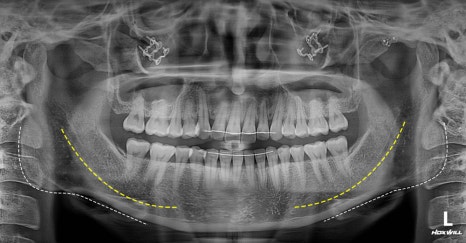
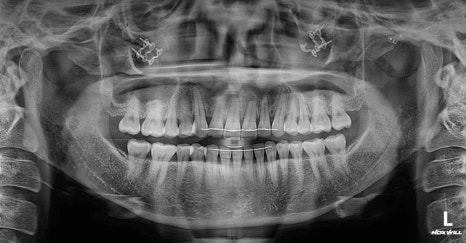
Before and after long-curve square jaw surgery
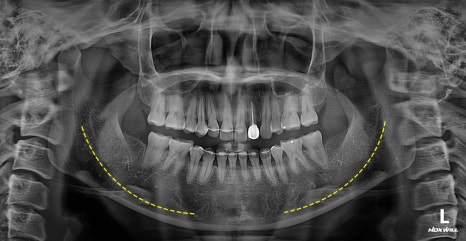
In the X-ray you are viewing, the yellow dotted line indicates the actual path of the inferior alveolar nerve.
In square jaw surgery, the bone is removed within the area below this nerve canal.
If the bone is removed too close to the nerve canal, the nerve may become exposed, which can increase the possibility of postoperative discomfort or sensory changes. For this reason, I generally perform surgery while maintaining a safety margin of approximately 3–4 mm to prevent nerve exposure.
If excessive bone is removed too close to the nerve canal, not only does the risk of nerve damage increase, but the jawline may also appear excessively sharply angled—the so-called “open-jaw” appearance—or sagging of the skin and soft tissue may become more likely.
In other words, excessive bone removal, the risk of nerve damage, and postoperative soft-tissue sagging are closely related in square jaw surgery. Rather than removing as much bone as possible, it is important to remove an appropriate amount while considering both safety and facial balance.
If the nerve canal is too low to allow sufficient bone removal,
is it difficult to achieve a noticeable frontal result?
Not necessarily. When the nerve canal is positioned too close to or too low relative to the intended bone-removal line, people with a low nerve canal can still achieve a noticeable frontal result if cortical osteotomy, partial masseter reduction, and deep cheek fat removal are performed together when appropriate.
I will show you a case of a patient whose bone-removal range was limited because of a low nerve canal, but who achieved good improvement by applying these methods together.
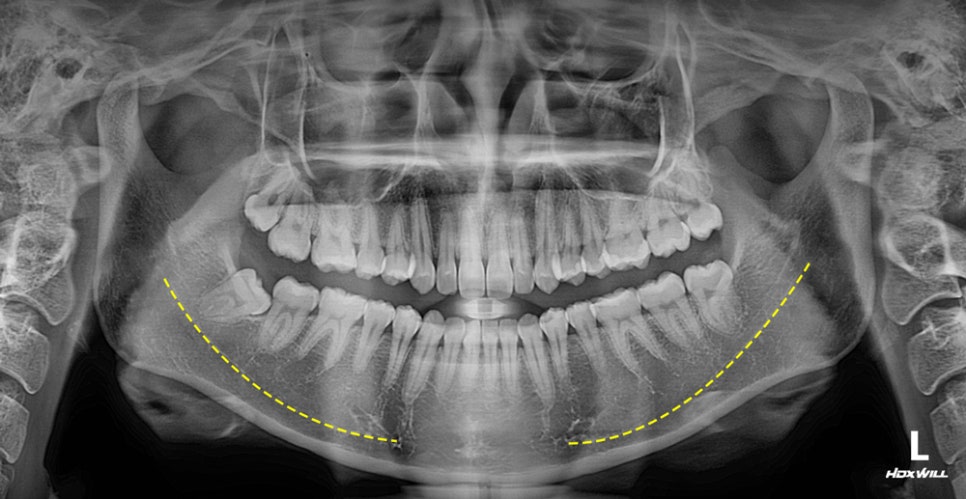
This is the patient’s panoramic image before surgery. First and foremost, it is important to accurately confirm the position of the inferior alveolar nerve canal.
As you can see in the image, this patient had significant development of both the square jaw and the front of the chin.
However, because the inferior alveolar nerve canal was positioned relatively low, partial masseter reduction to reduce the size of the masseter muscle and cortical osteotomy to reduce the thickness of the jawbone were performed together with long-curve square jaw surgery.
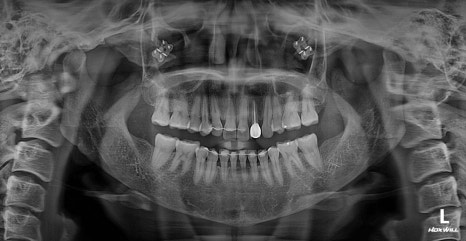
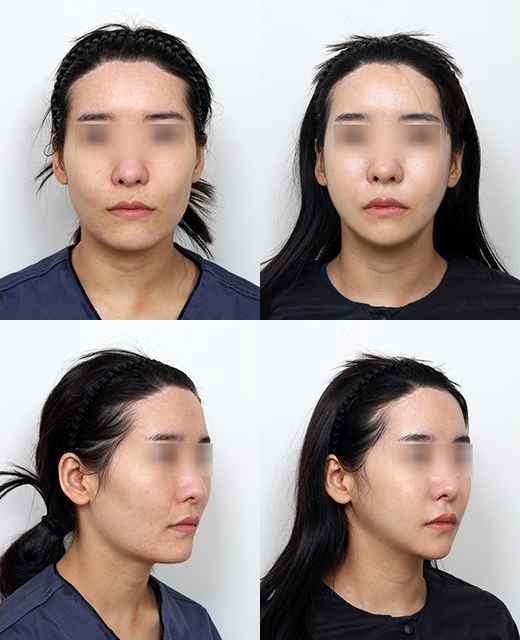
The patient’s appearance after surgery is shown below.
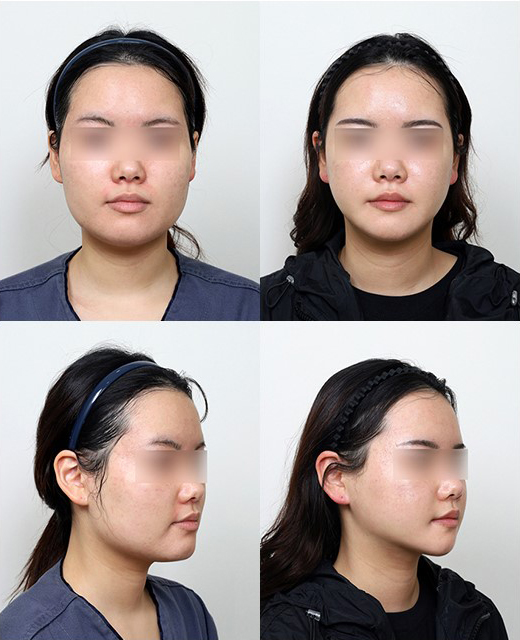
Square jaw surgery, cortical osteotomy, and partial masseter reduction
Facial contouring surgery is not simply a procedure that removes a large amount of bone. It is a highly precise operation that requires consideration of both the nerve position and the anatomical structures of the face.
In addition to an accurate diagnosis and individualized surgical plan before surgery, delicate and safe surgical techniques throughout the procedure are necessary to achieve satisfactory results.
Zygoma reduction, square jaw surgery, partial masseter reduction, and chin surgery
This patient underwent partial masseter reduction together with facial contouring surgery to enhance the frontal result.
When the masseter muscle covering the facial bones is excessively developed or there is a large amount of facial fat, making the face look generally full and wide, it may be difficult to achieve the desired frontal result by refining the bones alone.
In such cases, planning partial masseter reduction or, when necessary, a procedure to reduce facial fat together with the other procedures may lead to a more satisfactory frontal result and surgical outcome. Therefore, it is most important to accurately analyze both the bones and soft tissue that determine the facial contours and establish a surgical plan suited to them.
The change many people look forward to most after facial contouring surgery is the facial line seen from the front.
For square jaw surgery as well, a sufficiently satisfactory frontal result can be achieved by appropriately combining delicate cortical osteotomy through an intraoral incision with partial masseter reduction, depending on the patient’s condition. Of course, cortical osteotomy is not necessary for every patient, but in my experience, addressing this aspect often leads to a slimmer appearance in many cases.
It is most important to have a thorough consultation with the surgeon and undergo the procedure that is most suitable for you.
Thank you.