Hello, I am Dr. Hyunwoo Cho of 입체성형외과.
When consulting with patients about facial contouring surgery, there are several things I hear most often.
“Doctor, please remove as much bone as possible.” “I wish my face were smaller than it is now.” “Can facial contouring surgery make me as beautiful as a celebrity?”
Whenever I hear these questions, I ask my patients one question in return.
Is a smaller face really a beautiful face?
Many people believe that the smaller the face, the more attractive it is.
In fact, in Asia, including Korea, a small face is often regarded as one of the standards of beauty.
For this reason, many people think of facial contouring surgery simply as surgery to make the face smaller. However, that is not how I define facial contouring surgery.
In my view, facial contouring surgery is not a procedure that removes large amounts of facial bone. It is a design process that reconfigures the balance of the entire face.
In recent years, the direction of facial contouring surgery has clearly changed internationally.
In the past, an important research question was “How much bone can be safely reduced?” However, recent studies have focused on “How can the entire face be made to look more natural and harmonious?”
Accordingly, the goal of facial contouring surgery is shifting from Bone Reduction to Facial Harmony.
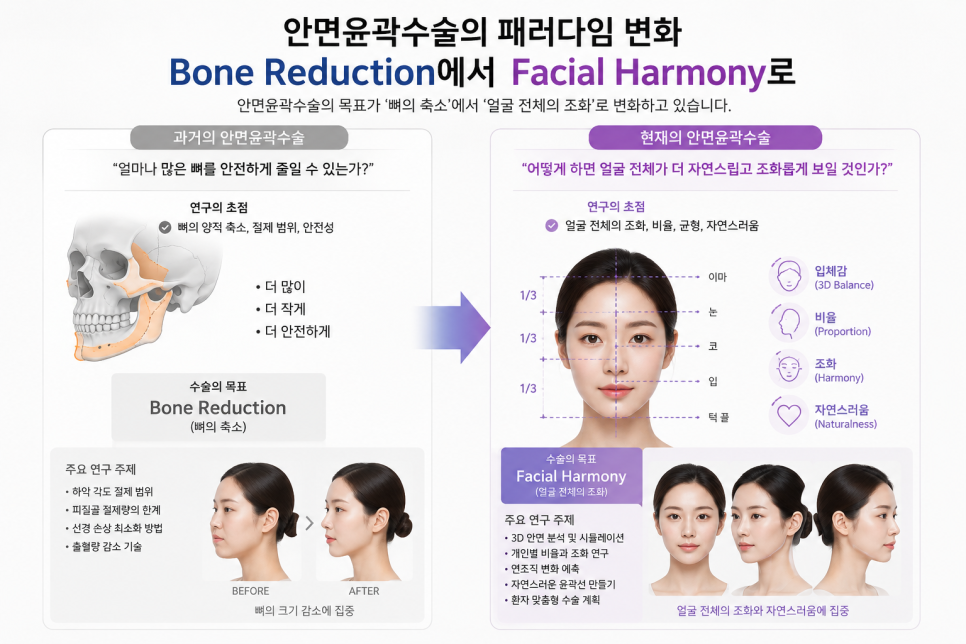
What is the difference between facial contouring surgery in the past and today?
Twenty years ago, facial contouring surgery was based on a relatively simple concept: reduce the cheekbones if they were large, and reduce the square jaw if it was prominent.
However, as time passed, unexpected outcomes also began to be observed. In some cases, the face looked awkward even though the cheekbones had been reduced significantly. In others, the face did not look as small as expected even though the square jaw had been reduced sufficiently. Conversely, some patients created a much more natural and refined impression even though the amount of bone cutting was not extensive.
We commonly evaluate our faces by looking in the mirror or taking selfies with our phones.
However, a person’s actual face is not a structure that can be explained by a single frontal photograph.
When we talk, walk, take photographs, or appear in videos, we are constantly looking at a three-dimensional face in motion.
Even so, many patients show only one photograph during a consultation and say, “Please reduce it to look like this.”
A good facial contouring procedure analyzes the front, side, and 45-degree views, facial expressions when smiling, the connection between the jawline and neckline, skin elasticity, and the length and width of the face as a whole.
The goal is not to create a face that looks attractive from only one direction, but to create facial lines that connect naturally from every angle.
What creates the face is not just bone.
Many people think that facial bones are the most important factor determining the size of the face.
Of course, prominent cheekbones or a developed mandibular angle can make the face look wider.
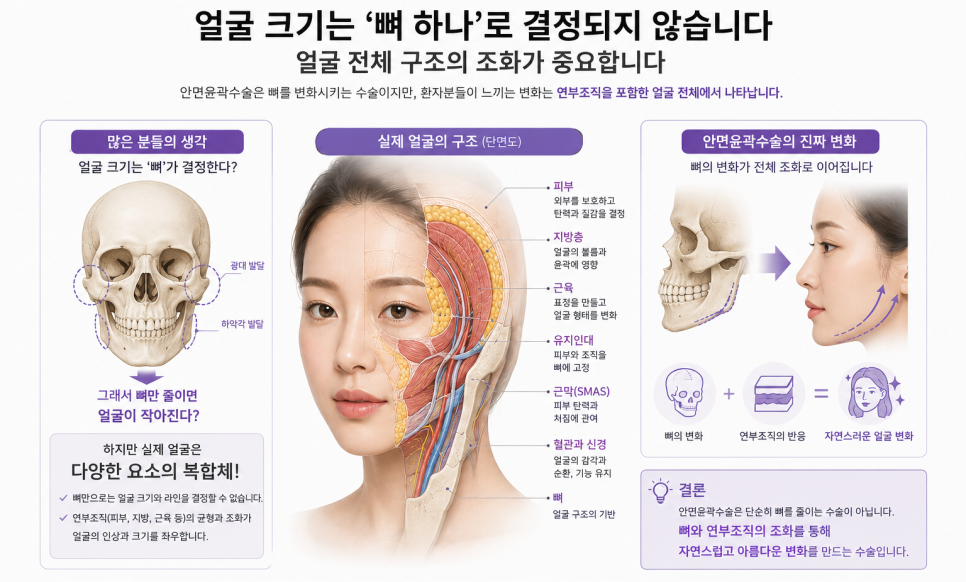
However, the actual appearance of the face is not determined by bone alone. There is skin over the bone, a layer of fat beneath the skin, and complex structures between them, including the muscles that create facial expressions, retaining ligaments, the fascia (SMAS), blood vessels, and nerves.
For this reason, two people with cheekbones of the same size can have completely different facial shapes.
One person may have thin skin and little fat, making the face appear smaller, while another may have fuller cheeks or developed masseter muscles, making the face appear much wider.
For example, reducing the cheekbones by 5 mm does not make the face 5 mm smaller.
Facial contouring surgery changes the bone, but the changes patients perceive ultimately appear across the entire face, including the soft tissue.
Is removing a large amount of bone the sign of a good procedure?
In the past, there were times when greater amounts of bone cutting were considered a sign of a successful operation. However, that is not the case today.
Rather, excessive bone removal can reduce the three-dimensional quality of the face, flatten the midface, or make sagging of the cheeks appear more pronounced over time.
The cheekbones are not simply protruding bones. They are important structures that maintain facial volume and create light and shadow, which form three-dimensionality.
The square jaw is also not simply bone that should be cut away; it is an element that creates balance in the jawline.
Therefore, modern facial contouring surgery places greater importance on determining which areas should be reduced and which should be preserved to create the most natural-looking face.
This is the concept of Facial Harmony, which has been repeatedly emphasized in recent international conferences and academic papers.
Then, why has this change taken place
in the field of facial contouring surgery in recent years?
The reason is that the perspective from which we view the structure of the face itself has changed.
In the past, the approach was to reduce the cheekbones if they were large, reduce the square jaw if it was wide, and bring the chin forward if it was short.
However, recent international journals explain that it is difficult to create a beautiful face through this approach alone.
It has now become important to view the entire face as a single three-dimensional structure.
Profiloplasty is a concept that represents this approach.
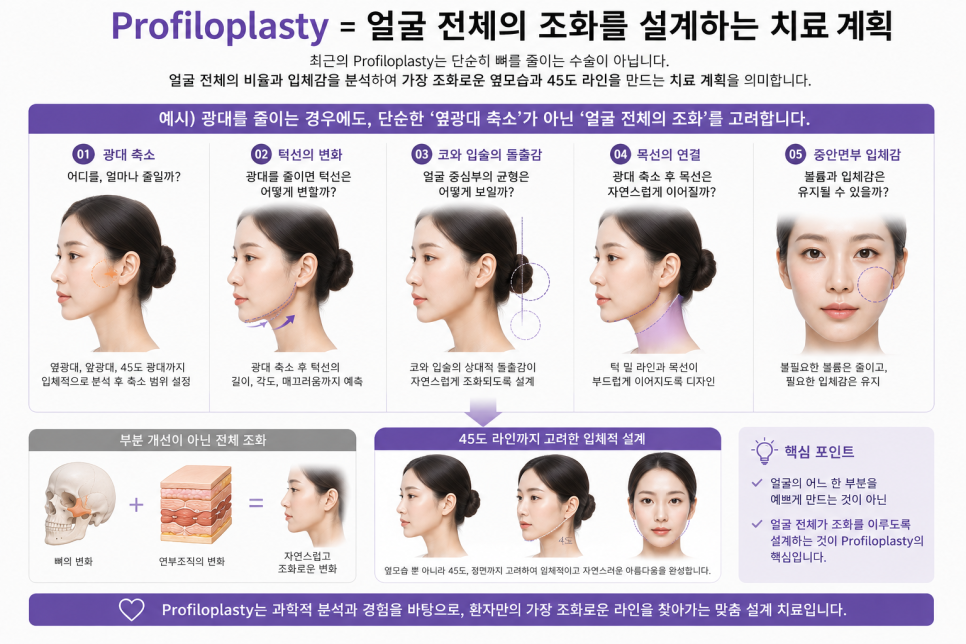
What is Profiloplasty?
Recently, the term has been used to describe a treatment plan that analyzes the proportions and three-dimensionality of the entire face to create the most harmonious profile and 45-degree contours.
In the past, the cheekbones and jaw were planned as separate procedures. With Profiloplasty, however, the entire face is viewed as one structure.
For example, when reducing the cheekbones, the plan considers not only reducing the lateral cheekbones, but also how the jawline will change, how the projection of the nose and lips will appear, whether the neckline will connect naturally, and whether the three-dimensional quality of the midface will be maintained.
The goal is not to make one part of the face look attractive, but to design the entire face so that it is harmonious.
Recent review papers in the field of facial contouring also emphasize that contouring surgery should not be an isolated osteotomy procedure, but a treatment aimed at achieving harmony across the entire face.
Today, we looked at the facial bones, the first factor that determines facial shape, and how facial contouring surgery has recently shifted its focus toward Facial Harmony. In the next column, we will take a detailed look at soft tissue, the second key factor that determines the face.
I will explain, based on medical evidence and in an easy-to-understand way, why facial impressions differ even when people have the same bone structure, and why soft tissue must also be considered in facial contouring surgery.
Thank you.