Hello. I am Dr. Hyun-woo Cho, director of 입체성형외과.
There are several reasons why the face may appear long. The forehead may be long, the midface may be long, or the lower jaw may be long, making the overall facial proportions appear elongated. I have also explained various ways to reduce facial length through several previous columns.
To improve facial length, it is necessary to consider not only the appearance from the front but also the proportions of the side profile. For this reason, in most cases, I recommend performing chin surgery together with square jaw surgery.
However, not everyone wants a major operation.
Many people feel concerned about general anesthesia or want an improvement through a simpler approach.
In these cases, it is possible to alter the length of the chin to some extent by adjusting the angle of the bone cut during chin surgery.
Today, I will explain this method.
Is chin advancement surgery only about moving the chin forward?
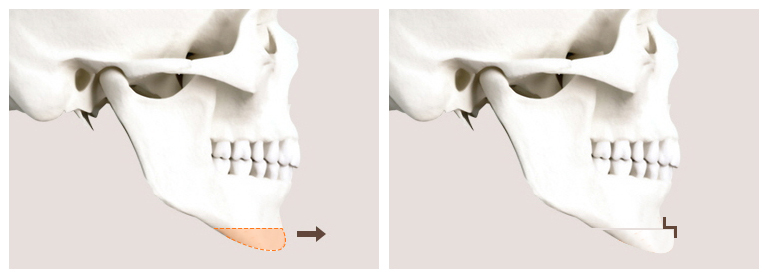
Many people think that chin advancement surgery, as the name suggests, is a procedure that moves the chin only forward. Of course, that is its primary purpose.
However, in actual surgery, the plan involves more than simply deciding how many millimeters to move the chin forward.
We also plan where to cut the bone, at what angle to make the cut, and how much to rotate the segment.
The length of the chin can change depending on this bone-cutting angle.
If the cut surface is made horizontal, the chin moves almost exclusively forward.
However, if the cut surface is angled, the chin moves forward while also shifting upward or downward.
What happens when the cut surface is angled?
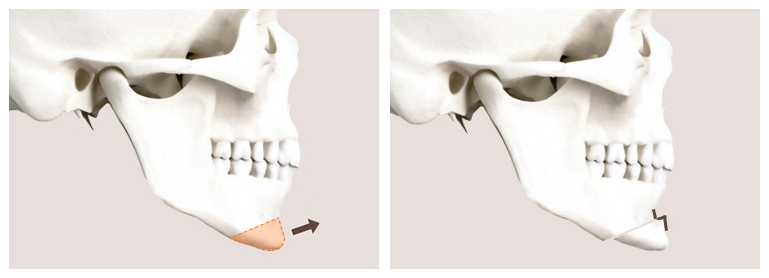
I previously introduced this method in an overseas research paper that I reviewed.
If the cut surface is angled upward while advancing the chin, the chin moves both forward and upward.
As a result, the chin may appear shorter.
Of course, this does not produce as substantial a change as surgery that directly removes bone to reduce the length. However, as the position of the chin and the facial proportions improve together, the face often appears shorter in a more natural way than expected.
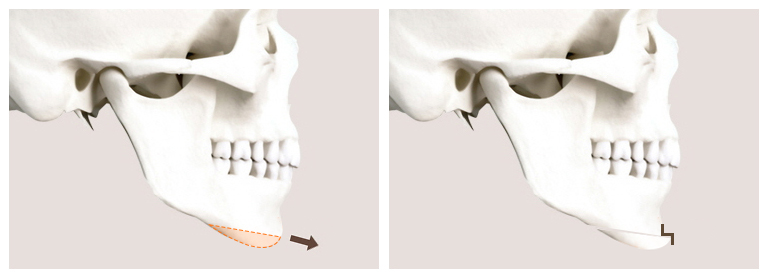
Conversely, if the cut surface is angled downward before advancing the chin, the chin moves forward and downward at the same time.
In this case, the chin can be made to appear slightly longer.
Thus, even with the same 5 mm advancement, completely different results can be achieved depending on the direction of the bone cut.
Does chin setback surgery work according to the same principle?
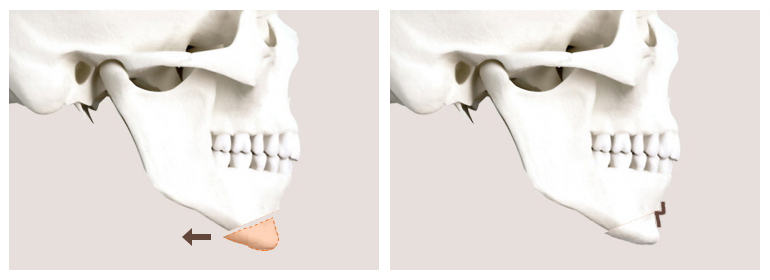
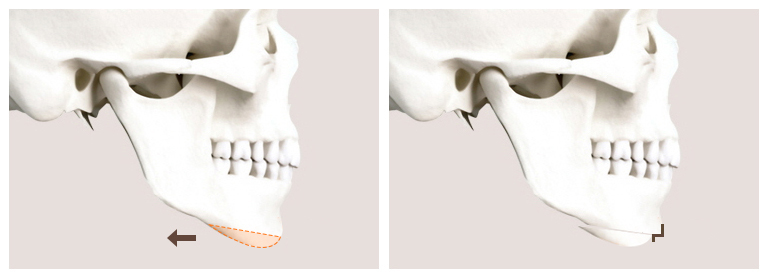
This principle also applies to setback surgery, in which the chin is moved backward.
By adjusting the direction of the bone cut during setback, it is possible to reduce facial length slightly or, conversely, increase it slightly.
The direction of the bone cut is more important than whether the chin is moved forward or backward.
Then why is this method not used for every patient?
There is an important point to understand here. Adjusting facial length through the bone-cutting angle is, ultimately, a method for creating an additional, limited change.
If the facial length needs to be reduced substantially, by approximately 7–10 mm, this method alone has limitations.
In such cases, chin reduction surgery, which directly removes bone to shorten the chin, or lengthening surgery using a bone graft may be much more effective options.
Therefore, it may be best to understand angle adjustment as a technique used during advancement or setback surgery to further refine facial proportions to a limited extent.
Let us look at some actual surgical cases.
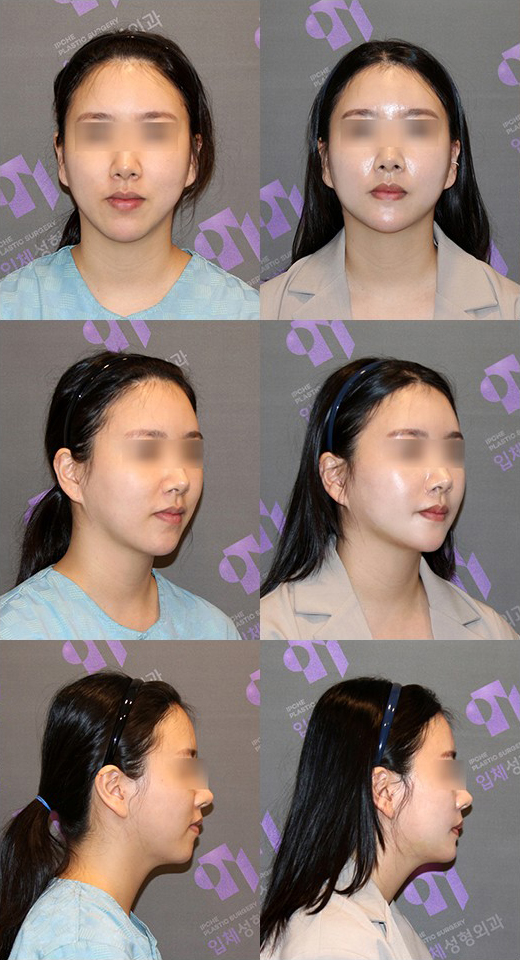
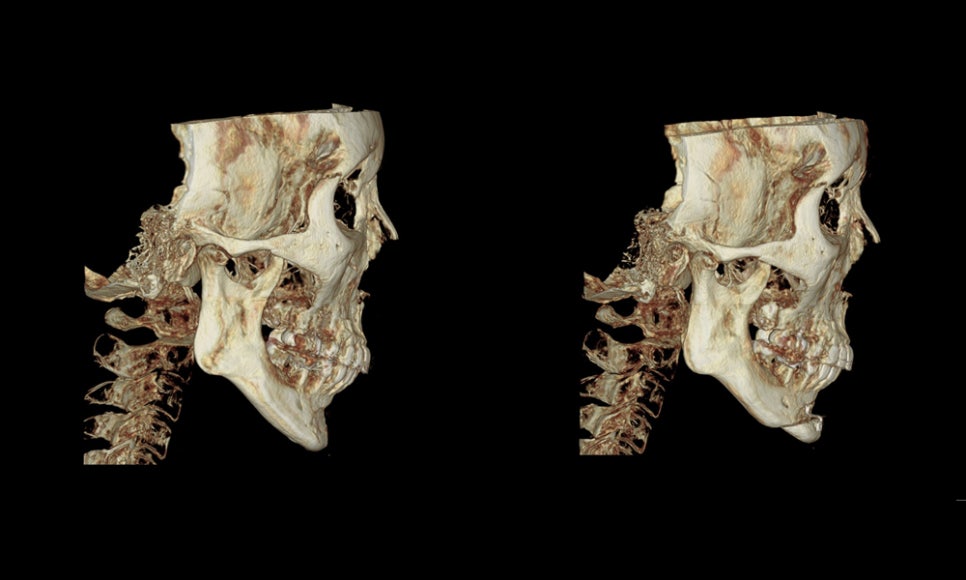
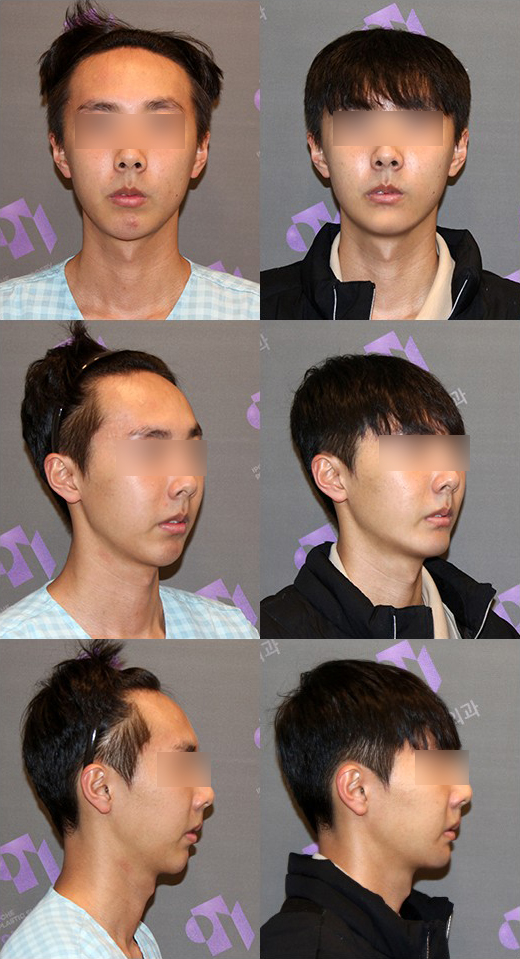
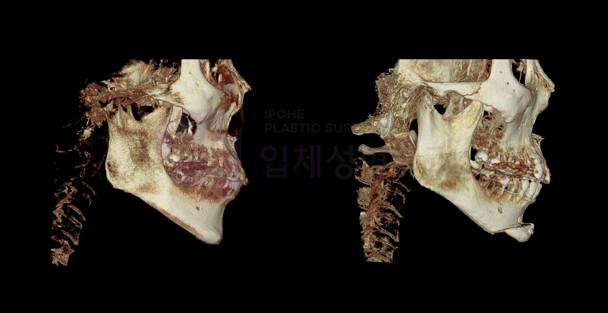
These are two patients who underwent chin advancement surgery.
In both cases, the chin was not simply moved forward; the direction of the bone cut was also planned to adjust the facial proportions.
After surgery, the chin moved naturally forward, the jawline became more defined, and the overall facial balance was improved in a more harmonious way.
Chin surgery is not simply a matter of deciding how many millimeters to move the chin forward.
The position and direction of the bone cut, the amount of movement, and the rotation all need to be considered together to improve both facial proportions and the side profile.
If you want to improve your facial proportions further while minimizing the extent of surgery, meaningful changes can be achieved simply by appropriately adjusting the bone-cutting angle during advancement or setback.
In addition, this procedure is relatively limited in scope, and depending on the circumstances, it may be possible to perform it under sedation alone.
Of course, the anesthesia method may vary depending on the patient's condition and the amount of movement required, but it is not necessarily an extremely major operation, as many people may assume.
Today, I introduced one relatively simple but very important technique in actual surgical planning.
I hope this has been at least somewhat helpful to those considering surgery.
Thank you.