Hello.
I am Heo Jae-won, a board-certified plastic surgeon performing facial rejuvenation surgery at 입체성형외과.
After a hectic summer, the hottest part of the season is gradually beginning to pass.
As the weather starts to cool, another season begins for plastic surgeons.
It is conference season.
This time, I was asked to prepare a presentation on double chin surgery, or submentoplasty, for the Minimally Invasive Plastic Surgery Research Society.
While organizing my presentation materials, I thought I would also discuss on this blog one of the topics I have been most interested in recently: “How effectively can a double chin be improved while keeping the incision as small as possible?”
Double chin treatment involves more steps than you might expect.
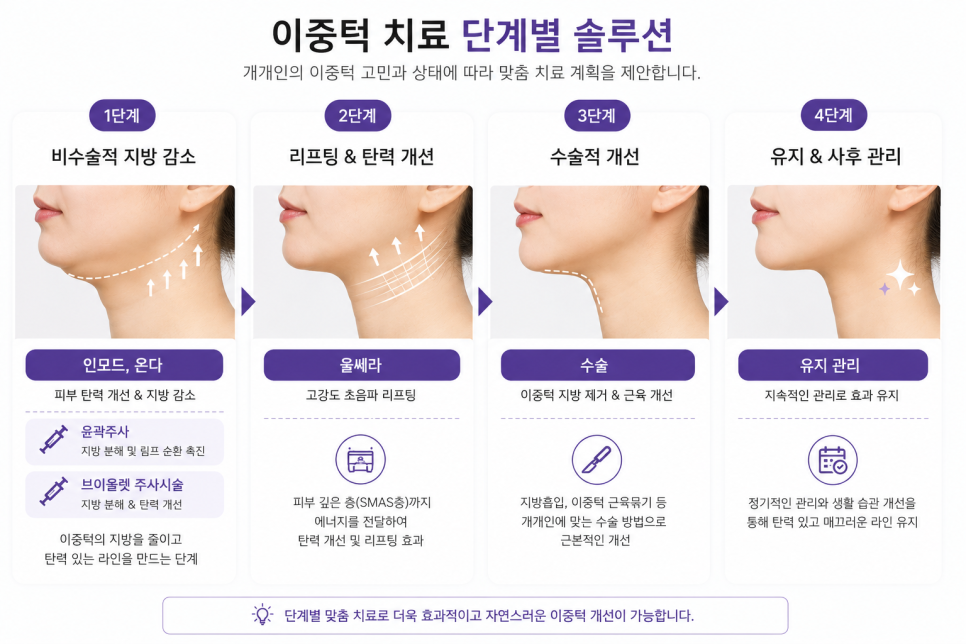
When people are concerned about a double chin, surgery is usually not the first option that comes to mind.
Most people begin with relatively low-burden procedures.
Common examples include energy-based treatments using devices such as InMode, Ultherapy, and Onda.
Another option is injectable treatment, in which medication is injected into the fat layer, such as contour injections or V-Olet.
The greatest advantages of these methods are clear.
They do not require an incision, and the recovery period is relatively short.
For people who are apprehensive about surgery or who cannot take extended time away from their daily lives, these can certainly be options worth considering.
However, based on my experience performing several types of these procedures myself, I have also found clear limitations.
With InMode and Onda, some degree of change can be felt immediately after treatment, but in some cases the results do not last long enough, which can be disappointing.
Ultherapy can produce a comparatively more noticeable change, but the anatomy of the double chin area differs from that of other areas of the face, so the procedure must be performed carefully and precisely.
In particular, overly aggressive treatment of the double chin area can carry the risk of side effects such as skin burns. Therefore, understanding the anatomy and performing the treatment accurately is more important than simply using a large number of shots.
Injectable treatments raise similar concerns.
Using a small amount may not produce enough change, while a more intensive treatment intended to increase the effect can cause considerable swelling, bruising, pain, and discomfort.
Compared with surgery, the results are also often less dramatic.
As a result, people who have undergone multiple procedures without achieving the jawline they want eventually begin considering a more intensive level of treatment.
The first surgical option most people choose is “double chin liposuction.”
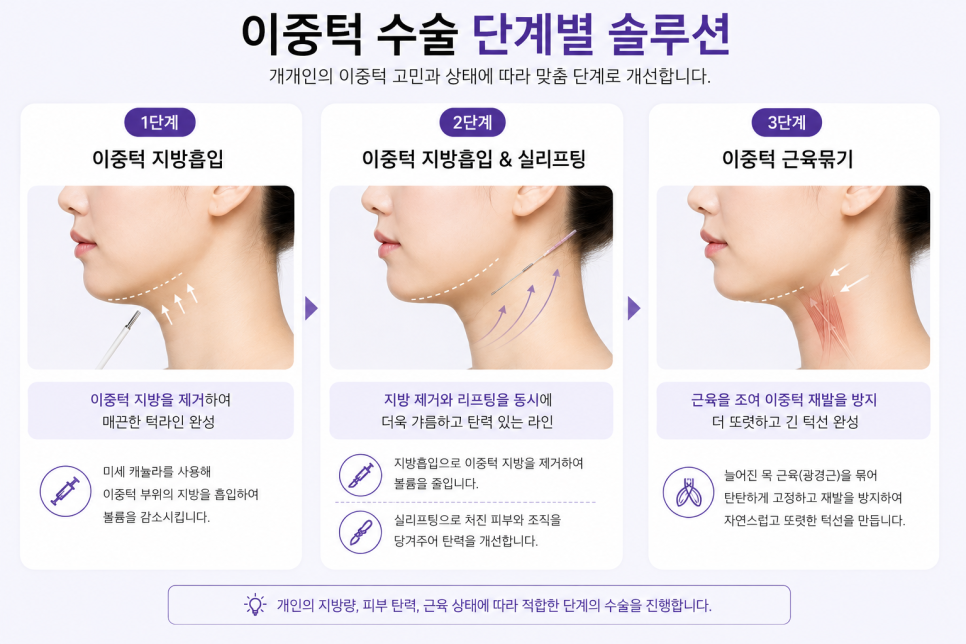
The most basic step in double chin surgery is liposuction of the double chin and jawline.
I consider liposuction to be a treatment one step beyond the various nonsurgical treatments mentioned above.
The reason is simple. Rather than indirectly affecting fat cells, it actually removes the fat located beneath the skin.
Surgery does not necessarily require a large incision.
Typically, a small incision of about 4–5 mm is made beneath the chin, and an instrument called a cannula is inserted through the opening.
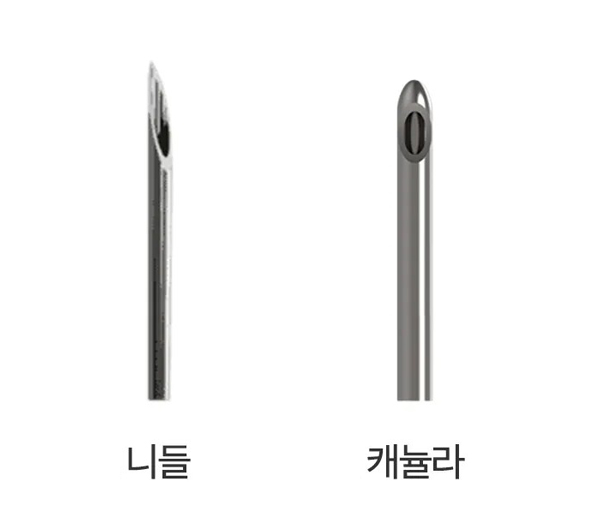
Unlike a sharp injection needle, a cannula is a relatively blunt, tube-shaped instrument.
Negative pressure is connected to it to suction out the fat beneath the skin. However, fat is not suctioned out immediately simply because it is present.
Before surgery, a sufficient amount of tumescent solution is injected into the fat layer to soften the tissue and create conditions that allow the fat to be removed more safely.
This process is more important than it may seem. The difficulty of liposuction and the degree of tissue damage can vary depending on the composition of the tumescent solution, how much is injected, and how long one waits after the injection.
In the past, when people referred to surgery for improving a double chin, liposuction was considered the most intensive treatment.
Many people do achieve very good results with liposuction alone. However, in some cases, the jawline does not become defined even after a substantial amount of fat has been removed.
Even after sufficient liposuction has clearly been performed, the area beneath the chin may not become as flat as expected.
At first, one may think, “Could there still be fat left?” and try performing liposuction for longer and in greater detail.
But beyond a certain point, the results do not improve. Instead, bruising, swelling, bleeding, and tissue damage may increase.
In other words, not every double chin is caused by fat located directly beneath the skin.
What if thread lifting is added to liposuction?
To address the limitations of liposuction, methods combining liposuction with thread lifting were also introduced.
For convenience, I sometimes describe this as approximately stage 1.5 of double chin surgery. Materials such as Mint threads and Elastikum have commonly been used.
After removing the fat, pulling the remaining tissue with threads can make the jawline appear more defined immediately after surgery.
However, this method also had its drawbacks.
With PDO-based Mint threads, if the threads are positioned close to the skin or pull the tissue strongly, dimpling may occur, making the points where the threads are anchored appear sunken.
With Elastikum, the initial lifting effect is relatively good, but as the tension of the threads decreases over time, I have encountered cases in which the area beneath the chin appears loose again after one to two years. Ultimately, the conclusion is that “removing fat and tightening the skin alone does not solve every problem.”
The structures that create a double chin are not limited to fat.
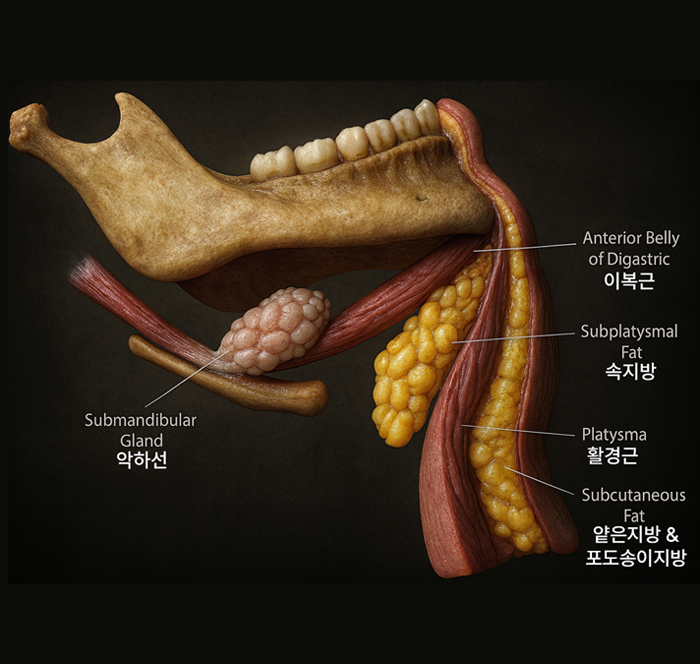
One reason double chin surgery has advanced considerably in recent years is that our understanding of the anatomy beneath the chin has become much deeper.
From the outside, all double chins may look similar, but when the internal structures are examined, the causes can differ considerably from person to person.
Some people have a large amount of superficial fat located directly beneath the skin, while in others, structures located deeper inside push the area beneath the chin forward.
A representative example is the platysma.
The platysma is a thin muscle that broadly covers the surface of the neck, and a deep fat layer that is difficult to access with liposuction may exist beneath it.
Still deeper are various anatomical structures, including the digastric muscle.
If these structures are developed or protrude forward, it can be difficult to fully reduce the volume beneath the chin by removing only the fat beneath the skin.
Even superficial fat is not equally easy to remove in every person.
There is another interesting aspect to consider.
The fat located directly beneath the skin, which may appear easy to remove with liposuction, also differs in its characteristics from person to person.
In some people, the fat is relatively soft, allowing the cannula to pass easily and the fat to be removed relatively evenly.
In other patients, considerably tough and thick fibrous tissue has formed between the fat deposits.
In such cases, the fat may appear to be divided into multiple small spaces and held tightly in place.
A blunt liposuction cannula alone may not be able to pass sufficiently through these fibrous structures.
In Korea, some doctors describe this type of fat using expressions such as “grape-cluster fat.”
Ultimately, what matters is not only the amount of fat beneath the chin, but also where it is located and what structures surround it.
This is why “platysma muscle tightening” began to develop.
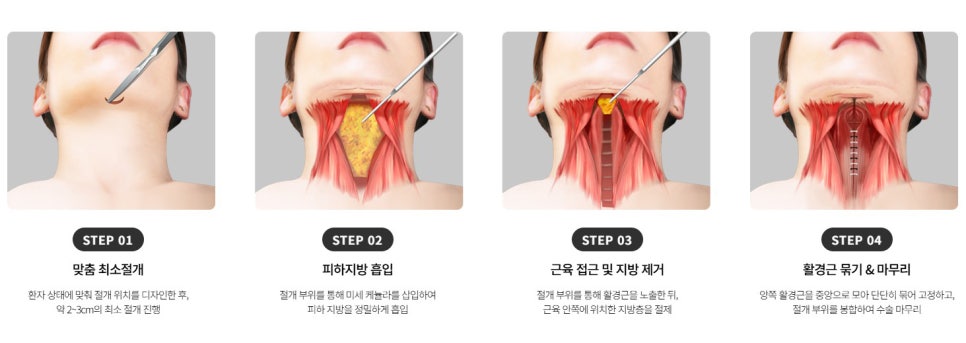
In the past, it was thought that liposuction performed through a small opening would be sufficient to resolve a double chin.
However, as our understanding of the anatomy deepened, it became clear that deep fat that cannot be removed with liposuction, dense fibrous tissue, the structure of the platysma, and even deeper muscle structures can all affect the jawline.
For people seeking a more definitive result, surgery using a somewhat larger incision than liposuction became necessary to directly examine and correct the structures beneath the chin. The surgery commonly known by patients as “platysma muscle tightening” is one of the methods that developed from this progression.
But this leads to another concern.
As the surgical area is expanded to enhance the results, the incision line inevitably becomes longer as well.
So, is it possible to further reduce the incision while maintaining the effects of conventional double chin surgery? This is precisely the area I have been most interested in and researching recently.
In my next post, I will discuss in more detail what submentoplasty, commonly called “platysma muscle tightening,” actually involves, the advantages and disadvantages of existing methods, and what approaches I am considering to reduce the incision.
Thank you.