Hello.
I am Heo Jae-won, a board-certified plastic surgeon specializing in rejuvenation surgery at Ipche Plastic Surgery.
In my previous column, I explained various procedures for improving a double chin, including relatively simple double-chin liposuction.
However, in actual clinical practice, there are patients whose jawline does not become sufficiently defined with liposuction alone.
Why does this difference occur?
Today, I will look at the cases in which a double chin is difficult to correct with liposuction and examine, one by one, the anatomical structures responsible for it.
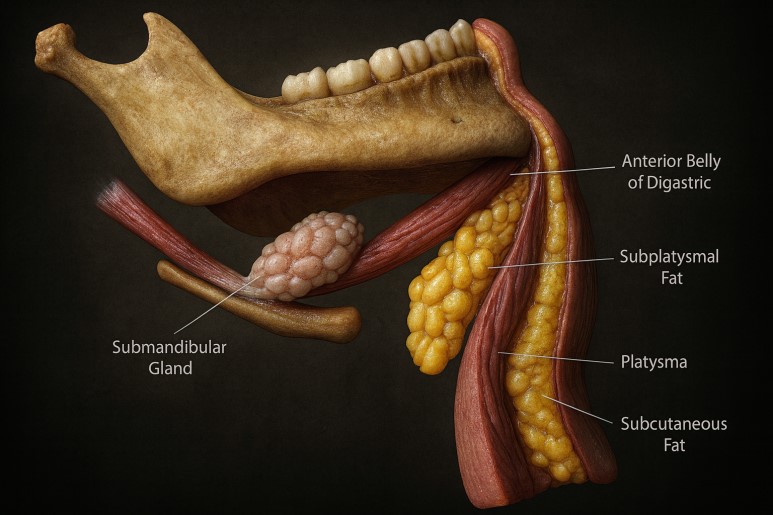
When we examine the structures beneath the chin in cross-section, we can broadly divide the cosmetically important structures into about five categories.
Two types of fat, two types of muscle, and one salivary gland.
First, the fat removed during the procedure commonly called “double-chin liposuction” is the outermost layer of fat marked as subcutaneous fat in the illustration.
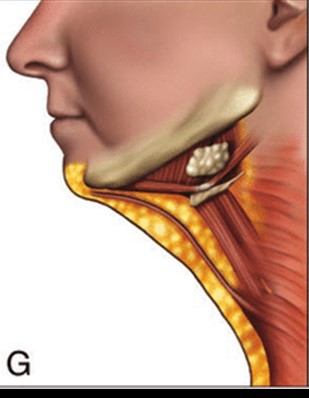
This subcutaneous fat is located directly beneath the skin. Rather than being concentrated only beneath the chin, it is distributed relatively broadly along the neck and jawline.
For this reason, people with thick subcutaneous fat often appear to have fullness not only beneath the chin but along the entire jawline as well.
In such cases, the goal is not to remove as much fat as possible indiscriminately, but to selectively reduce the fat thickness in areas of the face and neck that should appear relatively slimmer. This is the role of typical submental liposuction.
The next structure is the platysma.
The platysma is a thin muscle that broadly covers the surface of the neck and also contributes to pulling the corners of the mouth downward.
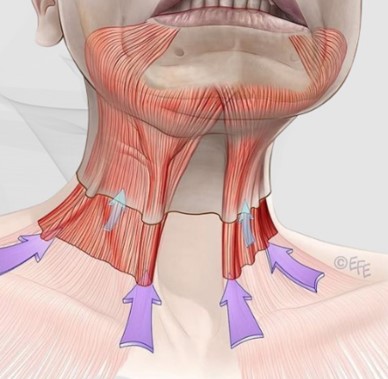
As we age, this muscle may become lax, or the borders of the muscles on both sides may begin to stand out, creating vertical lines in the center of the neck. These are commonly referred to as neck bands.
The structure targeted by the procedure commonly described in clinics as “double-chin muscle tightening” is also often the platysma.
The surgery that brings the platysma muscles together at the center and sutures them is called platysmaplasty.
However, there is one important point to note.
Platysmaplasty was not originally developed primarily to eliminate double-chin volume in young patients. Rather, it is closer to one step in a neck-lift procedure intended to correct a lax platysma and vertical neck bands.
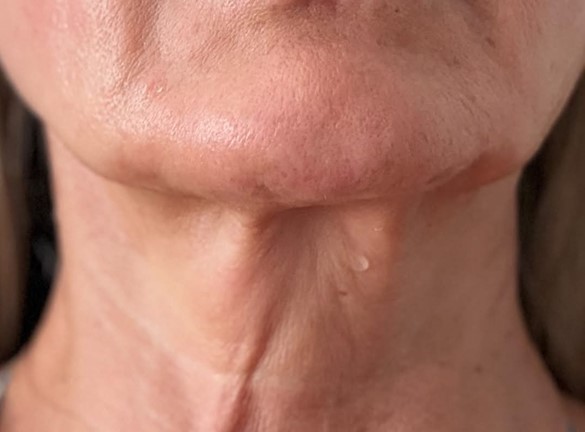
Therefore, in young patients with a double chin who do not have significant skin or muscle laxity, simply bringing the platysma muscles together at the center does not greatly reduce the volume beneath the chin. What, then, is an important reason that the area beneath the chin may still look thick even after liposuction in younger patients?
It is the subplatysmal fat, or deep fat, located beneath the platysma.
Subcutaneous fat lies outside the platysma, whereas this fat is located in a deeper layer than the platysma.
Therefore, even if sufficient fat is removed from beneath the skin, a large amount of this deep fat may leave the central volume beneath the chin unchanged.
In such patients, the subplatysmal deep fat must be directly identified and removed as needed for the contour beneath the chin to become more defined.
Removing deep fat also creates a certain amount of space in that area.
In this situation, bringing the platysma muscles together at the center does more than simply “tie the muscles together.” It also helps support and organize the structures beneath the chin after the deep fat has been removed.
In other words, for young patients with a double chin, surgery that tightens only the platysma while leaving the deep fat in place may have limited results.
The most important thing is not the muscle tightening itself, but first identifying which structure is actually creating the double chin.
One layer deeper is the digastric muscle.
The digastric muscle is also one of the important structures that determines the shape beneath the chin.
In male patients in particular, the digastric muscle itself is sometimes relatively large and well developed.
In these patients, a bulge may remain in the center beneath the chin even after the subcutaneous fat has been removed, the deep fat has been cleared, and the platysma has been corrected.
In such cases, it is necessary to consider that the source of the volume may be the digastric muscle rather than fat.
There is also a simple way to check this.
If you touch the bulging area beneath the chin and then open your mouth wide while saying “ah,” and you feel the area become firm or tense, the volume is more likely to be muscle-related.
For patients in whom the digastric muscle occupies a significant portion of the contour beneath the chin, the angle between the chin and neck can be made somewhat more defined, when necessary, by reducing part of the muscle’s surface. The entire digastric muscle is not removed.
Most of the muscle needed for function is preserved, while only the portion of its thickness that protrudes cosmetically is adjusted.
Finally, the submandibular gland must be evaluated.
Whereas the subcutaneous fat, deep fat, platysma, and digastric muscle described above are primarily related to the contour of the central area beneath the chin, the submandibular glands are structures that create volume slightly outside the center—in other words, on both sides.
Because the salivary glands are normally covered to some extent by fat and surrounding soft tissue, they may not be very noticeable before surgery. In particular, in patients with a large amount of fat beneath the chin and generally thick surrounding structures, the glands may be embedded in the surrounding tissue and not readily apparent.
The issue arises after the other structures have been addressed one by one.
Once the subcutaneous fat has been reduced, the deep fat removed, and the muscles refined, the previously hidden shape of the salivary glands may become relatively more prominent.
In patients who have undergone correction of the muscles beneath the chin or a facelift without touching the salivary glands,
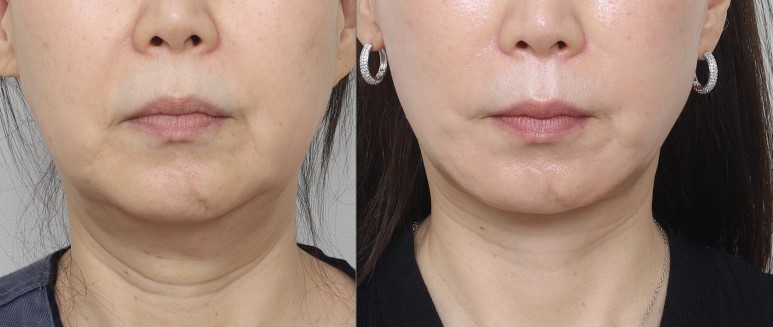
The jawline and neck line may look considerably improved from the front, but when viewed from a 45-degree angle, the volume of the salivary glands may remain on the outer sides beneath the chin, making the overall result feel slightly less complete.
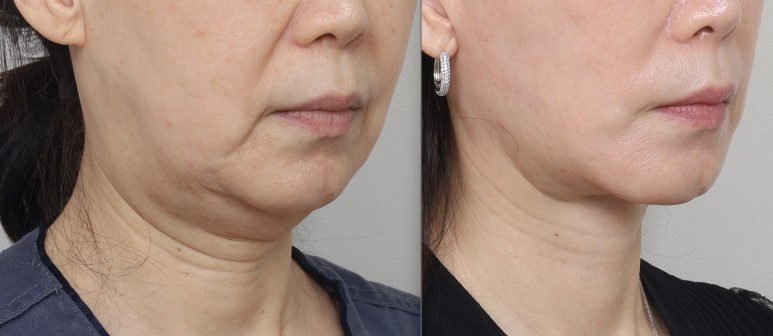
Therefore, when planning surgery beneath the chin, it is important not only to consider “how much fat is present,” but also to thoroughly evaluate the size and position of the salivary glands before surgery.
If the plan is not to reduce the salivary glands directly, patients should also be informed in advance that some degree of prominence may remain after surgery.
Although they may appear to be the same double chin, closer examination may reveal that subcutaneous fat is the cause in some cases, while deep fat beneath the platysma is the issue in others. In still other cases, the digastric muscle may be well developed or the submandibular glands may be prominent. Sometimes, several of these factors are present in the same person.
For this reason, I believe the most important aspect of double-chin surgery is not how much fat to remove, but accurately diagnosing which structures are creating the current shape beneath the chin.
In Part 3, I will discuss in more detail how these structures are actually approached and which areas can be corrected through submental surgery using minimal incisions.
Thank you.