“Lately, my face has been looking saggy, and I’m worried.”
“Which is better, Ulthera or Thermage?”
If you are concerned about reduced skin elasticity, sagging skin, or wrinkles,
you may have considered a lifting procedure at least once.
When looking into lifting procedures,
you naturally come across well-known treatments such as
Ulthera and Thermage.
However, rather than simply following a lifting treatment because it is said to be good,
or choosing the one that many other people get,
it is very important to find out which of the two procedures
is more suitable for you and then proceed accordingly.
So this time,
we will take a look at the difference between
Ulthera and Thermage at Mokdong Dermatology.
Ulthera and Thermage
What Is the Difference?
 An excerpt from website images used for easier understanding
First, in the case of Ulthera,
it can be said to be suitable when the elasticity inside the skin has decreased,
such as when the cheeks seem to have drooped downward compared to before.
Our face has a fascial layer called the SMAS beneath the skin.
This acts like the inner muscles that support the skin,
but as we age, this layer gradually stretches due to factors such as facial expressions and posture.
In such cases, the jawline becomes less defined,
and as the cheeks drop, the skin appears more spread out
and feels heavier.
 An excerpt from website images used for easier understanding
At this time, Ulthera delivers high-intensity ultrasound
HIFU energy to the fascial layer,
inducing collagen regeneration and helping create and lift a firm structure from within.
✔ People with a lot of cheek fat and a heavy, downward sagging feeling
✔ People whose jawline is not clearly defined
If the above applies to you,
we recommend the Ulthera procedure.
 An excerpt from website images used for easier understanding
Next, in the case of Thermage,
it is a recommended lifting procedure when, at some point,
the face as a whole feels dull and the skin seems to have lost its firmness.
This is a sign that the elasticity of the dermis layer beneath the skin surface
is gradually weakening.
The dermis is a key layer that maintains skin elasticity and moisture,
and it is where collagen and elastin are mainly located.
Collagen helps keep the skin firm,
and elastin is responsible for the skin’s elasticity,
allowing it to stretch and then return to its original position.
However, since the late 20s,
the amount naturally decreases,
causing the face to lose firmness and leading to fine sagging,
fine wrinkles, enlarged pores, and other concerns.
At this time, if the dermis is gently stimulated with radiofrequency energy through Thermage,
it plays a tightening role from within,
which can promote collagen production and improve elasticity.
 An excerpt from website images used for easier understanding
✔ People with thin skin and an overall feeling of lost firmness
✔ People concerned about pores, skin texture, and reduced elasticity
✔ People who want gentle changes rather than strong lifting
For those who fit the above cases,
Thermage lifting can be a good option.
Also, in the case of Thermage,
it is not a procedure that produces an immediate dramatic change,
so it takes time for collagen to be generated.
It can be said to be a procedure in which collagen is generated over 1 to 3 months after treatment,
and elasticity gradually improves.

To briefly summarize what we have covered so far,
Ulthera is a lifting treatment that firmly pulls up a collapsed structure,
while Thermage is a lifting treatment that strengthens the skin from within.
Additionally, you can undergo both lifting treatments together
to care for both the surface and the inside in one go.
Mokdong Dermatology Thermage, Ulthera Lifting
The Most Important ‘This’
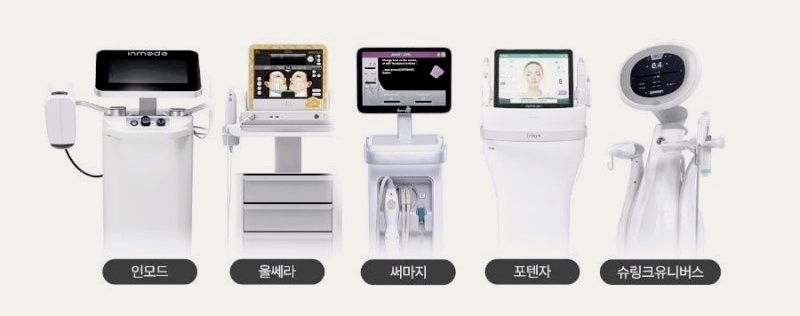 An excerpt from website images used for easier understanding
It is true that through Thermage and Ulthera,
you can improve skin elasticity
and maintain a youthful appearance,
but the most important thing is to proceed with the lifting procedure that is right for you.
Because each person’s skin condition and characteristics are different,
it is important to understand them well and undergo treatment through a dermatologist
with extensive experience and know-how who can provide customized procedures.
Therefore, for satisfying results,
we recommend visiting a dermatology clinic
with a high level of skill and expertise in lifting procedures.
Today, we looked into the details under the title
“Momokdong Dermatology: What Is the Difference Between Ulthera and Thermage?”
We hope that through the information provided,
you will be able to receive a more satisfying, personalized lifting procedure.