Hello. I am Lim Young-soo, Medical Director of Troy Plastic Surgery.
It can be particularly concerning when only the area under your chin remains unchanged even after dieting.
“Why has the fat on my face gone down, but the area under my chin remains the same?”
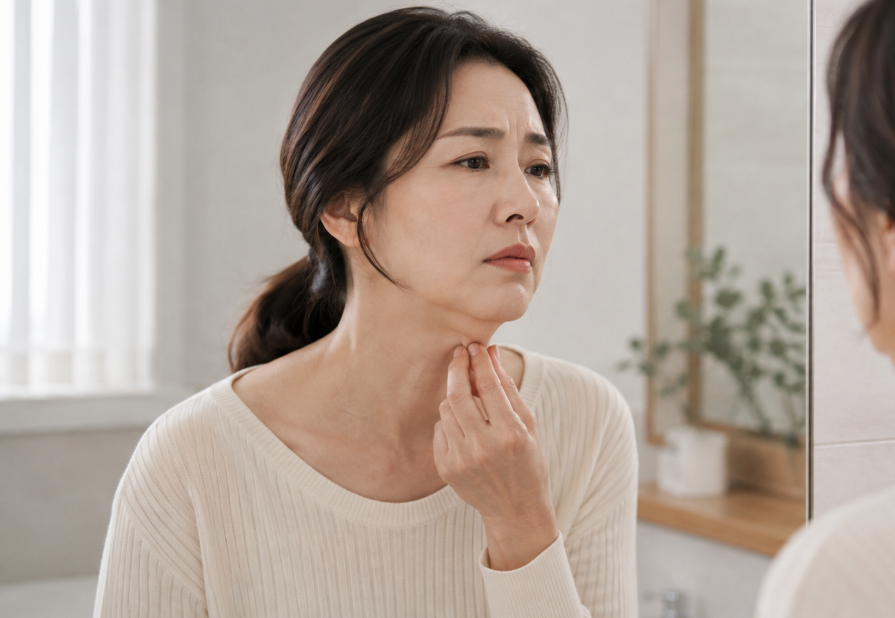
At first, you may think that you have not lost enough weight, but if the boundary between your chin and neck still looks indistinct over time, you may start looking into double-chin lifting.
However, when you search for information, there are so many options, such as InMode, Ultherapy, and liposuction, that it can become even more confusing to determine which one is right for your face.
That is why, rather than choosing a treatment name first for a double chin, it is important to determine whether the issue is fat or reduced skin elasticity and sagging.
- Why does my double chin remain even after losing weight?

A double chin may look similar on the surface, but its causes can differ.
During a consultation, we generally distinguish between the following four types.
Fat-dominant type: Soft fat is prominent under the chin
Reduced-elasticity type: The skin becomes loose and the jawline sags downward
Posture-related type: The boundary between the chin and neck looks less defined when the head and neck are held forward
Combined type: Fat and skin sagging occur together
In particular, people in their 40s and 50s often have reduced skin elasticity along with fat accumulation, so simply reducing the fat under the chin may leave something to be desired.
- If there is not much fat under the chin but it still looks saggy,
which type of lifting is appropriate?

If there is not much fat when you pinch the area under your chin with your hand, but your jawline looks indistinct, you should first examine your skin elasticity.
In such cases, laser lifting options such as InMode, Ultherapy, and Thermage are compared.
Because the energy used and the depth of action differ among devices, simply choosing a device that is “well known for double chins” is not the right approach.
-
The skin has become thinner and overall elasticity has decreased
-
The jawline has become looser than before
-
Sagging is more noticeable than fat
In this situation, after checking the skin thickness and the amount of fat under the chin, it is necessary to determine the depth and amount of energy required.
- If you can pinch the fat under your chin, is lifting alone enough?

If a thick layer of fat can be pinched when you grasp the area under your chin, it can be difficult to create the desired jawline with lifting that only tightens the skin.
If the amount of fat is not substantial, a relatively simple option such as a contour injection may be considered. However, if fat has clearly accumulated, more direct methods such as submental liposuction may be compared.
The important point here is not how much fat should be removed.
If too much fat is reduced, the remaining skin may look loose, or the area under the chin may become excessively hollow, disrupting the natural line of the neck.
Therefore, even when planning liposuction, we assess not only the amount of fat but also how much the skin can contract on its own.
If both fat and reduced elasticity are present, it is important to create a plan that anticipates the skin sagging that may remain after the fat is reduced.
- If laser treatment seems insufficient,
should you also consider thread lifting or a facelift?

As you research double-chin lifting, you may also come across thread lifting, a mini facelift, and a neck lift, making it even more difficult to decide what you need.
Thread lifting tightens sagging tissue with threads to define the jawline. It is often considered by people who feel that laser treatment alone does not provide enough tightening but who find surgery burdensome.
On the other hand, if the skin and tissues around the neck have become significantly loose and sagging below the jawline is pronounced, a surgical method may be more appropriate than repeatedly undergoing simple treatments.
In particular, after the 40s and 50s, fat under the chin and skin sagging may occur at the same time, making even the neck line appear less defined.
In such cases, it is possible to consider a mini facelift or neck lift after accurately determining whether the issue involves only the skin or whether deeper tissues have also sagged.
The difference between a procedure and surgery is not simply a difference in intensity; it is determined by the depth and extent at which the current sagging has developed.
- With double-chin lifting,
is the most important question ultimately whether to “remove the fat first”?
The first thing to determine during a double-chin consultation is not the name of the treatment.
You must first distinguish whether the volume under the chin seen in the mirror is caused by fat or by loose skin.
For example,
Fat is the primary concern → Contour injections or liposuction
Reduced elasticity is the primary concern → Lifting such as InMode, Ultherapy, or Thermage
Tissue sagging is pronounced → Thread lifting or a facelift
Multiple causes are present → A plan that considers both fat and elasticity
Organizing the causes first in this way can also help reduce unnecessary repetition of treatments.
In closing
A double chin may seem like a small area, but it is where the jawline and neck line meet, so even a small difference can affect the overall impression of the face.
When assessing a double chin, you should not look only at how much fat can be pinched under the chin. You should also examine the skin thickness and elasticity, as well as the direction in which the tissue below the jawline has sagged.
In particular, applying the same double-chin lifting treatment to a face with abundant fat and a face with loose skin will inevitably lead to different levels of satisfaction with the result.
Rather than repeatedly recommending a single treatment, make sure that the medical professional clearly explains whether fat should be reduced, the skin should be tightened, or both should be addressed together.
▼Have other concerns?▼
▼Go see it now▼