Hello.
I’m Youngjin Wi, Beauty’s Doctor.
When looking into the removal of melasma, blemishes, or tattoos,
you often come across the name of a device called “PicoWay.”
When the term
“picosecond laser” appears next to the name,
you might think:
“If it’s an extremely fast laser,
won’t everything disappear in just one session?”
In one sentence,
PicoWay is closer to a laser that approaches pigmentation by breaking the pigment particles into smaller pieces
rather than a device that makes pigmentation disappear all at once.
The pigmentation does not vanish immediately like it was erased with an eraser.
Instead, the process involves observing the skin’s response and progress
after the pigment has been broken into smaller particles.
That is why it is generally better to understand the process
as something carried out and assessed over multiple sessions
rather than something completed in a single treatment.
What does “picosecond” mean?

PicoWay
is a picosecond laser device made by Candela.
Here, picosecond
refers to a unit of time.
It means an extremely short moment
equal to one-trillionth of a second.
A picosecond laser
delivers energy during this brief period
to approach pigment particles.
Put simply,
rather than applying heat for an extended period,
it concentrates energy in a brief moment
to break pigment particles into smaller pieces.
A concept often mentioned in this context
is the photoacoustic effect.
The photoacoustic effect
refers to the principle by which light energy is converted into momentary vibration or impact,
affecting pigment particles.
Therefore, rather than understanding it simply
as a method of burning away the pigment,
it is better viewed as a method that uses a brief delivery of energy
to work with the pigment particles after making them smaller.
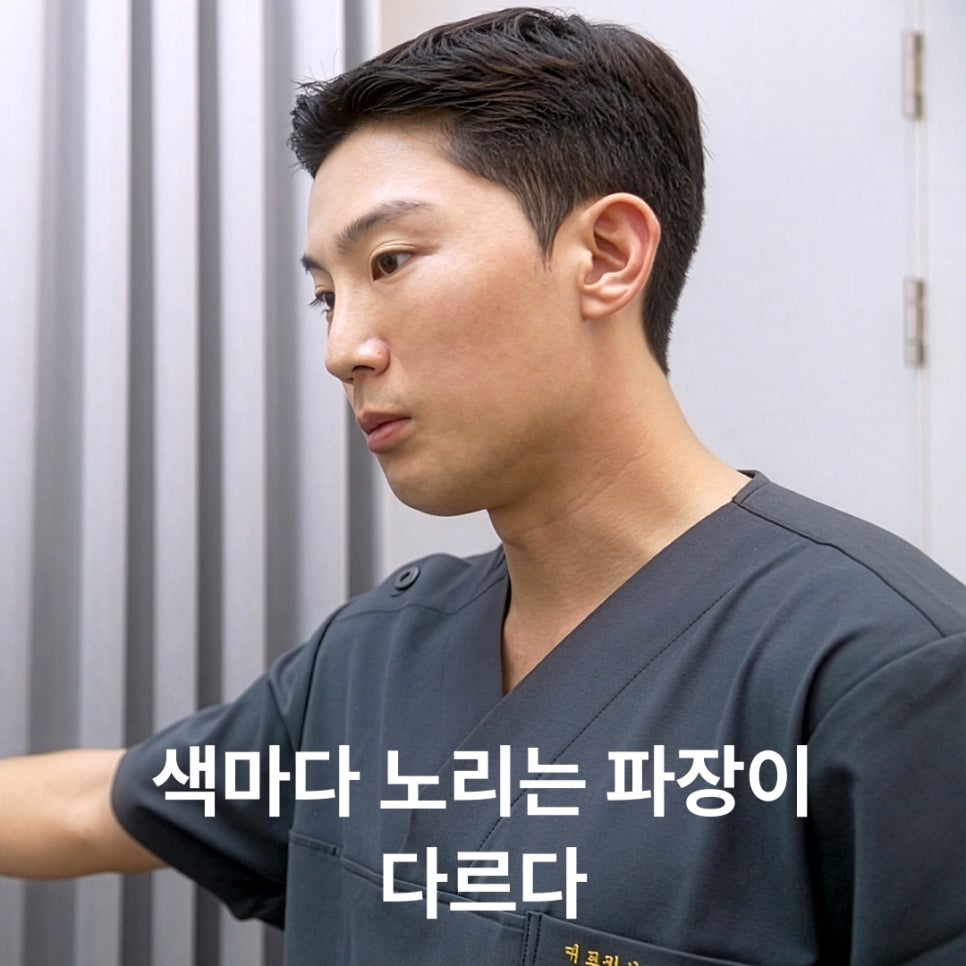
Different colors may require different wavelengths
PicoWay
does not use only one wavelength.
Because the wavelength that responds to the pigment may differ
depending on its color and depth,
multiple wavelengths are often discussed.
For example,
the 532 nm wavelength
is mentioned for red, yellow, and orange pigments.
The 785 nm wavelength
may be used for more difficult colors to treat,
such as green or blue.
The 1064 nm wavelength
is mentioned when addressing black or brown pigments
or relatively deep pigmentation.
However, even pigments of the same color
may differ in depth within the skin and in their ink components.
So, when considering tattoo removal,
it is important not only to ask “What color is it?”
but also to check
how deep it is,
how old the tattoo is,
and what the skin type is.
Why is it difficult to finish in a single session?

PicoWay delivers
energy to pigment particles over a short period.
However, this does not mean that the pigment
disappears completely on the spot.
After changes occur in the pigment particles,
it is necessary to allow time to observe the progress
while considering the condition of the skin and the body’s response.
This process varies from person to person.
If there is a large amount of pigment,
if it is located deeply,
or if multiple colors are mixed,
the approach may become more complex.
Tattoo treatment can also differ
depending on whether the tattoo is a single black color
or contains multiple colors.
The same applies to skin pigmentation such as melasma or blemishes.
Even if it looks similar on the surface,
the approach differs depending on whether the pigment is located in the epidermis,
whether it is deeper,
or whether it is pigmentation that is sensitive to irritation, such as melasma.
Therefore, even when PicoWay is used,
it is difficult to treat all pigmentation in the same way.
Could the color look darker?
During the process of treating pigmentation,
there are cases in which the color may temporarily appear darker.
This is sometimes called paradoxical darkening.
In particular, white, peach-colored, and some other light-colored pigments
are reported to sometimes appear darker
after reacting to the laser.
It does not occur in everyone,
but it is something that should be checked carefully
when considering tattoo or skin pigmentation.
In addition, pigmentation reactions may occur in East Asian skin,
so it is important to monitor the response while adjusting the intensity and intervals.
That is why pigment lasers
require a process of checking the skin’s response
rather than automatically using high intensity.
What should be checked first?

Knowing the name of the device can be helpful,
but what is more important
is checking the condition of your pigmentation.
For tattoos,
the ink color, depth, and age should be assessed.
For melasma or blemishes,
the type and depth of the pigmentation,
along with the sensitivity of the skin, should be considered.
Even with the same PicoWay device,
the wavelength used and the treatment intervals
may vary depending on these conditions.
Because skin conditions differ from person to person,
a particular treatment is not necessary for everyone.
If you are looking into pigmentation or tattoo removal in Hapjeong,
it is best to first have your current condition assessed through a consultation.
After that, the appropriate sequence is to determine based on your condition
whether PicoWay is suitable
and whether it would be better to consider it together with another approach.
Frequently asked questions
Q. Will all pigmentation disappear in a single PicoWay session?
It is generally difficult to determine the outcome after just one session.
The progress may vary depending on the type, depth, and amount of pigmentation,
as well as the skin’s response.
For this reason, treatment is often divided into multiple sessions
while the skin’s response is monitored.
Q. Does the treatment approach vary depending on the tattoo color?
Yes.
The wavelength that each color responds to may differ.
Depending on the type of pigment—black, brown, red, yellow, green, blue, and so on—
the wavelength used and the approach may vary.
It is especially important to assess the condition of tattoos containing multiple colors.
Q. Can the color look darker after the laser treatment?
The color may temporarily appear darker in some cases.
This is called paradoxical darkening,
and the progress should be monitored carefully
depending on the tattoo pigment and skin type.
That is why pigment laser treatment
should be carried out while adjusting the intensity and intervals.
Thank you for reading this long post.
This was Youngjin Wi.