Hello.
This is E pyeonhan Sesang Dental Clinic, Hwagok Branch.
When meeting patients who come in for orthodontic consultations,
many are very interested in whether their teeth are straight or whether their front teeth protrude,
but often do not know how their molars are actually coming together.
The front teeth are easy to see in a mirror or when taking photos,
but it is uncommon to open the mouth wide and check the molars directly.
If there is no usual discomfort, it is also difficult to take an interest in what one’s bite is like.
However, bite problems require greater attention
than simply thinking of them as slightly crooked teeth.
Today, among the many types of bite problems,
we will focus on scissor bite
and explain why it occurs and which cases require treatment.
What Is a Scissor Bite in the Molars?
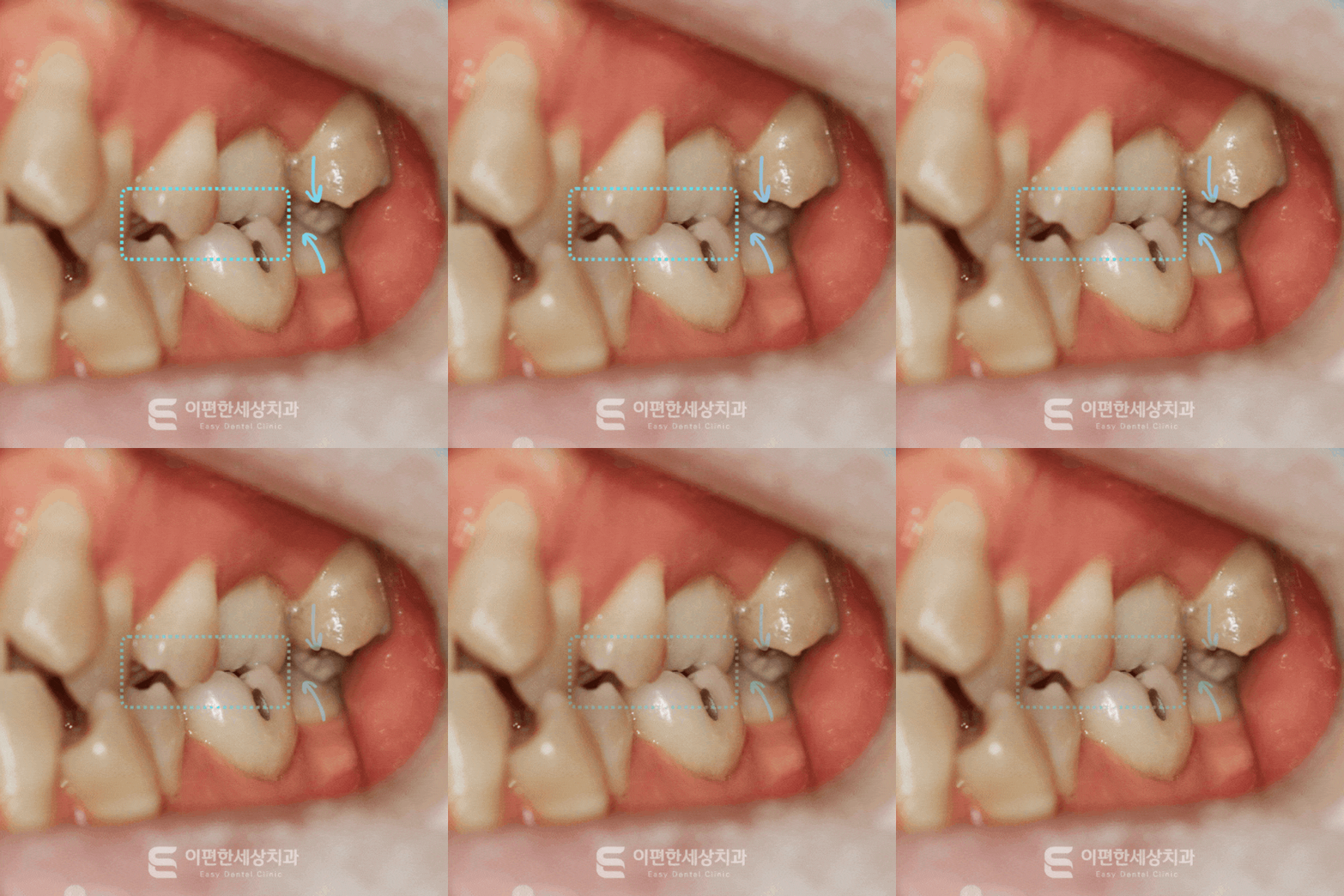
This image is for reference and is intended to aid understanding.
Normally, the upper and lower molars
fit together appropriately.
The upper and lower molars interlock with each other,
forming a structure that allows food to be efficiently crushed and ground.
However, in a scissor bite, this normal bite relationship is disrupted.
One molar is positioned excessively toward the outside,
so the occlusal surfaces do not fit together properly.
Rather than the upper and lower molars interlocking like gear teeth,
if one side appears to cover the other from the outside,
a scissor bite may be suspected.
As you can see in the attached image,
the upper and lower molars are not fitting together normally.
Of course, not all scissor bites appear in the same way.
They may occur in one or two teeth,
throughout the molars on one side,
or simultaneously in the molars on both sides.
Therefore, please view the attached image only as a reference;
the most accurate way to assess the actual bite is to have it examined at a dental clinic.
Why Does a Scissor Bite Occur?
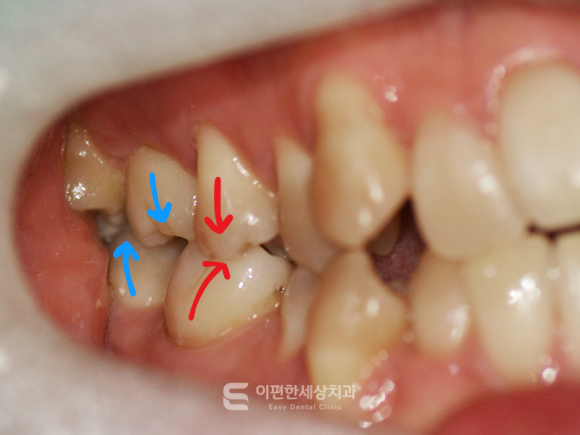
This image is for reference and is intended to aid understanding.
- When there is a difference in the width of the upper and lower jaws
When the widths of the upper and lower dental arches are not in harmony,
it becomes difficult for the molars to meet in their normal positions.
- When the molars are excessively tilted
This refers to cases in which the teeth are tilted toward the cheek or toward the tongue.
In such cases, a scissor bite can occur even without a difference in jaw width.
- Differences in the dental arches formed during growth
Because the jaws continue to grow until adulthood,
a scissor bite may occur when the direction and rate of growth of the upper and lower jaws do not match.
A scissor bite does not occur for just one reason.
More often, it develops as the factors mentioned above influence one another.
Therefore, please remember that even when orthodontic treatment is started for the purpose of treating the same scissor bite,
the treatment plan may differ depending on the cause.
Do I Really Need Treatment If It Does Not Hurt?
Not every scissor bite case
necessarily requires treatment.
If the extent of the scissor bite is very small,
there are no significant functional problems,
and the condition has remained stable for a long time,
regular checkups alone may be sufficient.
However, if the bite is unstable and chewing is uncomfortable,
there is a habit of unconsciously chewing only on one side,
excessive tooth angulation or eruption is present,
or the bite relationship is gradually worsening,
the need for treatment may become greater.
Whether treatment is needed can be determined only after considering
the degree and cause of the bite abnormality,
its functional effects, and the possibility of future changes.
The difference in the way your molars come together,
which you may not normally notice,
may have been affecting your overall chewing function and bite balance.
If the way your molars come together feels even slightly different,
we recommend having your bite checked at a dental clinic at least once.
Having your bite checked at a dental clinic
is not only a process for deciding whether to undergo orthodontic treatment.
Please think of it as a process of determining the condition of your teeth,
what may be causing any problems,
and whether treatment is currently necessary,
and feel free to visit us. ^^
This has been E pyeonhan Sesang Dental Clinic, Hwagok Branch.
Thank you for reading today.
At the E pyeonhan Sesang Dental Clinic Naver Café,
you can see cases in which scissor bites in the molars were improved through orthodontic treatment.