Gangnam Station Dental Clinic Implant: "Cases Where Immediate Implant Placement Is Possible After Extraction vs. Cases Where You Need to Wait"
Hello.
#GangnamStationDentalClinic #GangnamStationDentalClinicImplant #GangnamStationImplantDentalClinic
#GangnamStationWhiteDreamDentalClinic.
One of the most common questions patients ask during implant consultations is:
If a tooth is extracted, can an implant be placed right away?
To start with the conclusion:
For some teeth, immediate implant placement is possible after extraction,
but
for others, the implant has to be placed after waiting for the bone to recover.
 Why is there such a difference in the timing of implant placement?
The reason is that before extraction,
the condition of the bone around the tooth, whether there is periodontitis, the condition of the gingival soft tissue, the degree of bone resorption,
and the distance from the maxillary sinus or the nerve canal,
vary greatly depending on many conditions.
The case we prepared today is
"It is uncomfortable to chew on both sides equally."
They came to White Dream Dental Clinic at Gangnam Station with this concern,
but
on the left side, an implant could be placed immediately after extraction,
while
on the right side, placement was only possible after waiting three months.
 Let’s take a look at the patient’s initial X-ray first.
The teeth in the molar areas on both sides
showed considerable progression of periodontitis and bone resorption around the roots.
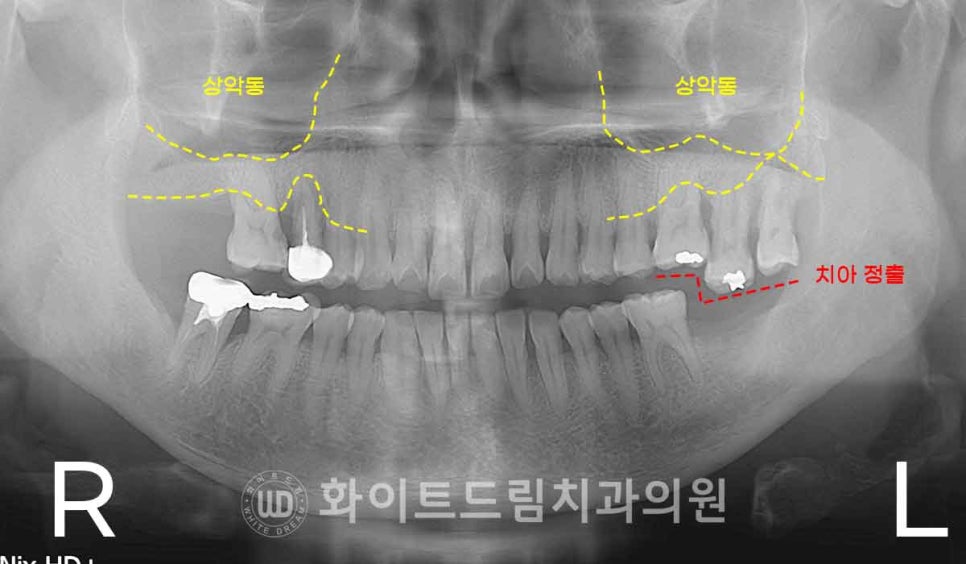
The alveolar bone supporting the roots had been greatly lost, leaving almost no support,
and the left maxillary molar had also erupted downward due to the loss of the mandibular molar,
showing extrusion as the tooth moved downward,
so the tooth was no longer salvageable.
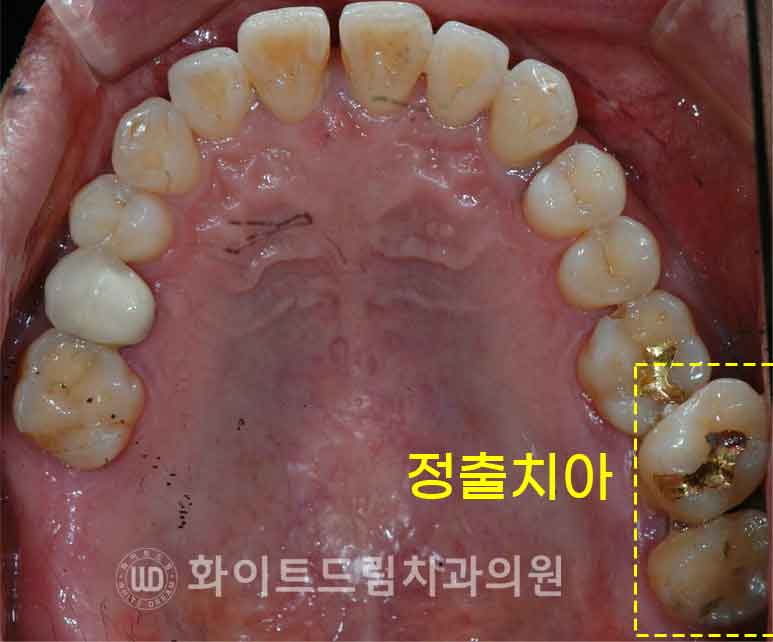 Teeth with extrusion
have roots that are excessively exposed,
Teeth with extrusion
have roots that are excessively exposed,
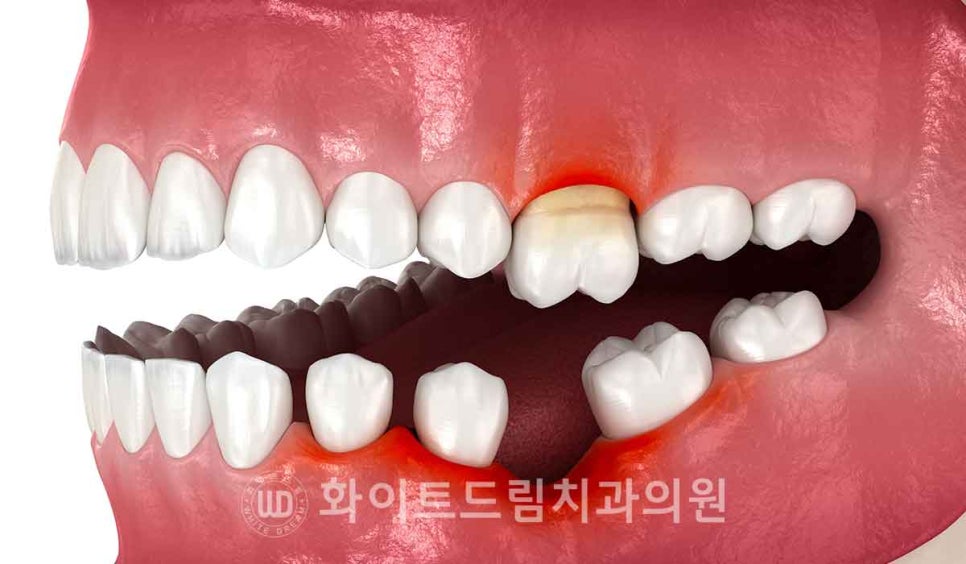
so bacteria and tartar can easily attach, which tends to make periodontitis worsen more quickly.
Moreover, tooth roots are not as hard as enamel,
and are made of relatively softer and weaker dentin and cementum,
so they become more vulnerable to contamination and damage.
As these changes repeat,
a vicious cycle is created in which the surrounding gum bone is absorbed more quickly.
Therefore, areas where the gum bone around the tooth roots had severely resorbed like this
were decided, after discussion with the patient, to be reconstructed with extraction followed by implants.
However, it was not possible to perform surgery on all areas on the same day.
In the patient’s case, the right maxillary and mandibular molars were in a condition where implants could be placed immediately,
but
the left maxillary molar area had more severe bone resorption, making immediate placement difficult.
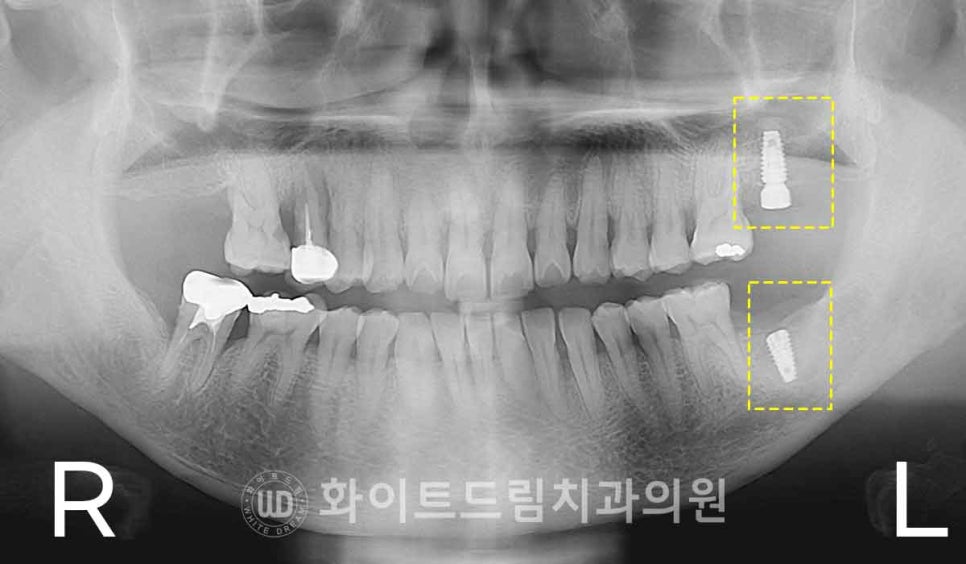 ▲ Left maxillary/mandibular implant surgery, Gangnam Station dental clinic implant surgery date: 16.12.27
So the treatment plan was divided as follows:
The right maxillary and mandibular molars would be operated on immediately on the day of the visit,
and the left maxillary molar would be treated with implant placement after about three months of healing following extraction.
In addition to this reason,
if both molar areas on both sides are operated on at once,
the surgical sites would exist simultaneously, which can make eating so uncomfortable that it becomes nearly impossible.
Especially in cases involving both the upper and lower jaws,
it is much more beneficial for recovery to divide the left and right sides and perform surgery in stages so that one side can still maintain chewing function.
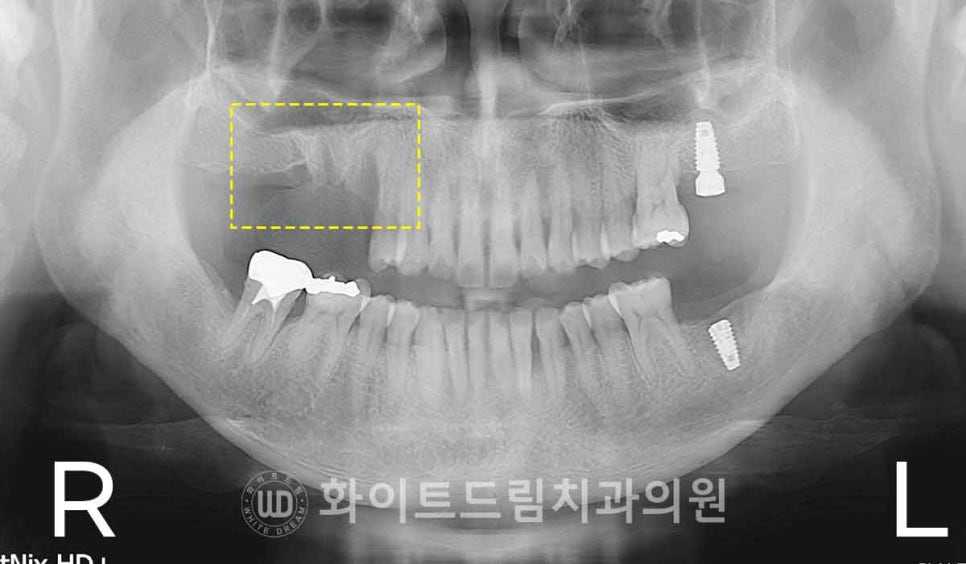 ▲ Right maxillary molar extraction, left extraction one month later: 17.01.13 / Gangnam Station dental clinic implant
In this patient’s case, extraction on the left maxilla was performed first in January,
and after allowing about two months for the alveolar bone to recover,
the implant was placed in March.
The two-month recovery period after extraction is
an important healing period in which inflammation subsides, the soft tissue heals,
and the bone surface stabilizes.
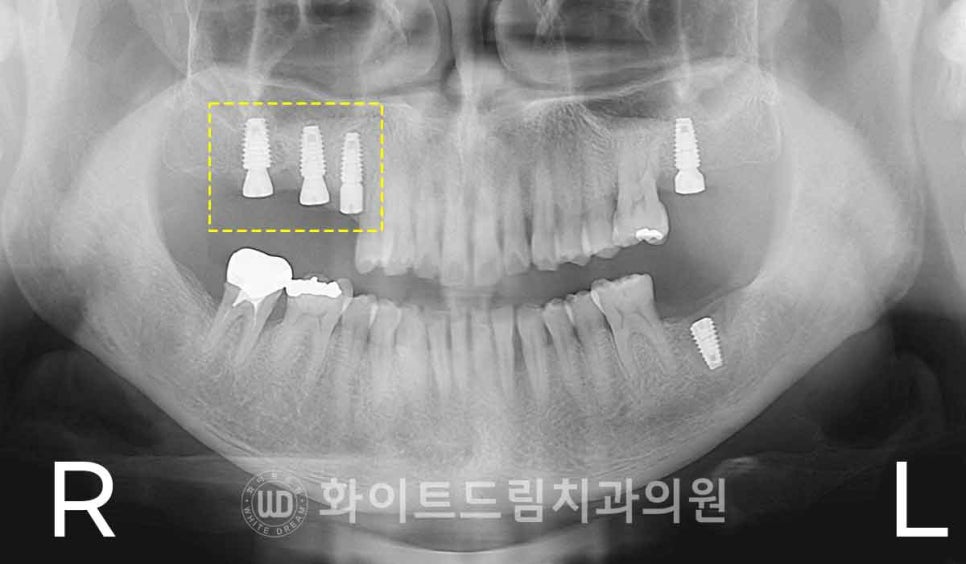
Especially in areas like the left maxilla,
where bone resorption is severe or the distance to the maxillary sinus is too close,
placing an implant immediately on the day of extraction
carries a high risk of failure because initial stability may not be achieved well,
so after a certain healing period following extraction,
placing the implant on a stabilized bone environment
is the treatment approach that can offer the best prognosis. ^^
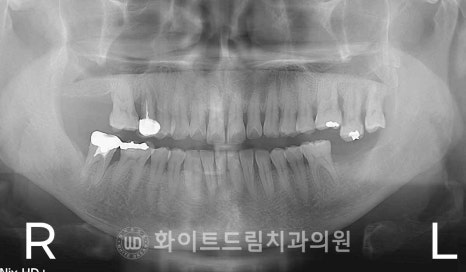
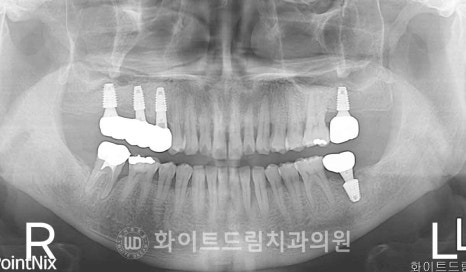 [Same person, photographed in the same environment / Total treatment period for Gangnam Station dental clinic implant: 16.12.28 - 17.07.08]
Although the timing of surgery differed between the left and right sides,
the final prostheses were intentionally set on the same date for both implants to achieve a more accurate and stable occlusal balance.
If molar prostheses are attached one side at a time,
there may be slight discrepancies in occlusal height, centric contact, and distribution of chewing force,
so if possible, setting both sides on the same day is the most ideal.
So even though there was a difference in the timing of treatment for the two areas,
the prosthetic work was completed with simultaneous bilateral placement in July.
Today, we talked about
cases where an implant can be placed immediately after extraction and
cases where it should be placed only after allowing enough healing time.
Since the condition of the teeth and the alveolar bone varies from patient to patient,
treatment plans can differ completely even in situations that look similar.
So after having an in-depth consultation with a medical team experienced in the procedure,
we hope you proceed with the proper implant treatment.
Thank you for reading this long post today.
This has been Gangnam Station dental clinic implant, White Dream Dental Clinic at Gangnam Station.