
Gangnam Station Front Tooth Dental Clinic / “The tooth that had root canal treatment turned yellow.” How do you treat teeth discolored after root canal treatment?
Hello.
#Gangnam Station Front Tooth Dental Clinic #Gangnam Station Dental Clinic #Gangnam Station Front Tooth Treatment
#ToothDiscoloredAfterRootCanalTreatment #FrontToothDiscoloration #GangnamStationWhiteDreamDentalClinic
Because front teeth stand out even with small changes,
many people worry and visit the clinic when the color becomes dull or yellow.
When seen from the outside, the teeth may look clean,
but sometimes only one or two teeth suddenly become darker or look yellow.
In most cases, these teeth have internal discoloration caused by
post-root-canal discoloration or
pulp (nerve) necrosis from past trauma that was not noticeable at the time.
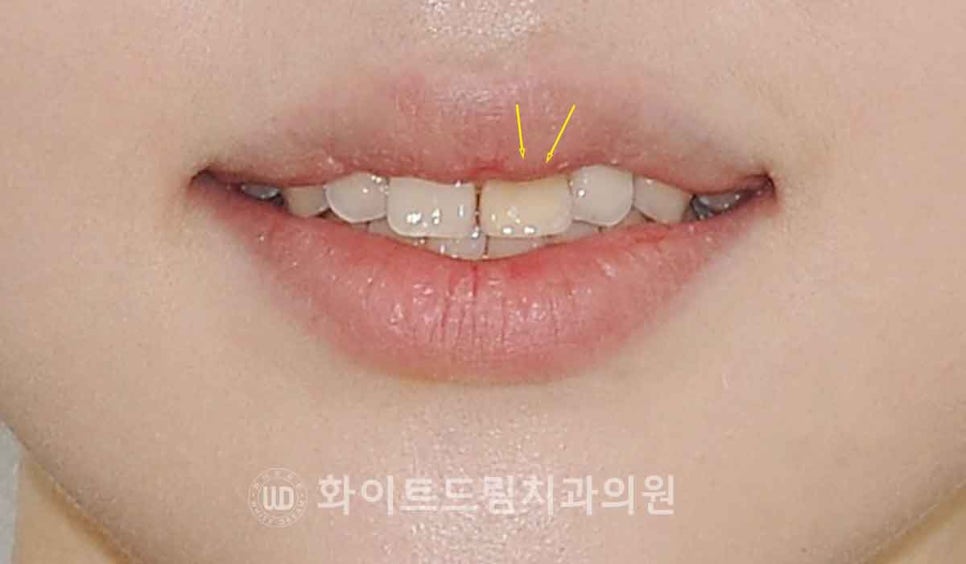
Unlike surface staining,
this kind of internal discoloration changes color from inside the tooth,
so no matter how much scaling or whitening is done,
it can actually end up looking duller and darker over time.
The patient in today’s case also
came to our Gangnam Station front tooth clinic because of this concern.
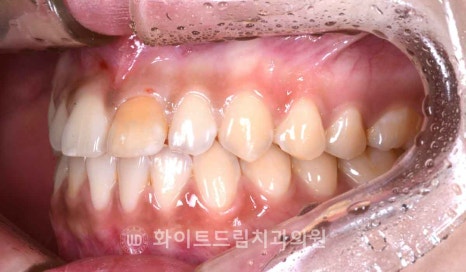
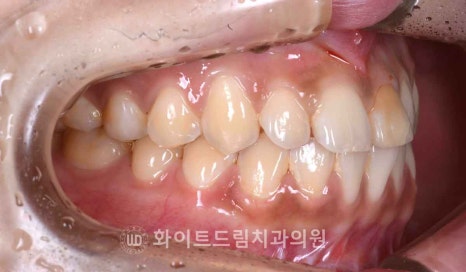
If you look at the initial intraoral photos, you can see that the highly visible upper left central incisor, tooth 21, has turned yellow.
If we also look at the patient’s X-ray,
this tooth was not just stained on the surface,
but showed a typical pattern of “post-root-canal discoloration,”
with the color gradually darkening from inside the tooth.
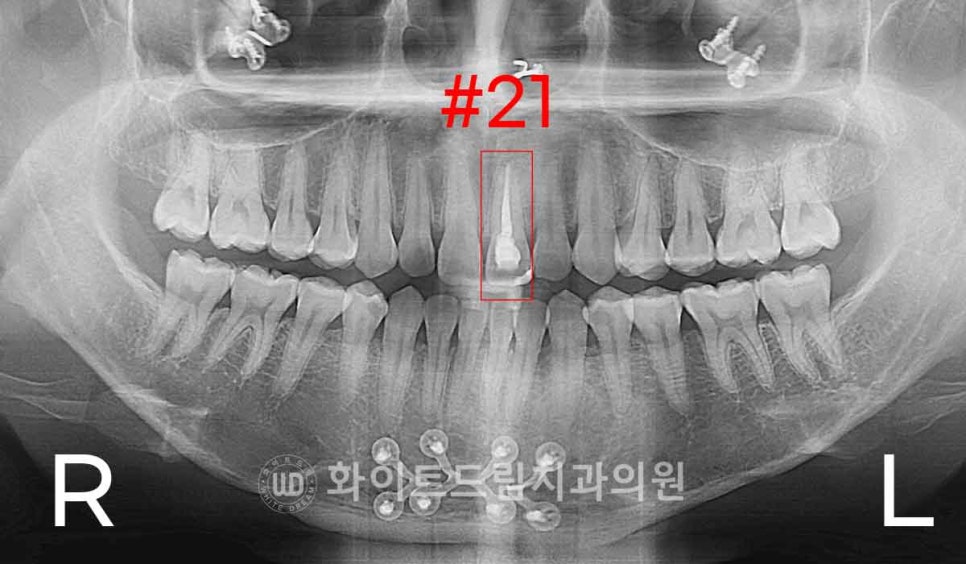 ▲ Upper left central incisor, tooth 21, with root canal treatment / Gangnam Station Front Tooth Dental Clinic
Teeth whose nerve has once been damaged or that have undergone root canal treatment
often show blood breakdown products, protein debris, and root canal medication remnants over time
that seep into the dentin and appear as
yellowish-brown or grayish-brown changes that cannot be removed by brushing the surface.
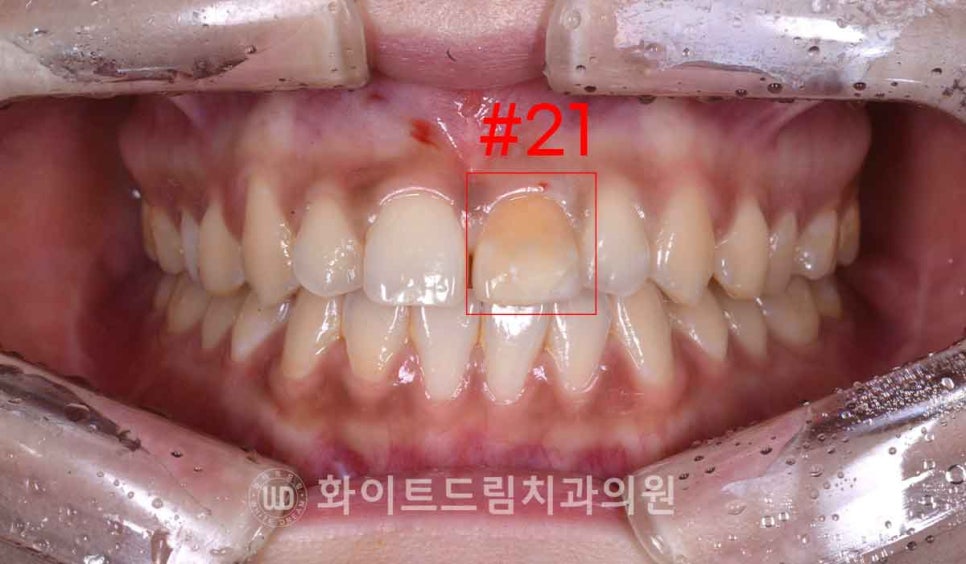 ▲ Gangnam Station Front Tooth Dental Clinic, initial visit before treatment (23.09.12)
In this patient as well, due to this cause,
the front tooth that was easy to see did not match the neighboring natural tooth color,
stood out prominently, and drew attention every time they smiled,
causing significant cosmetic discomfort.
Then how do we treat a tooth with internal discoloration like this?
This patient
wanted to resolve the yellow discoloration of tooth 21,
and also wanted to improve the gap between the front teeth visible when smiling (midline diastema).
 First, because tooth 21, which had become discolored,
had already undergone root canal treatment and the tooth structure had become weakened,
it required not only cosmetic restoration but also structural protection.
So tooth 21 was planned for full restoration with a zirconia crown
to completely cover the internal discoloration,
wrap and protect the weakened tooth at once,
and match the adjacent teeth as naturally as possible in color, shape, and thickness.
There is also a procedure called non-vital tooth whitening that can brighten teeth discolored after root canal treatment.
In this patient’s case, the discoloration was not as severe as a tooth that had turned completely black (for example, black to gray-brown),
but whitening could only brighten it within a limited range, up to about A2 to A1.
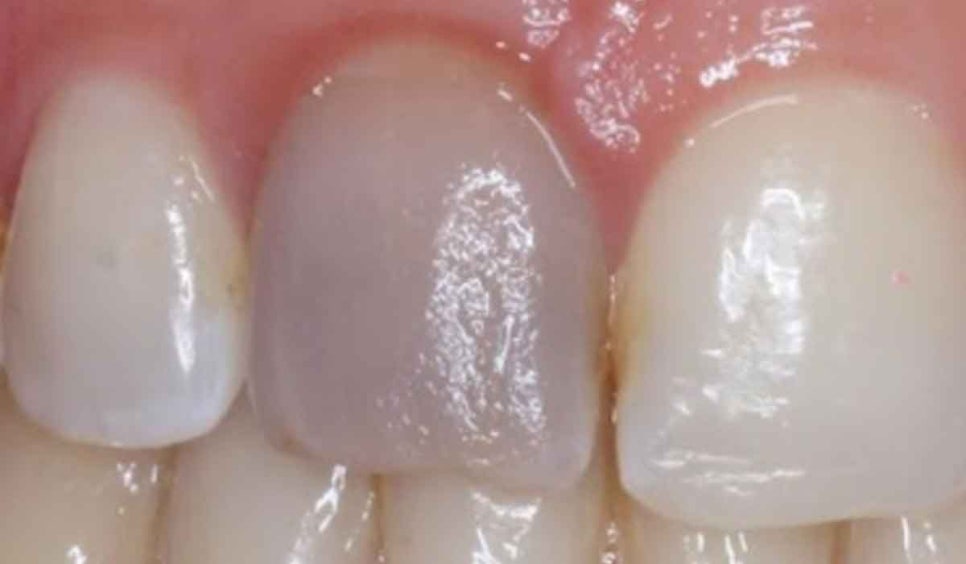 ▲ For a front tooth that has turned black after root canal treatment, cases like this are often treated by first brightening the tooth color to some extent with non-vital tooth whitening
and then proceeding with crown treatment.
Moreover, because the tooth structure had become significantly weakened after root canal treatment,
whitening alone would make it difficult to secure the desired brightness and durability,
so in this case, using a crown to achieve color, durability, and aesthetics at the same time was the most reasonable choice.
I want to improve the gap between my teeth.
The gap between the teeth that the patient wanted to improve at the same time
was planned to be corrected by naturally adjusting the width and line of the adjacent tooth 11 with a laminate veneer.
The photos below were taken after tooth preparation and before setting the prosthetics.
Many people think laminate veneers are a treatment that requires a lot of tooth reduction,
but in reality, that is not the case.
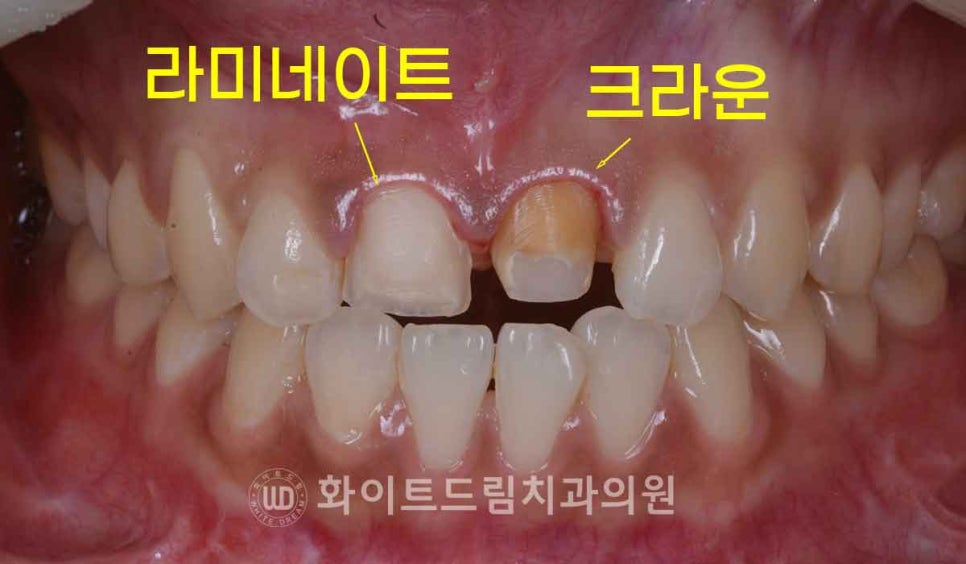 ▲ Especially in cases like the patient’s tooth 11, where the gap is naturally closed
and only the front tooth line is slightly adjusted,
it is enough to thinly reshape only about 0.3 to 0.6 mm of the outer surface of the tooth. ^^
The principle of laminate veneers is minimal reduction within the enamel range,
and compared with crowns, which reshape the entire tooth into a rounded form,
the amount of reduction is much smaller, making it a conservative treatment. ^^

Before setting the prosthetics,
gingival contouring was performed first
to make the front tooth line look more natural and balanced.
It is not enough for only the tooth color and shape to look good.
If the gum line is asymmetric or uneven,
even the most beautifully made prosthetics can still make the overall aesthetics look less refined.
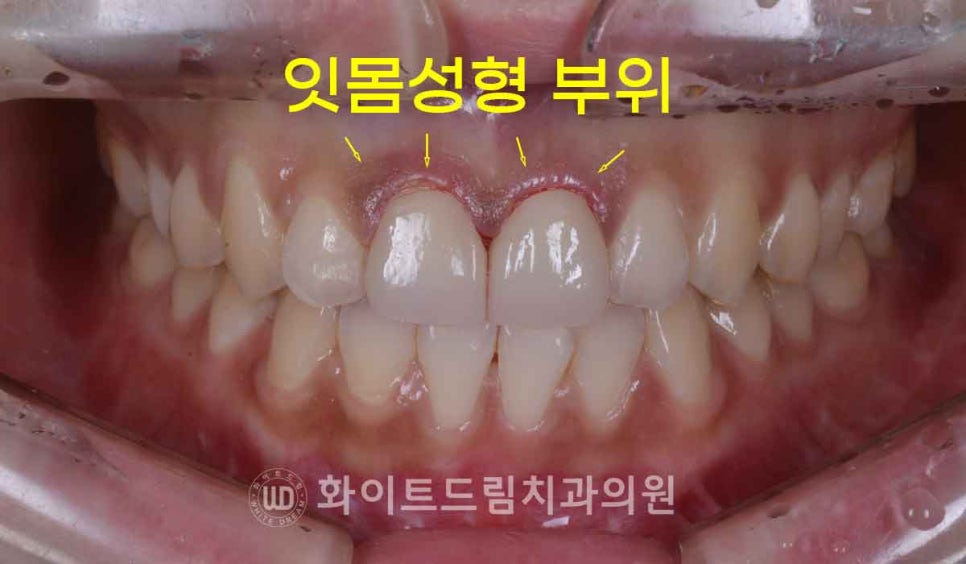 ▲ Photo taken on the day the prosthetics were set. (23.09.19)
On the day the prosthetics were set,
the gums may appear a little swollen or the margins may look thick,
which is a normal temporary reaction that occurs right after gingival contouring.
Such gum swelling quickly subsides within a few days,
and as the gum line stabilizes,
the prosthetics and gums gradually fit together naturally.
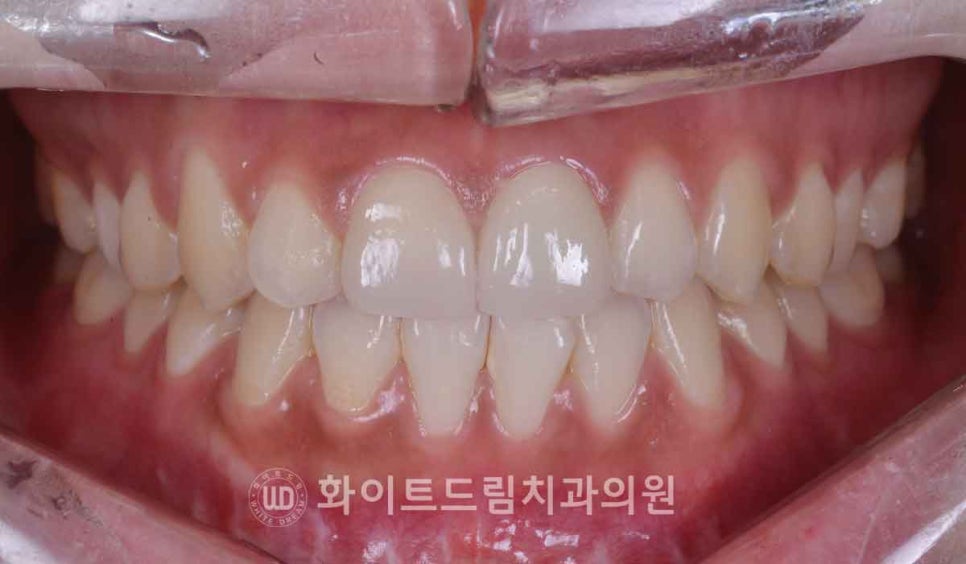 ▲ Photo taken 7 days after prosthetic setting & gingival contouring (23.09.26)
You can see that the gums have settled naturally and the gum shape has also taken on a nice form.
Once the gums settle into place,
the length, width, and curve of the teeth look much more natural,
and the amount of gum exposure when smiling is balanced,
leading to a higher overall level of aesthetic completion. ^^
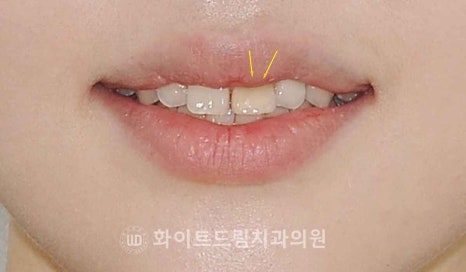
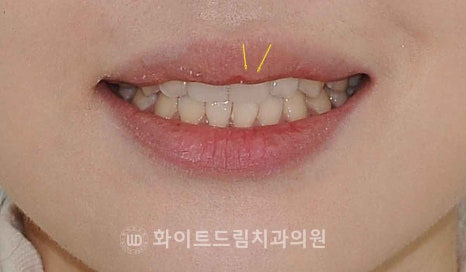 [Same person, photographed in the same environment / Gangnam Station Front Tooth Dental Clinic: 23.09.12 - 23.09.26]
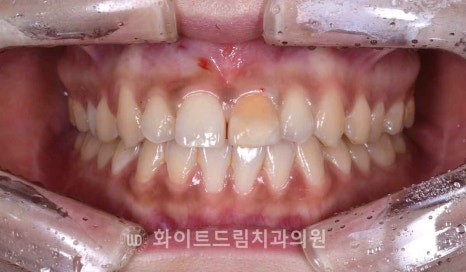
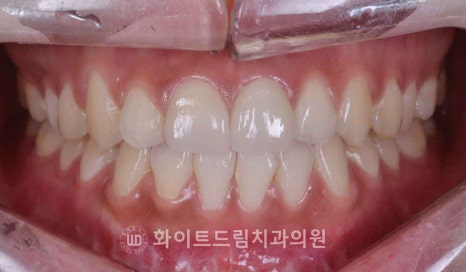
If you look at the patient’s before-and-after photos together, you can see that not only the gap between the teeth but also
the front tooth discoloration that had been a long-standing concern has been neatly improved.
The color of the discolored tooth 21 was naturally restored with a crown,
and the gap in adjacent tooth 11 was closed with a laminate veneer,
completing the treatment so that the two teeth connect smoothly as if they were part of one line.
Today, we introduced a case in which internal front tooth discoloration and a gap were improved at the same time.
Discoloration of a tooth that has undergone root canal treatment
often appears darker over time, causing stress for many people.
If you combine a crown and a laminate veneer appropriately like in this patient’s case,
and also perform gingival contouring when needed,
you can restore a natural front tooth line
and create a bright, balanced smile.
If you are worried about changes in front tooth color or gaps,
please do not worry alone and consult a dental specialist.
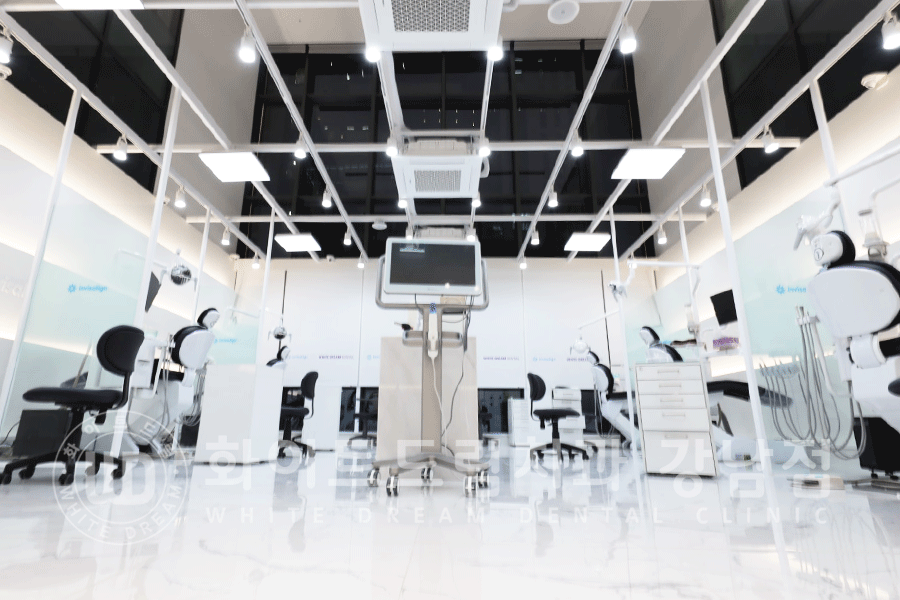
This was Gangnam Station Front Tooth Dental Clinic, Gangnam Station White Dream Dental Clinic.